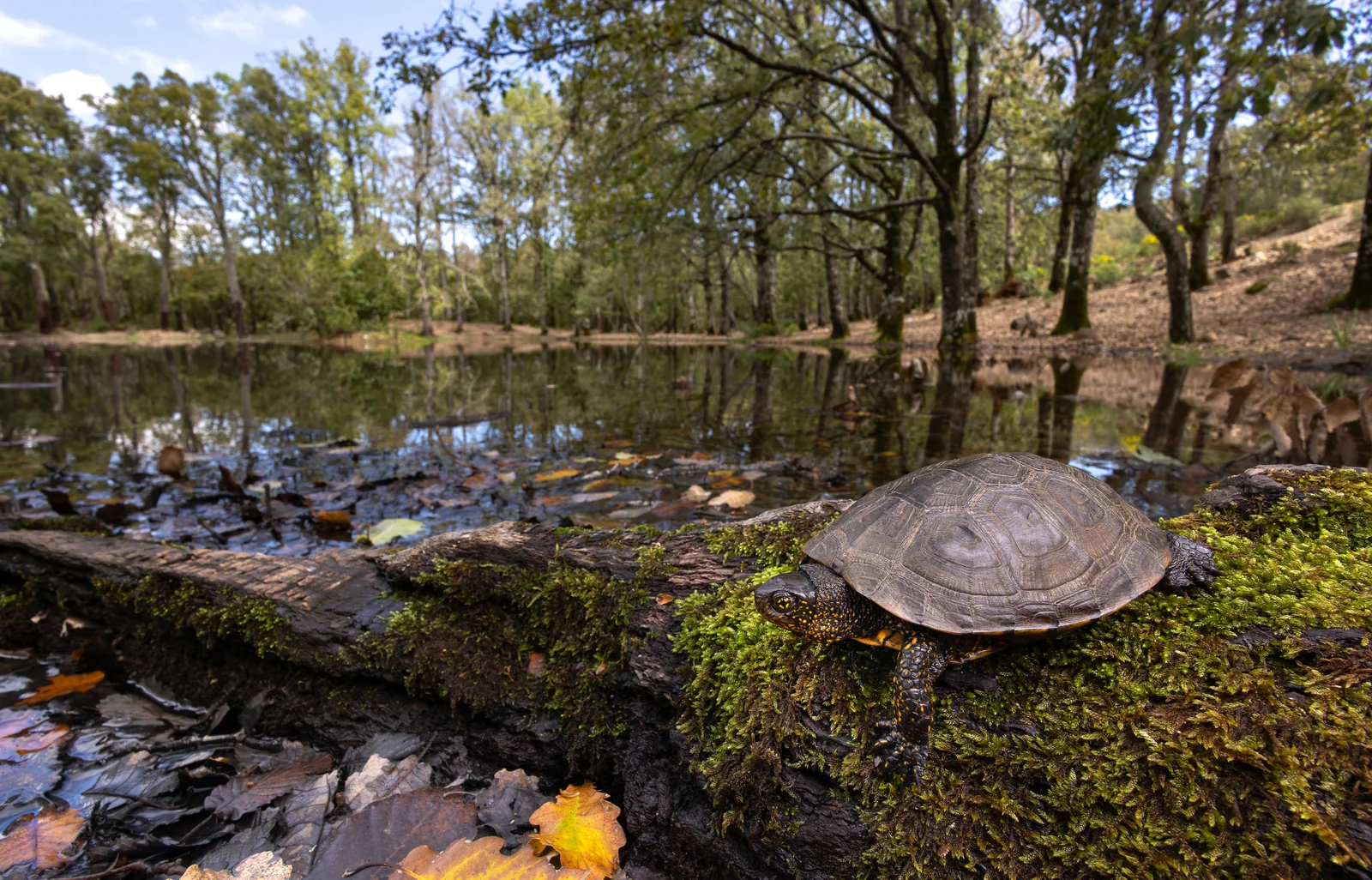
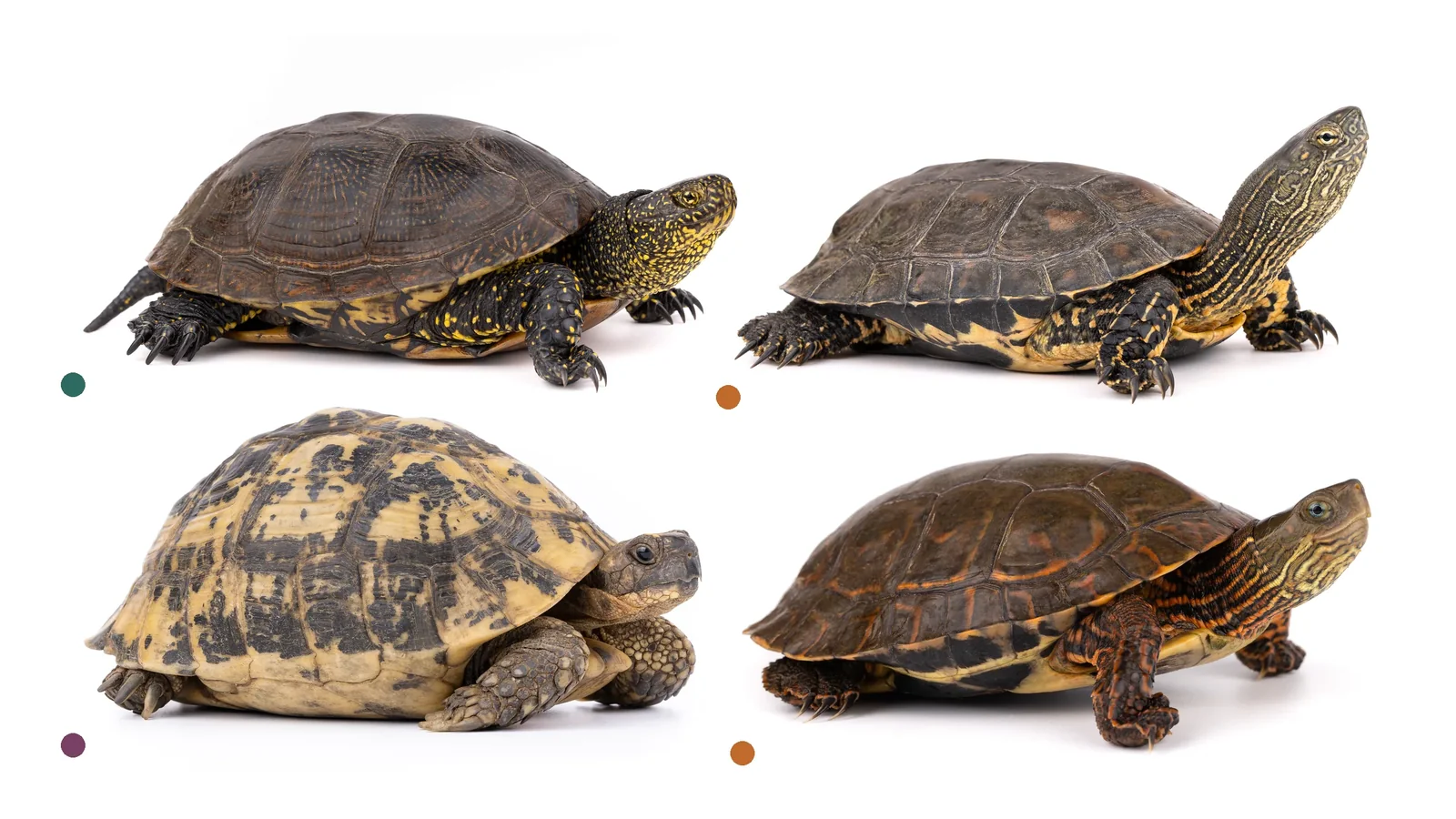
The European Pond Turtle (Emys orbicularis) is a medium-sized freshwater turtle with a slightly domed shell, sometimes almost round but usually a little wider towards the rear[20]. In the Mediterranean region, adults rarely exceed 15 cm in carapace length[15][8]. In the Rif, adults measure about 12 to 13 cm[8]. The plastron (the underside of the shell) carries a hinge, and its connection to the carapace (the upper shell) is not bony, so the turtle can partly close its shell[15]. The toes are webbed[18], an adaptation to life in water.
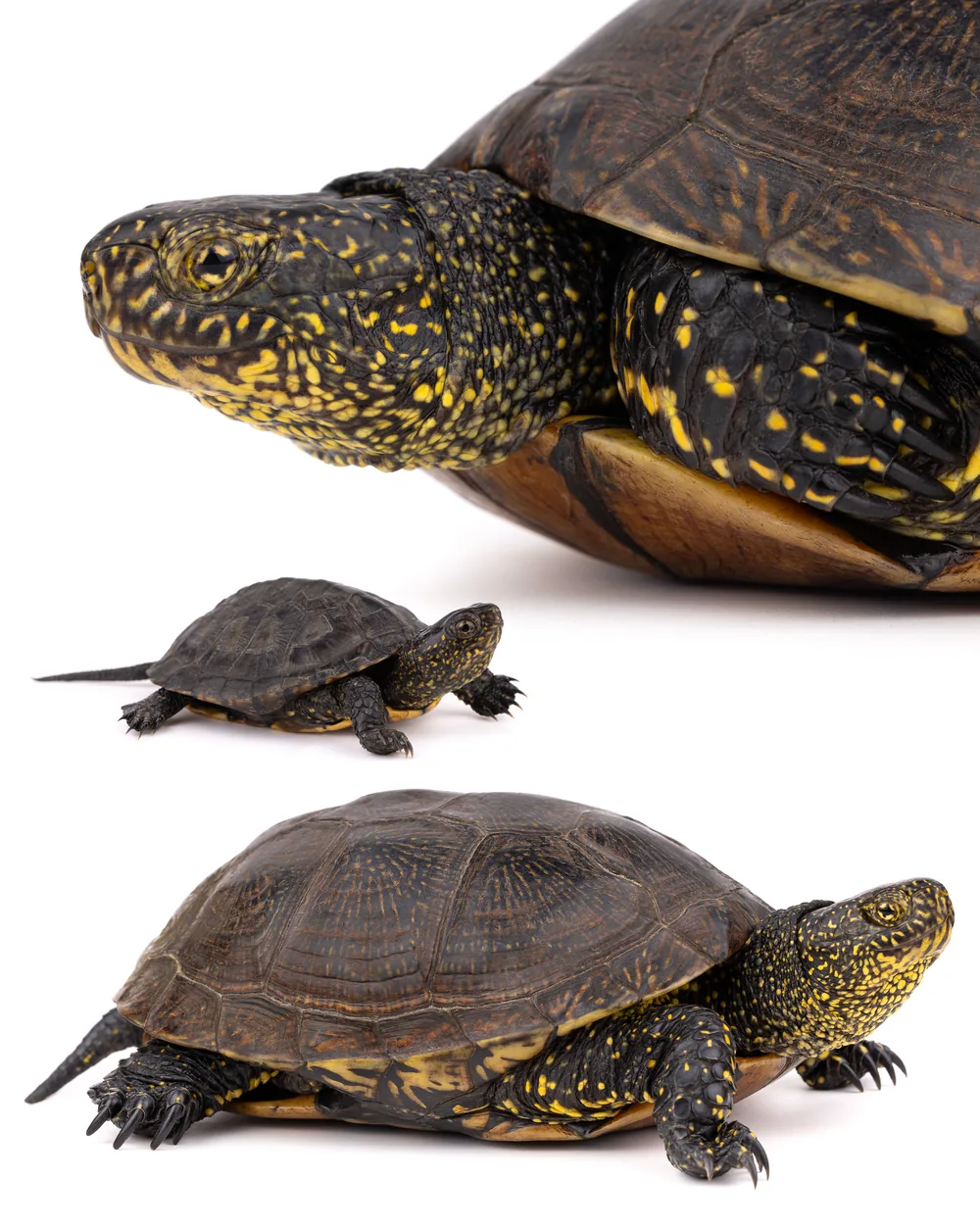
The head is dark, with a bright, contrasting yellow pattern on top[12]. In turtles from the Iberian Peninsula and the Maghreb, these markings form a worm-like pattern on a black background, and the forelimbs usually carry two pale bands[13]. The iris is yellow to yellowish white, with a black cross centred on the pupil. This cross is much more distinct in females than in males[12].
In adults, the carapace is black, with short, thick yellow streaks radiating from the centre of each plate[12]. In subadults and young adults, the plastron is often more than 90% black. This black fades with age, and many old animals have an entirely yellow plastron[12]. The skin is dotted and streaked with yellow[20]. The shells can be eroded by green algae[12], and in the Rif some shells are stained reddish by iron-rich deposits[11].
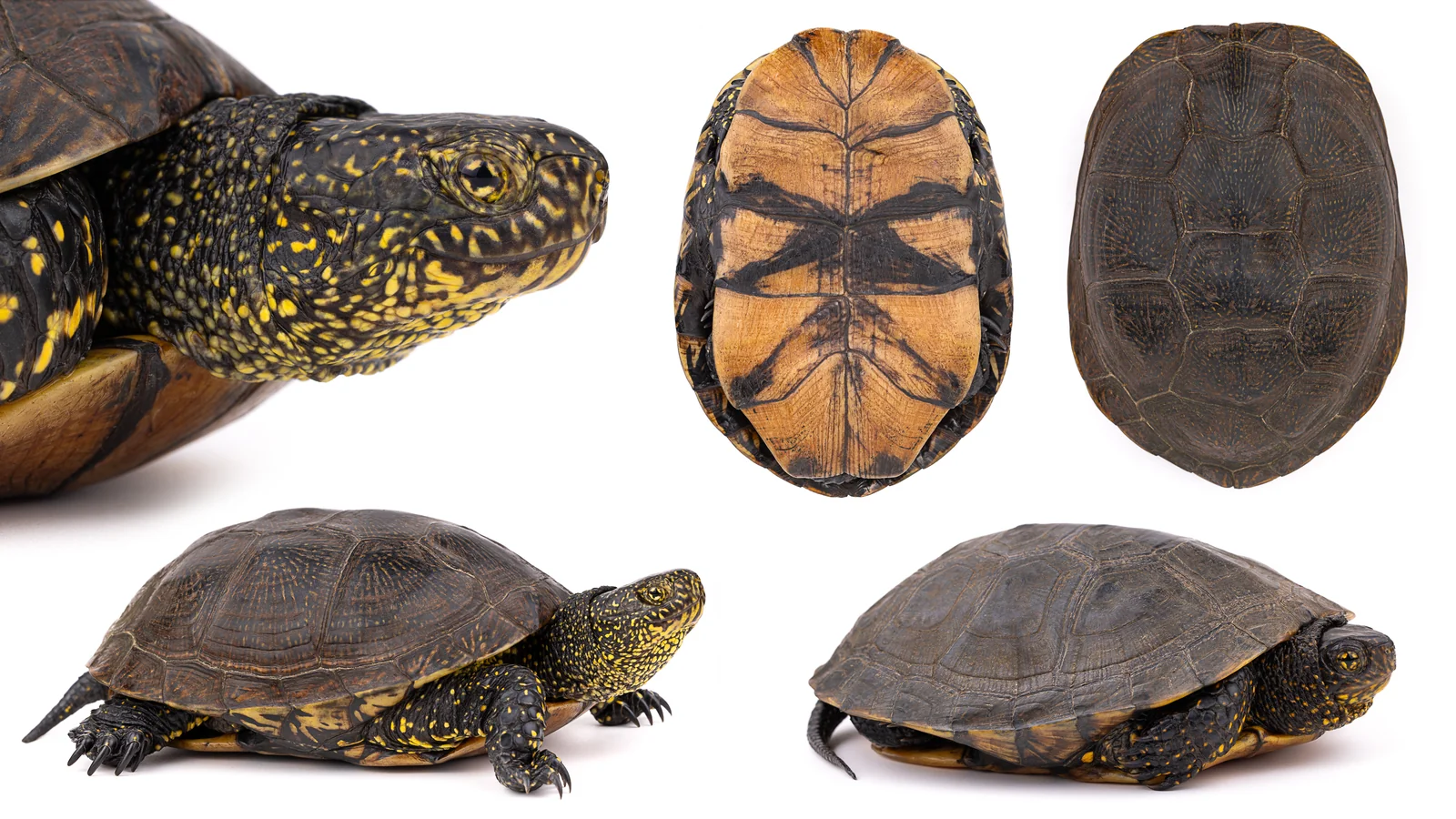
European Pond Turtle (Emys orbicularis): the head with its yellow markings, the plastron and carapace, and two individuals in profile showing colour variation in both the shell and the body.
Males and females differ clearly in shell shape and tail. Males have a flatter shell, often with a concave plastron, more curved claws and a thicker tail. Their vent lies further from the rear edge of the shell[15]. In this subspecies (Emys orbicularis occidentalis), males tend to have shorter and rounder yellow markings than females[12].
Juveniles have a more or less marked keel along the midline of the carapace[20]. Moroccan hatchlings have a brown carapace with a yellow rim, a yellow spot in the middle of each side plate and fine black speckles all over. Their plastron is yellow with a large black patch in the centre[12].
Rif turtles show the typical pattern of yellow rays on a black shell[10]. Some Middle Atlas turtles are much paler, with a yellow shell carrying thin black lines[12]. Turtles from this region also have more yellow on their forelimbs than most lowland turtles[12].
The European Pond Turtle (Emys orbicularis) and the Sicilian Pond Turtle (Emys trinacris) are the only Old World members of a family otherwise confined to the Americas[36]. Until 2014, all North African pond turtles were placed in the subspecies Emys orbicularis occidentalis and regarded as recent arrivals from Europe[36]. Genetic analyses of turtles sampled across North Africa then showed that only the Moroccan animals belong to that subspecies, while those of eastern Algeria and Tunisia form a distinct, still unnamed one[36].
The same study placed Iberian turtles within the Moroccan group on the family tree and found them genetically less diverse. This suggests that pond turtles reached Morocco first and later recolonised the Iberian Peninsula from there[36]. Iberian turtles, until then described as a separate subspecies (Emys orbicularis fritzjuergenobsti), were therefore included in Emys orbicularis occidentalis[36].
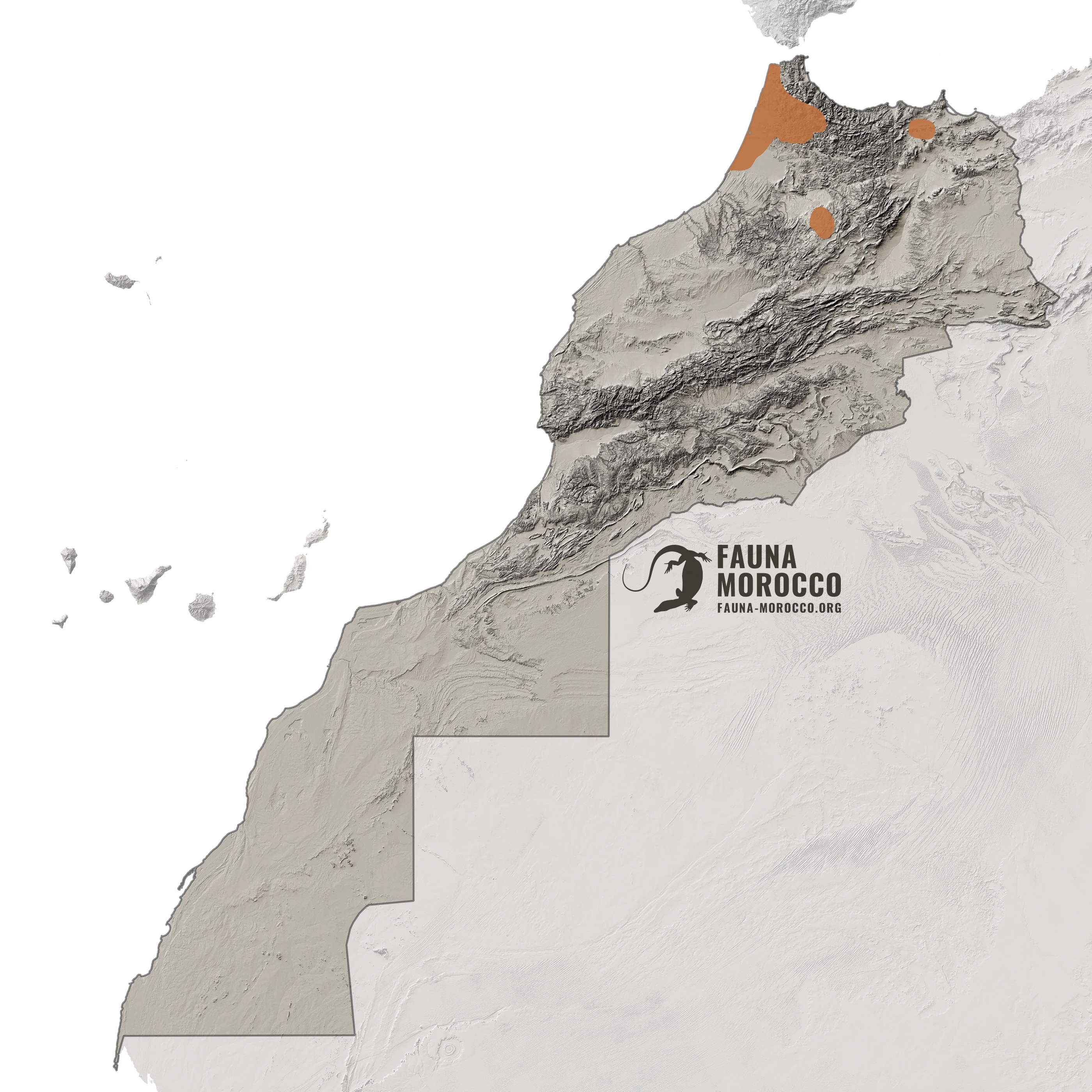
Within Morocco, turtles of the Rif differ genetically from those of the Middle Atlas[36][40]. The few turtles sampled in the Kenitra province, on the Atlantic plain, belong to the Middle Atlas group[36], and the Middle Atlas populations show low genetic diversity[40]. The Rif holds the highest genetic diversity, and the Moroccan lineage probably originated there[40].
Some turtles from Cádiz and Málaga (southern Spain) carry genetic types otherwise known only from the Rif. They may descend from a second, recent crossing of the Strait of Gibraltar or from turtles carried by people, and current data cannot separate the two explanations[40]. Overall, Moroccan populations are genetically more diverse than Iberian ones, and both have followed largely separate evolutionary paths, shaped by the Strait of Gibraltar[30].
The European Pond Turtle (Emys orbicularis) can be mistaken for the Mediterranean Pond Turtle (Mauremys leprosa), which often shares the same waters, and, from a distance, for the Moorish Tortoise (Testudo graeca). The most reliable feature is the plastron, which is hinged in the European Pond Turtle.
European Pond TurtleEmys orbicularis
Mediterranean Pond TurtleMauremys leprosa
Moorish TortoiseTestudo graeca
Habitat
Aquatic
Aquatic
Terrestrial
Plastron
Hinged[15]
Rigid
Rigid
Carapace
Slightly domed, dark, often dotted with yellow
Low, tan to olive, sometimes with large blotches
High and domed, yellowish to brown
Head and neck
Dark, with yellow dots
Olive, with stripes that fade with age
Dark head, spotted with yellow
Legs
Webbed
Webbed
Column-like