Only the larval diet has been studied in Morocco. The larvae are opportunistic, taking small aquatic invertebrates such as tiny crustaceans and aquatic insect larvae, and on one occasion even a pseudoscorpion11. The adult diet has not been studied in Morocco, but is probably similar to that of European salamanders, made up mainly of low-mobility terrestrial invertebrates such as millipedes, roundback slugs and earthworms27, and occasionally other insects such as moths (pers. obs.).
North African Fire Salamander
Salamandra algira
Conservation status:VUVulnerable
Population trend:Decreasing
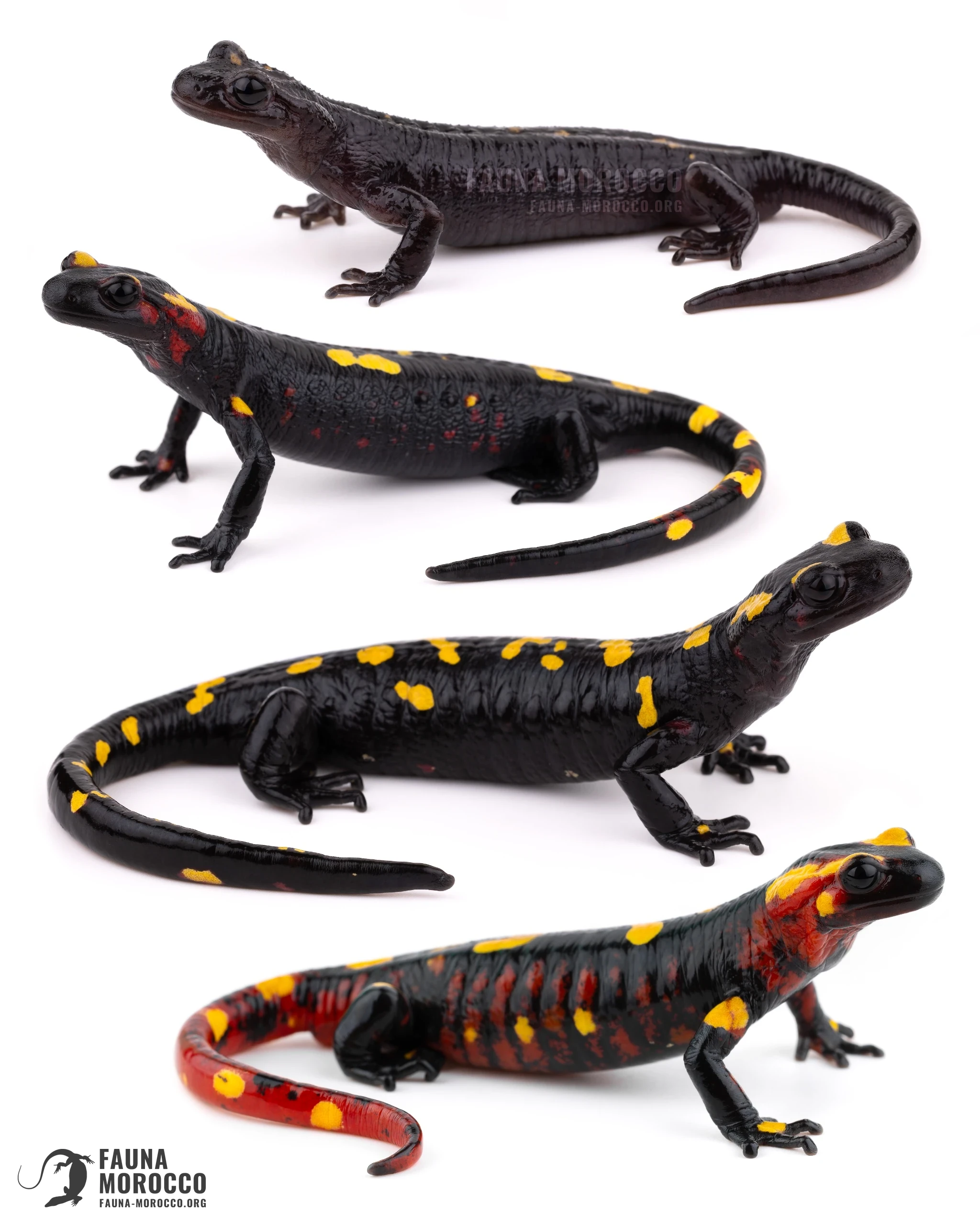
The North African Fire Salamander (Salamandra algira) is the only salamander native to the African continent, and one of the most emblematic amphibians of Morocco's wildlife. Elusive and very localized, it is confined to a few cool, humid pockets of habitat in northern Morocco.
However, its survival is increasingly at risk. Prolonged droughts, combined with ongoing habitat loss, are rapidly shrinking these already fragile environments. As a result, Salamandra algira has become a symbol not only of ecological uniqueness, but also of the urgent need to conserve North Africa's last remaining pockets of suitable habitat.
The North African Fire Salamander (Salamandra algira) is a medium-sized amphibian found only in North Africa, 15 to 25 cm long, with a rounded snout. Its most distinctive feature is its coloration: a dark, glossy ground marked with bright yellow or orange-red patterns that form irregular spots or blotches along the body and tail1827.
The sexes are hard to tell apart by size, but breeding males develop a swollen cloaca, and in Salamandra algira tingitana the forearms thicken as well1021.
Five subspecies are recognised17. Four live in Morocco, while the nominate form is restricted to Algeria.
- Salamandra algira tingitana is the smallest subspecies and the earliest-diverging of the Moroccan lineages17. It is highly variable in coloration: depending on the locality, some animals are almost uniformly black or brown, while others carry well-marked yellow spotting, with rare red dots in a few localities (pers. obs.)1018. Most striking is its reproduction: some Salamandra algira tingitana populations are viviparous, bearing fully formed young rather than laying larvae in water (see the Reproduction section).
- Salamandra algira splendens is usually strongly marked with red, most prominently around the parotoid glands, the throat and between the limbs; in the easternmost populations the red deepens almost to grape-purple (pers. obs.). It also carries abundant yellow dots, and has a longer tail and a more elongated body than the other subspecies18.
- Salamandra algira spelaea has a fairly uniform coloration: numerous yellow markings, with white dots15 and occasional wine-red dots or patches on the flanks, throat and belly (pers. obs.). Genetically, it is closer to the Algerian populations far to the east than to the neighbouring Rif subspecies, a trace of the species' eastward history151726.
- Salamandra algira atlantica is a large, slender subspecies. Its coloration is highly variable, and it is the only subspecies in which red can cover more of the body than black; the yellow dorsal blotches are usually fewer than in the other forms. Some individuals are almost entirely red, keeping only a few yellow marks21.
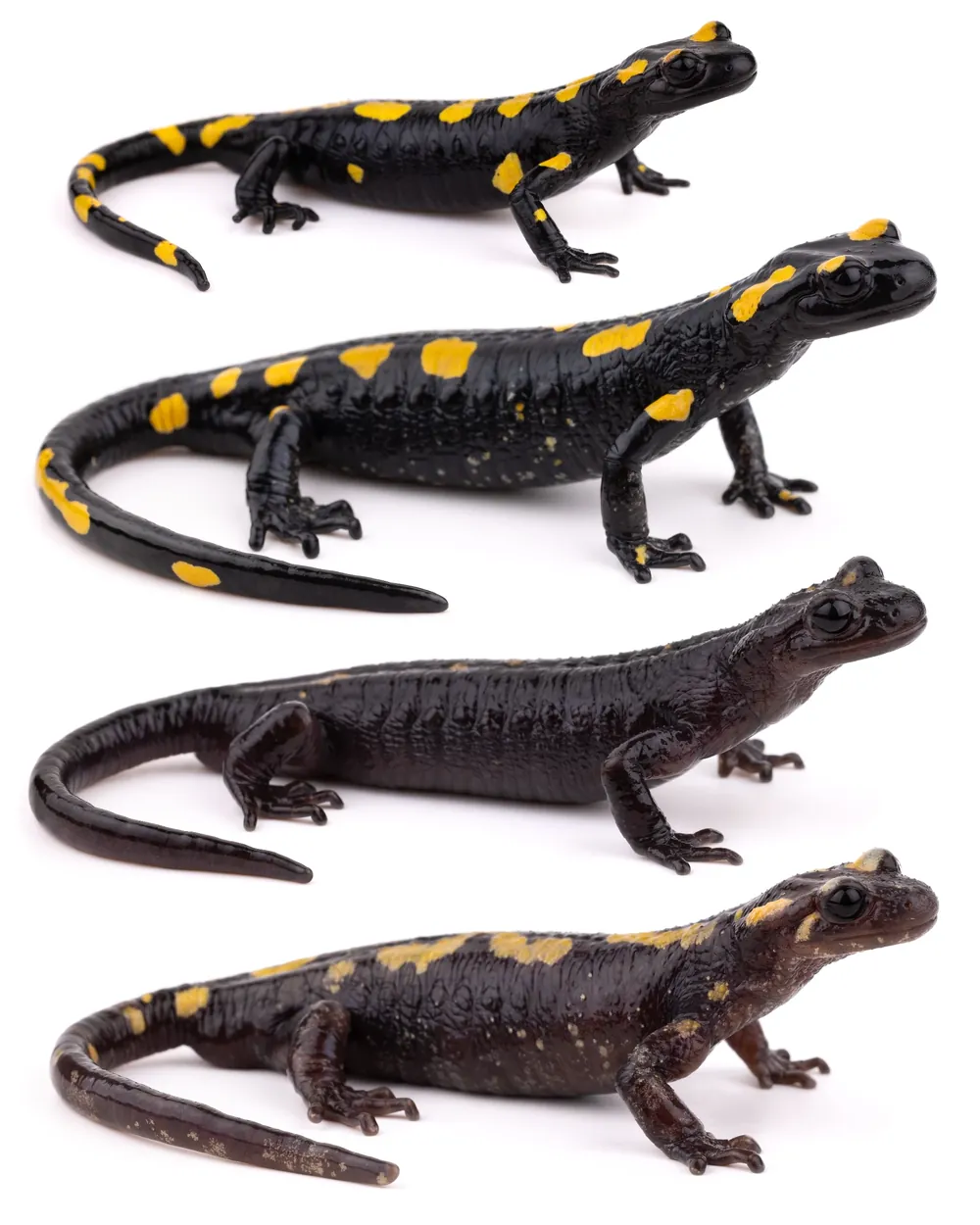
Salamandra algira tingitana, a subspecies endemic to the Tingitana Peninsula. It is extremely variable in colour and is the only subspecies with individuals that are sometimes almost devoid of yellow.
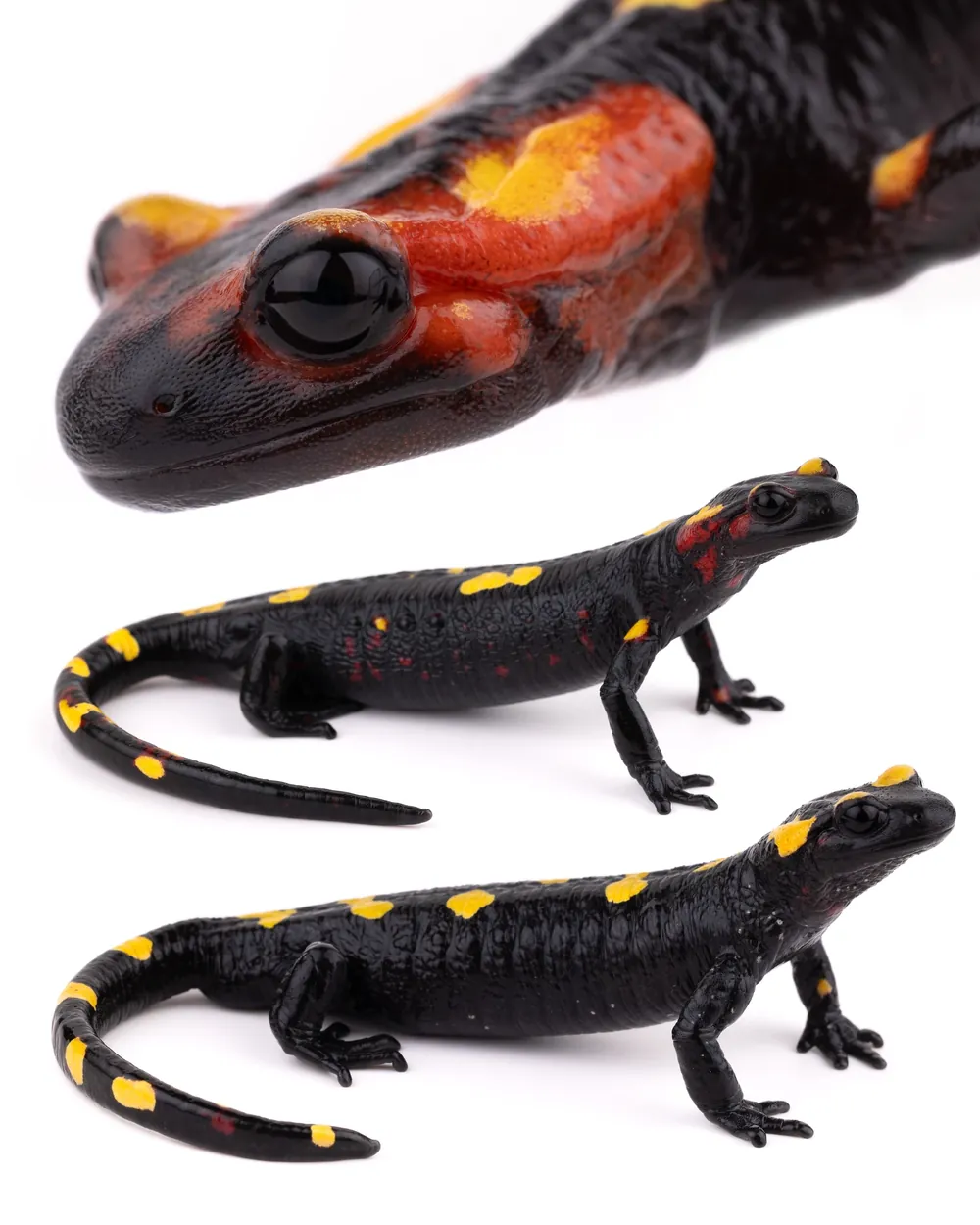
Salamandra algira splendens, endemic to the mountains of the eastern Rif. Genetically close to the Middle Atlas subspecies, it shares with it the red that is sometimes very extensive in certain individuals.
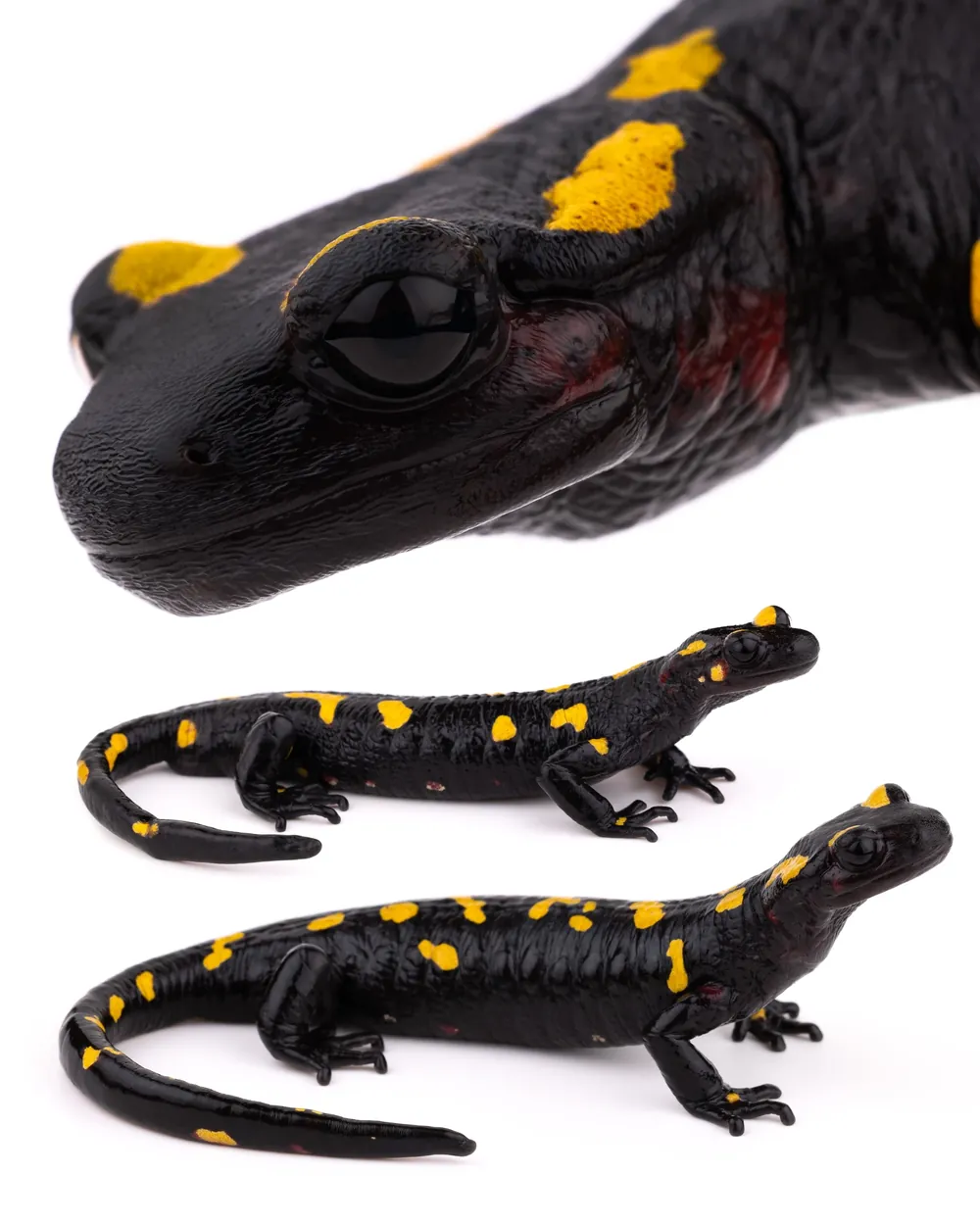
Salamandra algira spelaea, endemic to the Beni Snassen massif in the east of the country. Darker, it usually bears wine-red blotches together with numerous yellow spots.
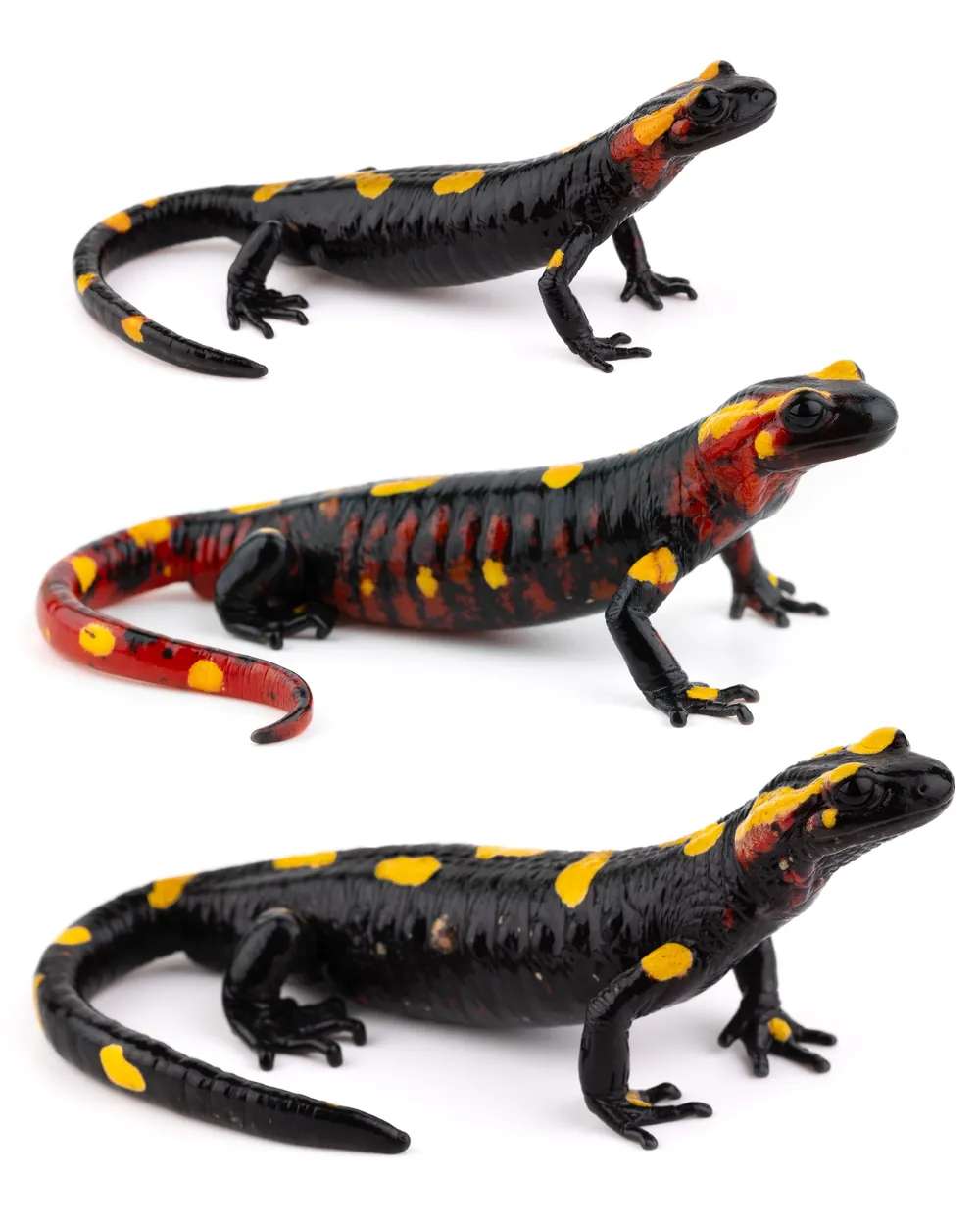
Salamandra algira atlantica, from the Middle Atlas. The subspecies is fairly variable in colour, ranging from individuals with very little red to the reddest known individuals of the species.
01 / 04
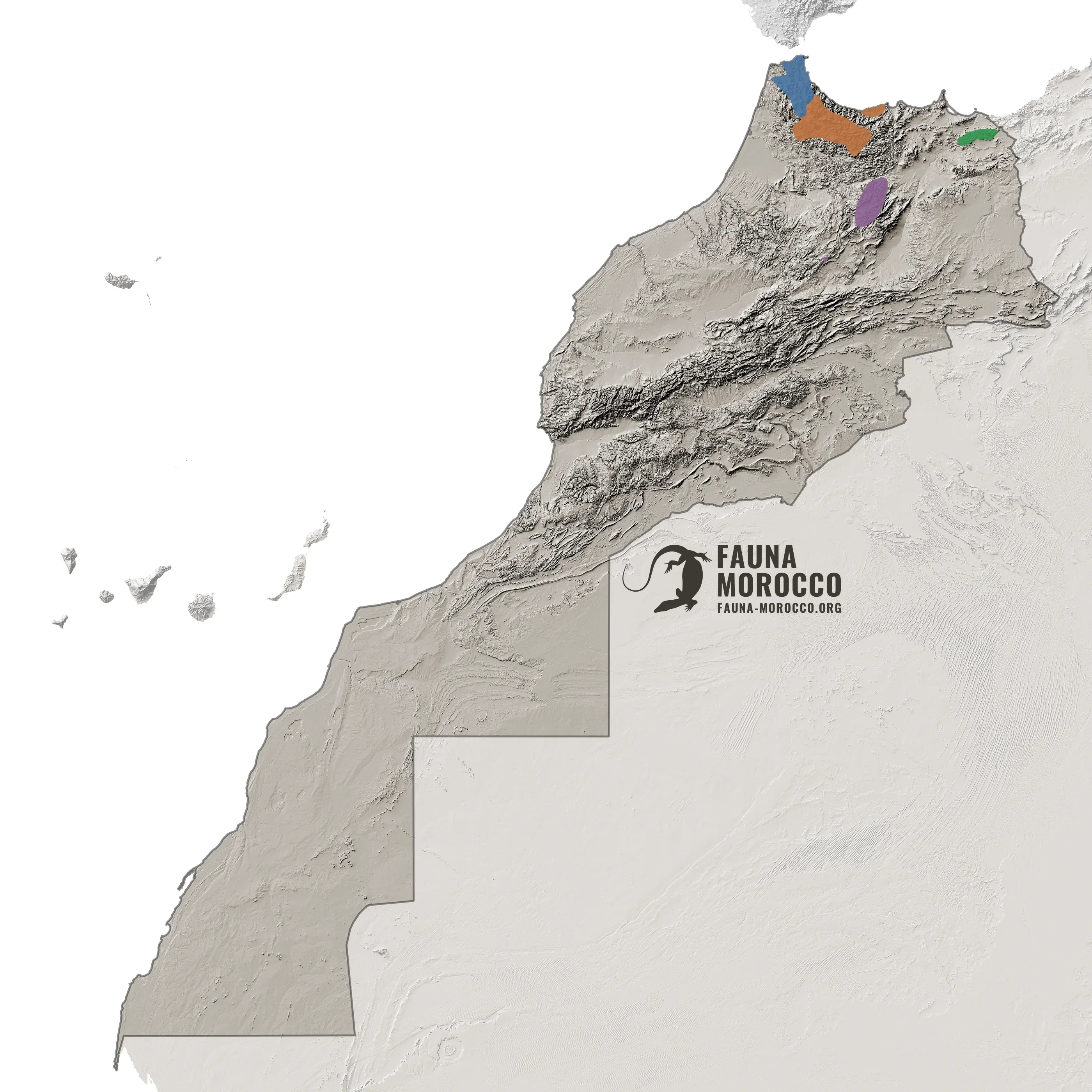
Distribution of Salamandra algira in Morocco, showing the ranges of different subspecies:
S. a. tingitana S. a. splendens S. a. spelaea S. a. atlanticaAbout this map
These distribution maps are produced by Fauna Morocco. Ranges are shown as estimates based on published records and our own field observations. They are updated when new data become available. Check out the references used for this map.
Africa's only salamander, the species is a relict of an ancient link with Europe. Its ancestors are thought to have crossed from the Iberian Peninsula some 5 to 7 million years ago38. Its range is confined to the mountains of northwestern Africa and is highly fragmented, with populations isolated on separate massifs by climate and terrain21.
In Morocco, the four subspecies inhabit different areas:
- Salamandra algira tingitana occupies the northwestern Rif, on the Tingitana Peninsula, north and west of the Oued Laou, from Ceuta to Jbel Sougna41825.
- Salamandra algira splendens ranges through the central and eastern Rif, south of the Oued Laou, from Chefchaouen to Al Hoceima, reaching its eastern limit in the recently discovered Bokkoyas populations42021.
- Salamandra algira spelaea is confined to the Beni Snassen massif in the northeast, within a small area of about 45 km²15.
- Salamandra algira atlantica is endemic to the northern and central Middle Atlas, chiefly around Jbel Tazekka and the Bou Iblane massif21.
The nominate Salamandra algira algira lives in Algeria, in the coastal mountains of Annaba, Kabylia and the Blida Atlas, some 800 km from the Moroccan populations815.
This fragmented distribution reflects the salamander's need for damp ground in a mostly dry region. The arid Moulouya basin is the main divide: it splits a western group (S. a. tingitana and S. a. splendens) from an eastern one (S. a. spelaea and the Algerian populations), and marks the species' deepest genetic split, though nuclear data show extensive mixing in the Middle Atlas816. Further west, the Oued Laou draws the line, with tingitana to the north and west, and splendens to the south48. The two subspecies still exchange genes through a narrow contact zone along the Oued Laou17. The species does not reach Tunisia, despite old reports: the animals once recorded there turned out to be misidentified European fire salamanders (Salamandra salamandra)5.
In Morocco, the North African Fire Salamander lives in cool habitats with high humidity or high rainfall, from about 30 m up to 2,455 m in elevation21. Its habitat ranges from forest to more open maquis, sometimes almost devoid of shrubs, and varies considerably between subspecies:
- Salamandra algira atlantica lives in subhumid to humid forest and limestone (karst) terrain at 600 to 2,455 m, in humid forests of cedar, fir, pine and oaks (Cedrus atlantica, Abies, Pinus, Quercus)21.
- Salamandra algira spelaea occupies rocky ground and caves in the Beni Snassen massif at 600 to 1,300 m, ranging from cave refuges to the surrounding Mediterranean forest1516.
- Salamandra algira splendens spreads more widely, from 280 to 2,000 m in the Rif and Middle Atlas, favouring calcareous soils under pine, cedar and oak, usually near springs and small streams; near Al Hoceima it descends to about 220 m in mesic mixed forest with dense scrub1820.
- Salamandra algira tingitana keeps to limestone terrain between 390 and 1,274 m, in Mediterranean maquis with low shrubs, herbs, and pine and oak forests18.
Larvae develop in a range of standing or slow-moving water: springs, seeps, streams, temporary pools, even cattle troughs and irrigation reservoirs. A few populations skip the aquatic stage altogether by breeding viviparously, in the north of the Tingitana Peninsula, north of the Oued Martil316.
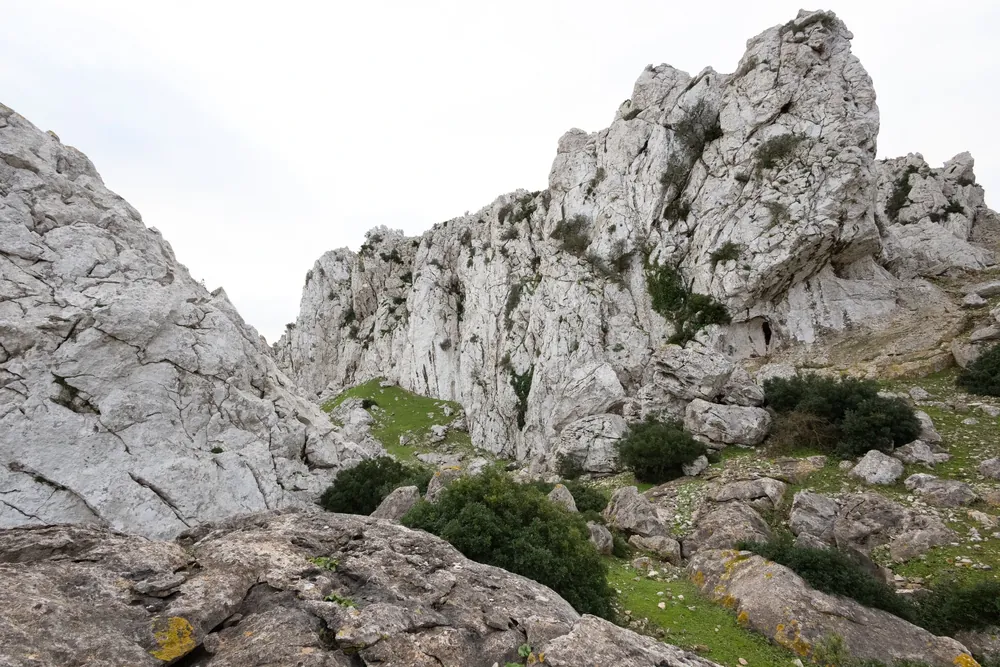
Habitat of a viviparous population of Salamandra algira tingitana in the north of the Tingitana Peninsula: karst relief with scattered bushes and shrubs.
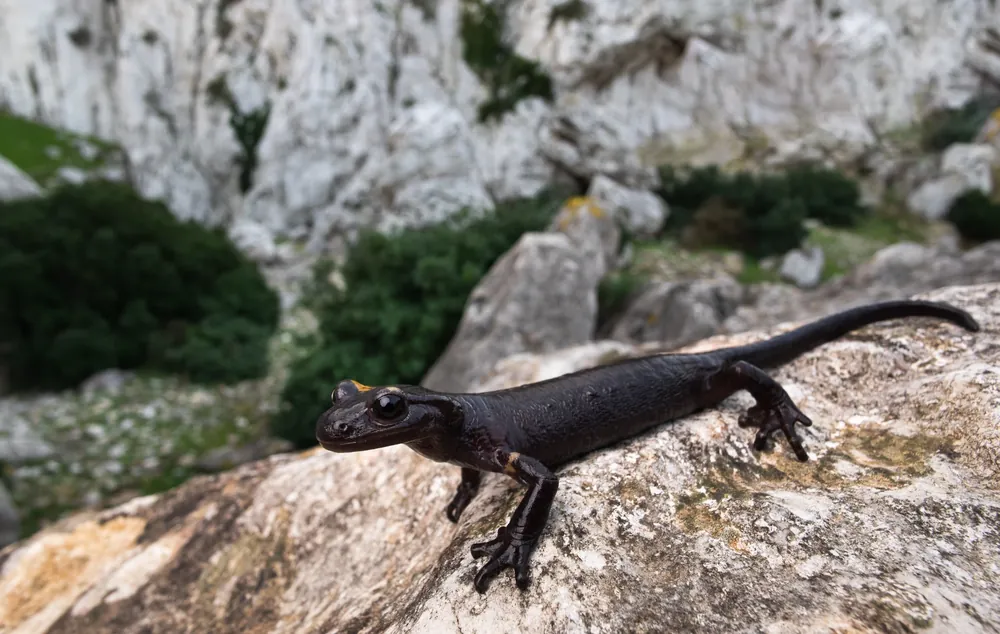
Viviparous Salamandra algira tingitana in its environment.
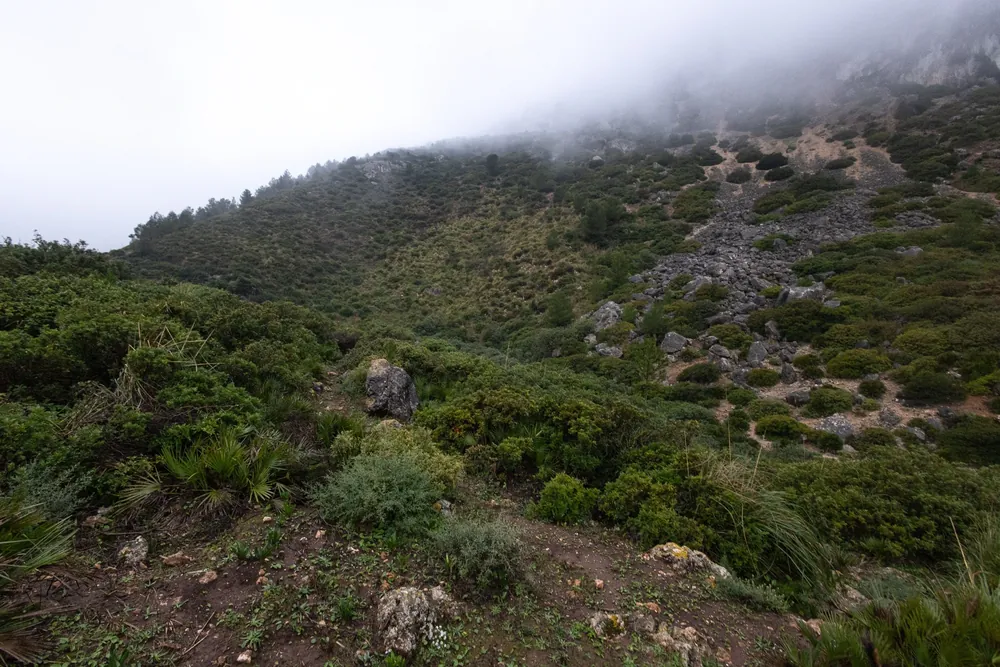
Habitat of Salamandra algira tingitana, among dwarf palms, scree and pine woods.
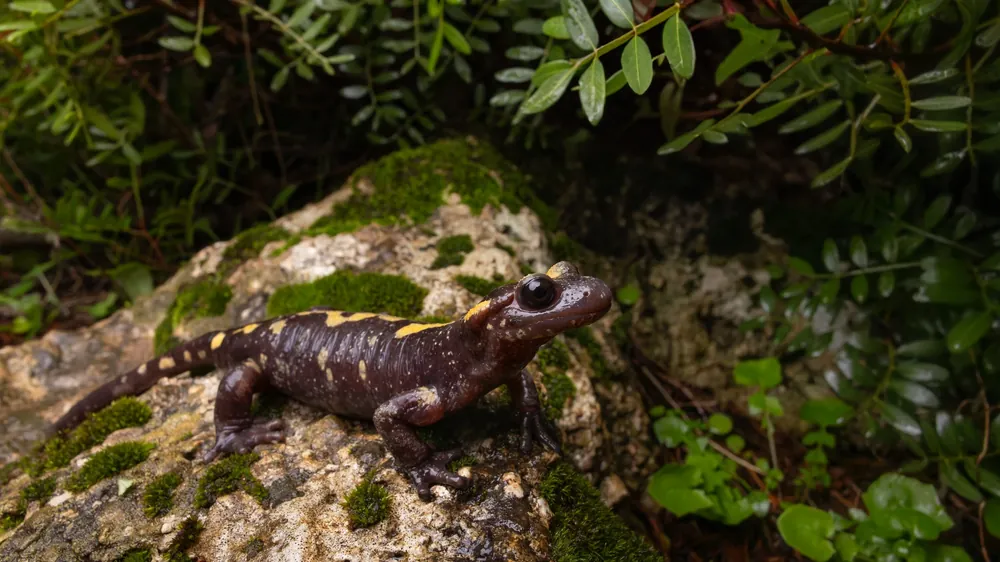
Salamandra algira tingitana with atypical colouration, in its environment in the east of the Tingitana Peninsula.
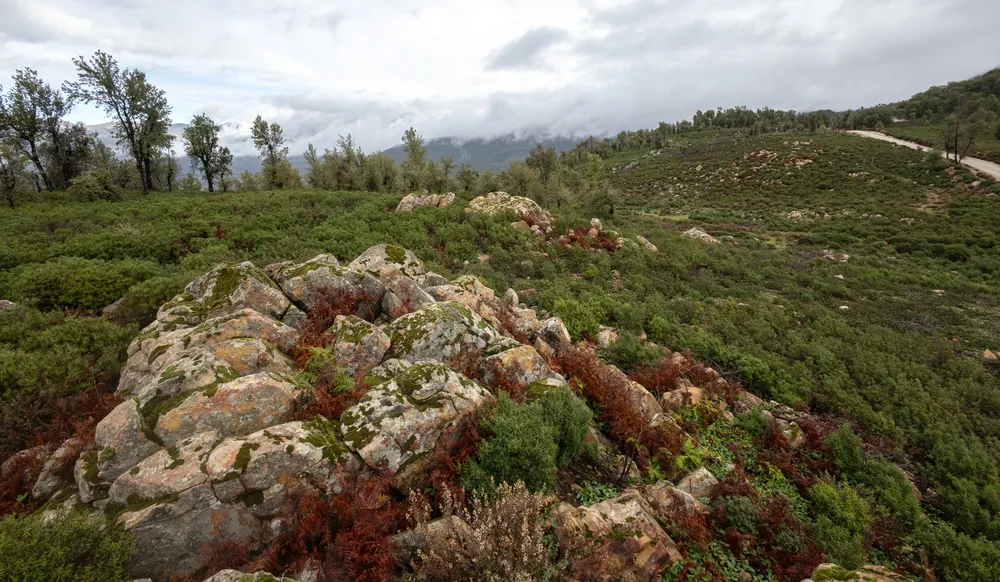
Habitat of a population of Salamandra algira tingitana in the uplands of the central Tingitana Peninsula, among pine woods, oak woods and maquis, close to a stream.
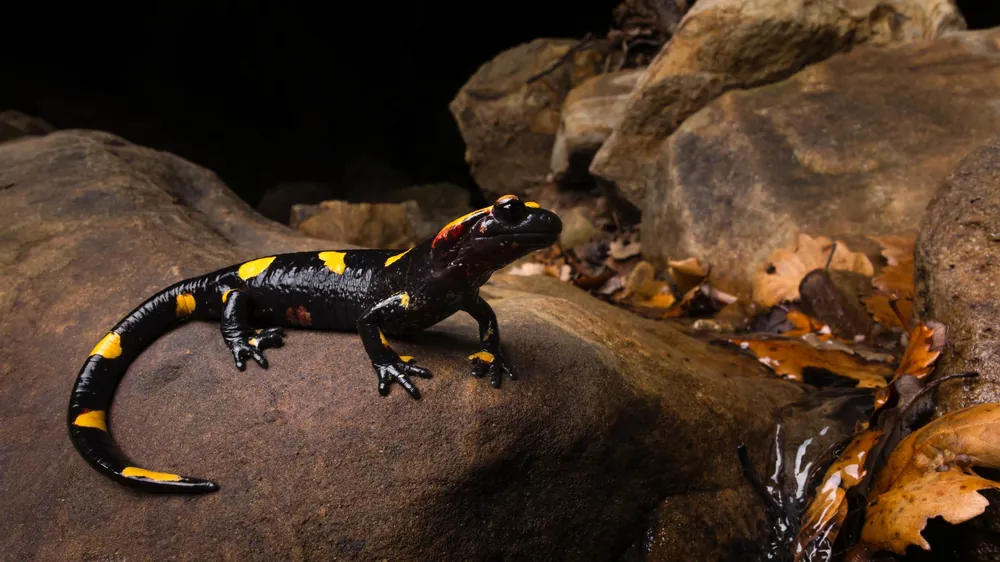
Salamandra algira tingitana found at the edge of a stream, among the trees of an oak wood.
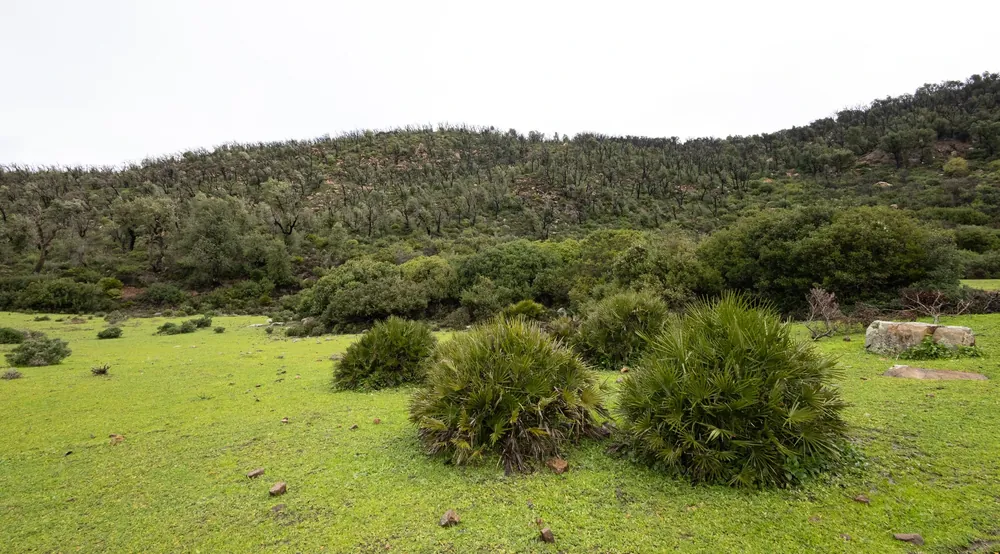
Habitat of Salamandra algira tingitana at the foot of an oak wood hit by recent summer fires, beside a stream.
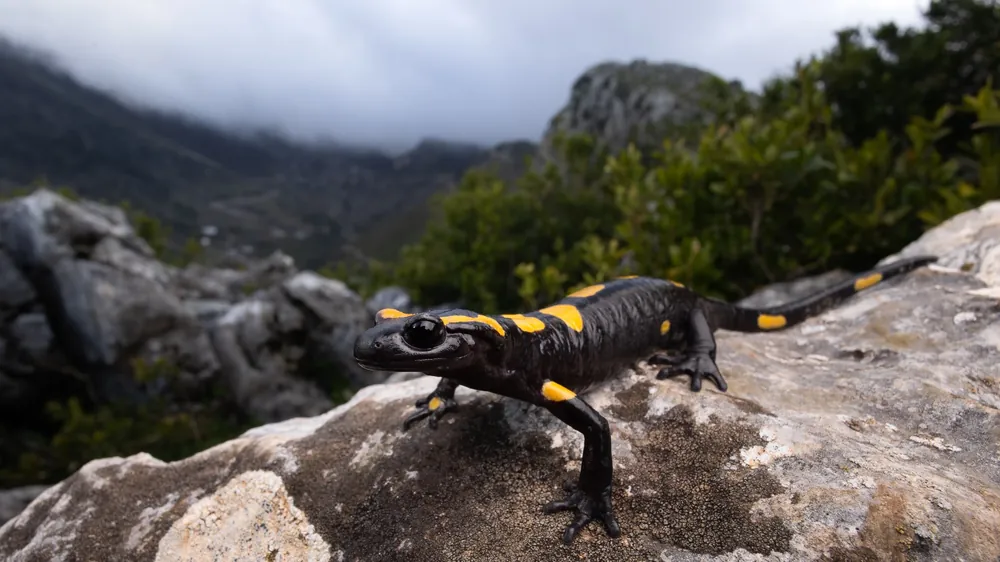
Salamandra algira tingitana from the east of its range, occupying open habitats on rocky plateaux unsuitable for agriculture.
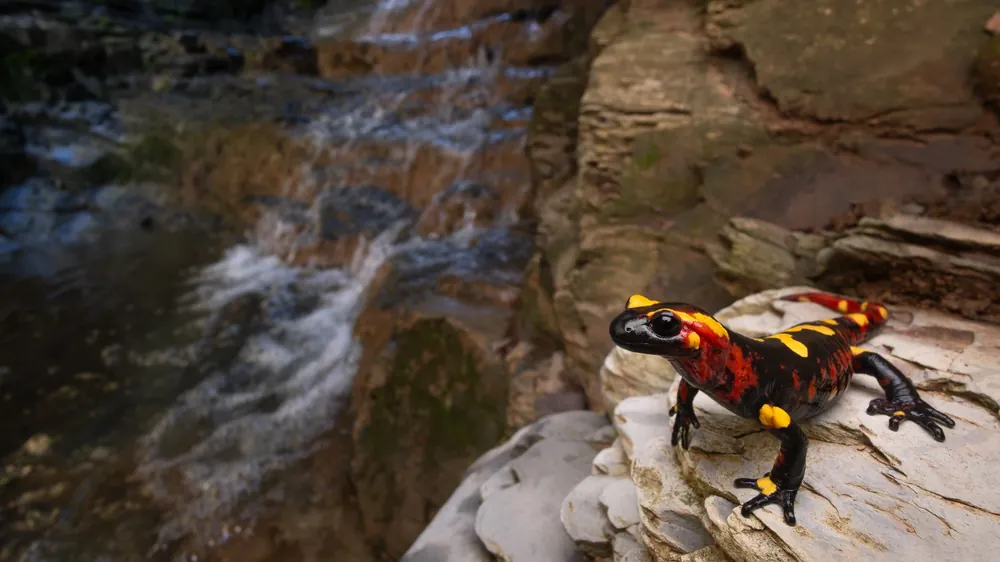
Salamandra algira atlantica at the foot of a waterfall, in Tazekka National Park.
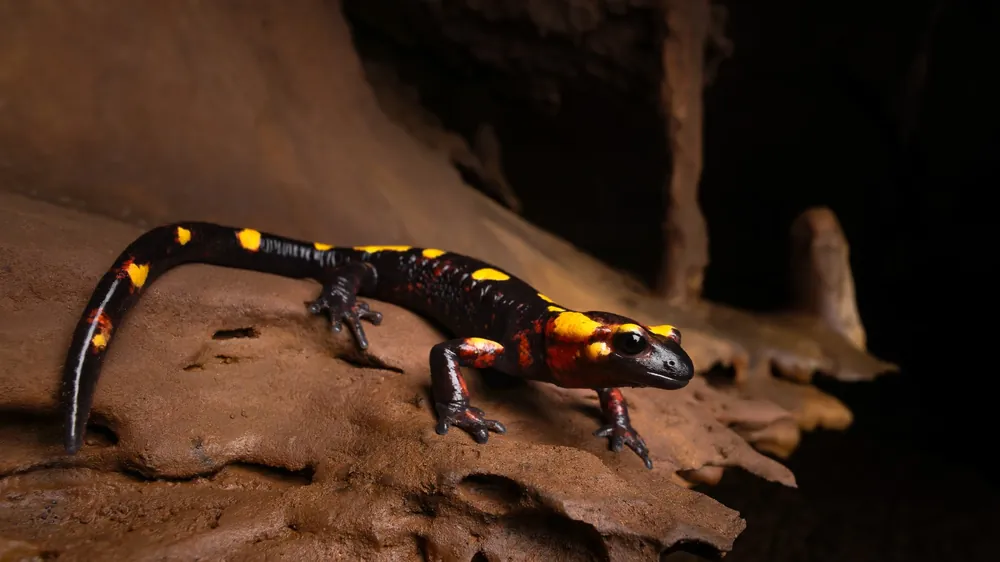
Salamandra algira atlantica from a cave-dwelling population, in Tazekka National Park.
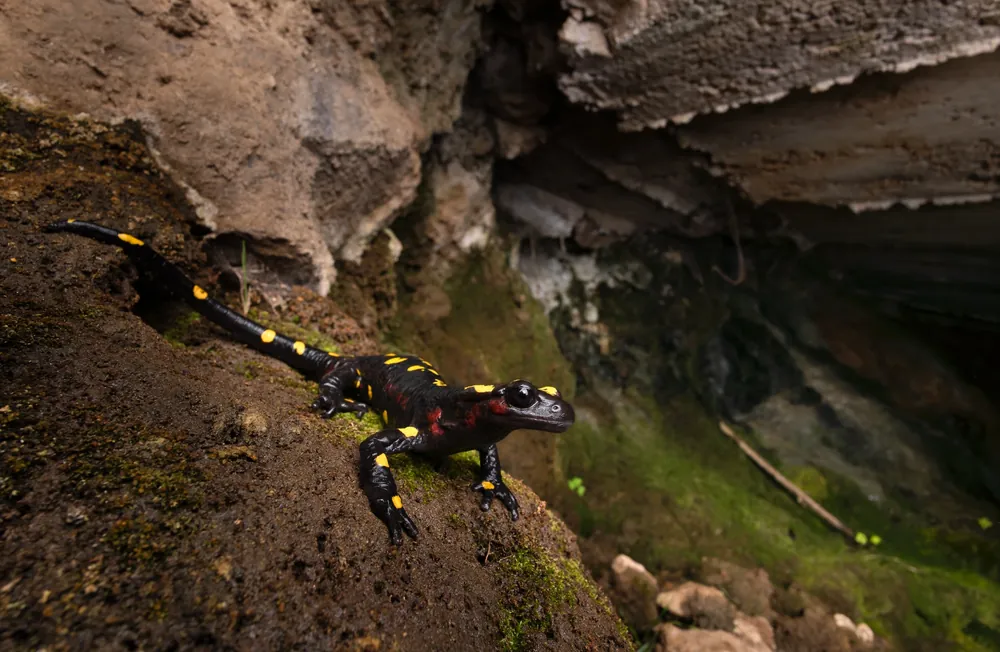
Salamandra algira spelaea near a spring, one of the few damp spots in the Beni Snassen massif.
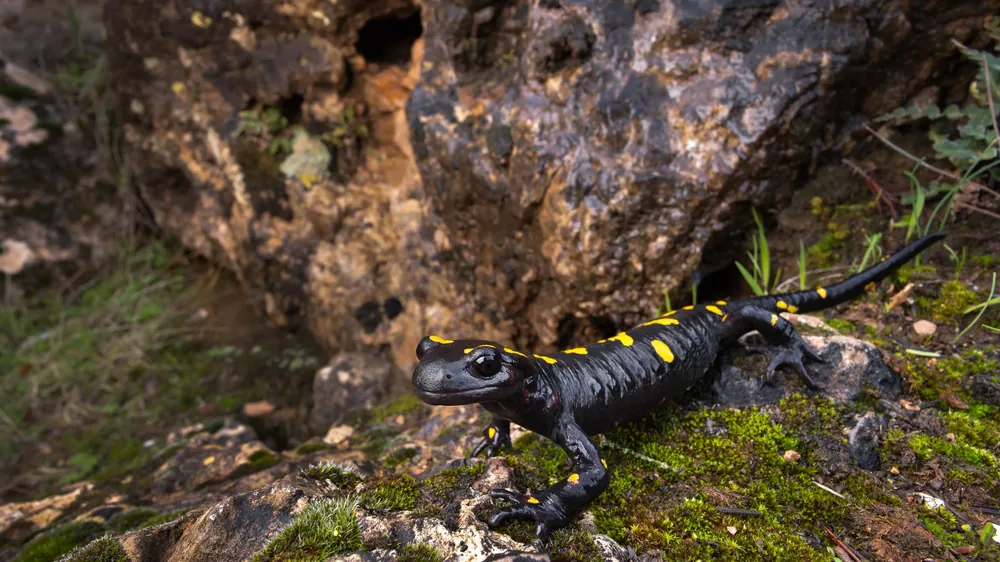
Salamandra algira spelaea at the entrance of a cave, the habitat that gave the subspecies its name.
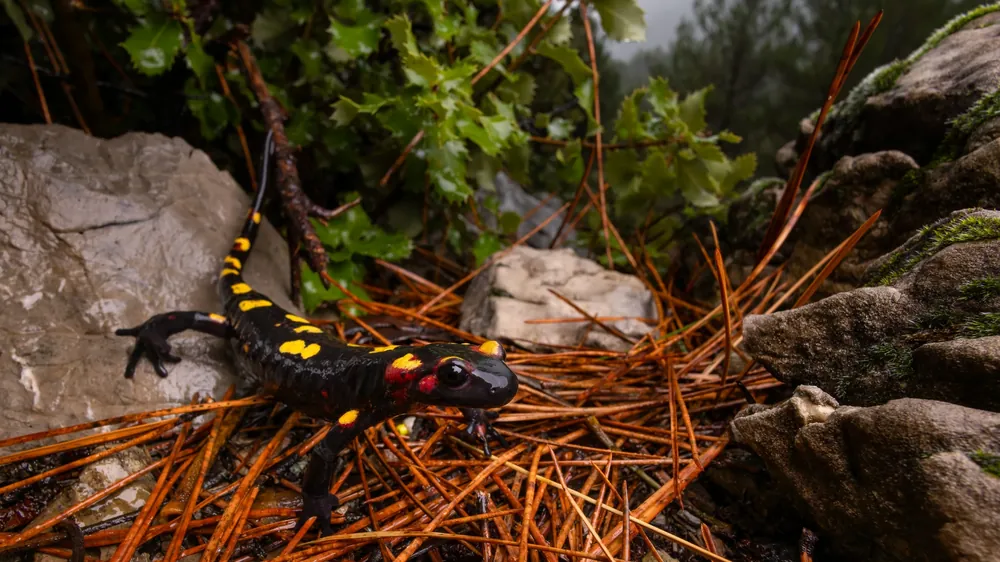
Salamandra algira splendens in a pine forest in the heights of the Rif.
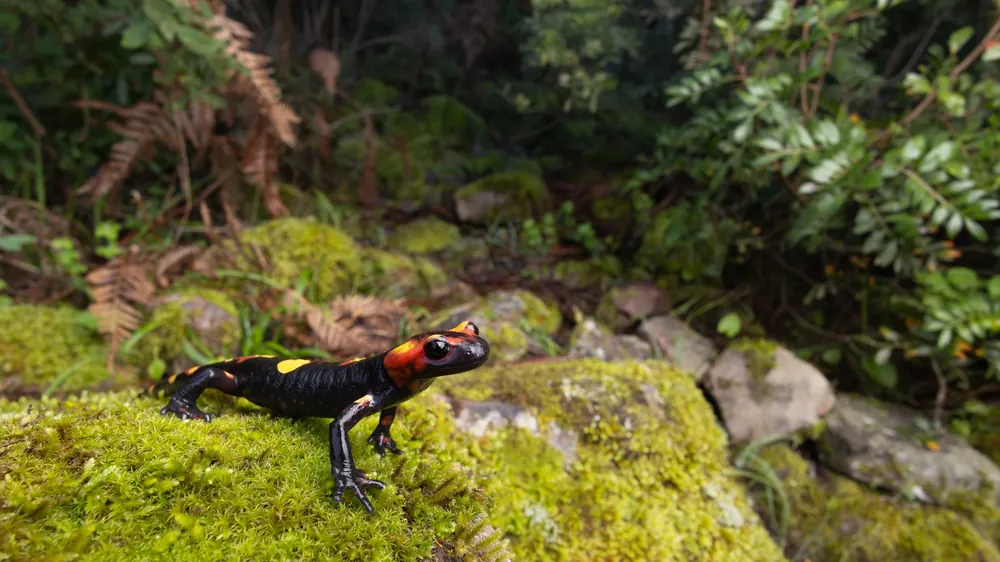
Salamandra algira splendens near a spring, in the surroundings of Chefchaouen.
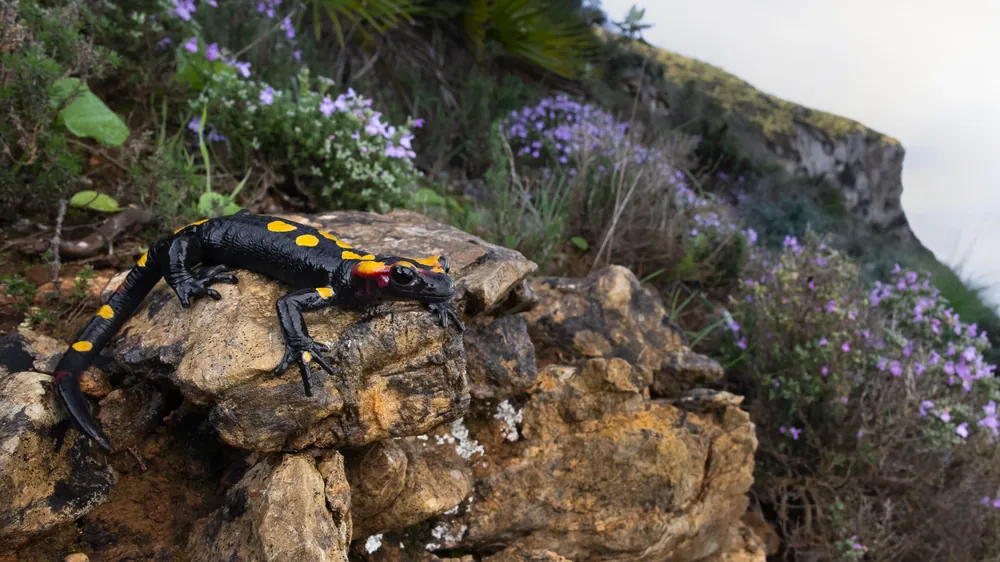
Salamandra algira splendens on coastal cliffs at the far north-east of its range, a long way from the damp forests where the species is expected.
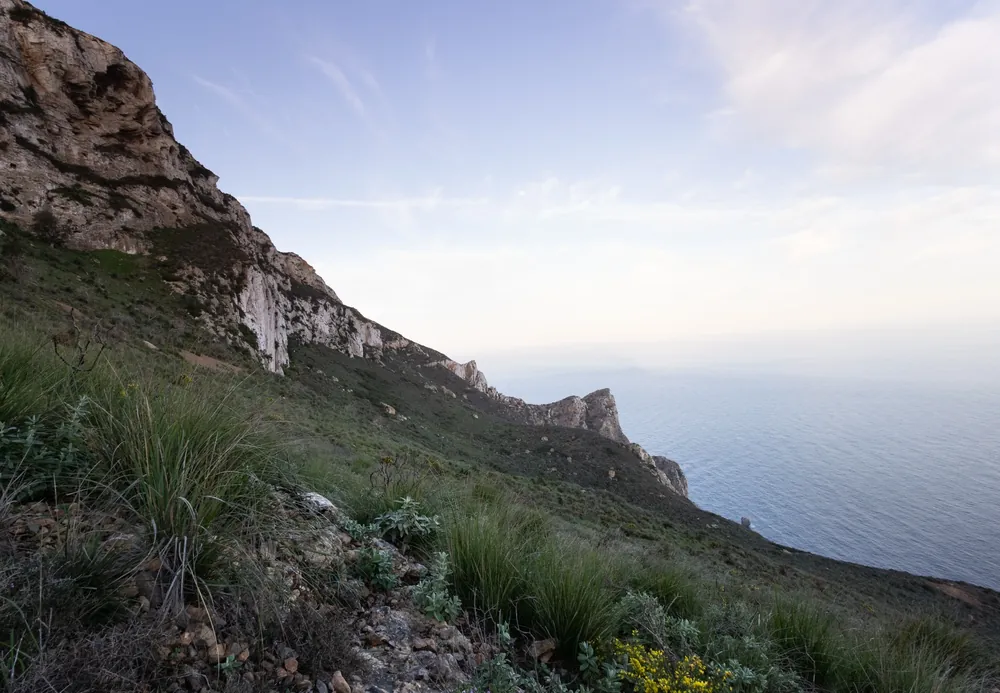
Coastal habitat of Salamandra algira splendens, cliffs overlooking the sea.
These defences are effective: the noxious secretions and warning colours mean that few predators take the species regularly30. In Morocco, documented predation is rare, with two noteworthy observations, both on larvae: a water bug (Nepa cinerea) taking a Salamandra algira spelaea larva, and a Viperine snake (Natrix maura) taking Salamandra algira tingitana larvae30.
The species reproduces in two ways. Most populations are ovoviviparous: the female drops fully formed larvae into water, where they finish developing. Others are viviparous, giving birth to fully metamorphosed young that never enter the water at all; this mode occurs only in some northern Salamandra algira tingitana populations, north of the Oued Martil3910. Which mode a population follows appears to be strongly influenced by humidity, though this is likely not the only factor714.
Mating takes place on land on rainy nights, between autumn and spring. Viviparous females give birth to 3 to 17 young (27.4 to 39 mm)7, while egg-laying females carry about 13 eggs on average (range 7 to 22), more in larger animals28. Some Middle Atlas Salamandra algira atlantica breed deep inside caves, as does Salamandra algira splendens1921.
The North African Fire Salamander is listed as Vulnerable on the IUCN Red List, and its numbers are falling22. Threats reach across its small North African range, breaking populations into ever more isolated fragments.
Because that status is set for the species as a whole, a subspecies-level reassessment would be valuable. The subspecies Salamandra algira spelaea is of particular conservation concern; given its extremely restricted range (under 45 km²) and specialized habitat requirements, it may warrant elevation to a more serious endangerment status in future assessments15.
The main threats in Morocco are:
- Habitat loss through deforestation, overgrazing, farming and infrastructure such as roads22.
- More frequent droughts, which cut habitat quality and breeding chances, the salamander's particular reproductive needs making it especially sensitive to climate change12.
- Channelisation and reshaping of streams for irrigation22, along with local water pollution (pers. obs.).
- Introduced fish and the red swamp crayfish (Procambarus clarkii), recorded even in protected areas, are a threat to eggs and larvae2; the team has recorded their presence at salamander sites (pers. obs.).
- Fungal diseases, chytridiomycosis in particular: the chytrid fungus Batrachochytrium dendrobatidis (Bd) has been present in Moroccan amphibians since 2011, its first North African record, and the rise of herping tourism adds to the risk, as visitors can spread it between sites without basic biosecurity such as disinfecting boots and gear1 (pers. obs.).
Recent work has clarified the effects of these threats. The species was added to CITES Appendix III in 2023, and its population is thought to have dropped by about 30% over the past decade6. In the Rif, the spread of cannabis growing adds further local pressure29.
The salamander occurs within several parks and reserves, including Talassemtane National Park and the Parc National d'Al-Hoceima, both established under Morocco's protected-areas law (Law 22-07)23. No Moroccan amphibian has species-specific legal protection29; however, since its 2023 listing on CITES Appendix III, the species falls under Law 29-0524, which regulates the collection, keeping and trade of listed species.
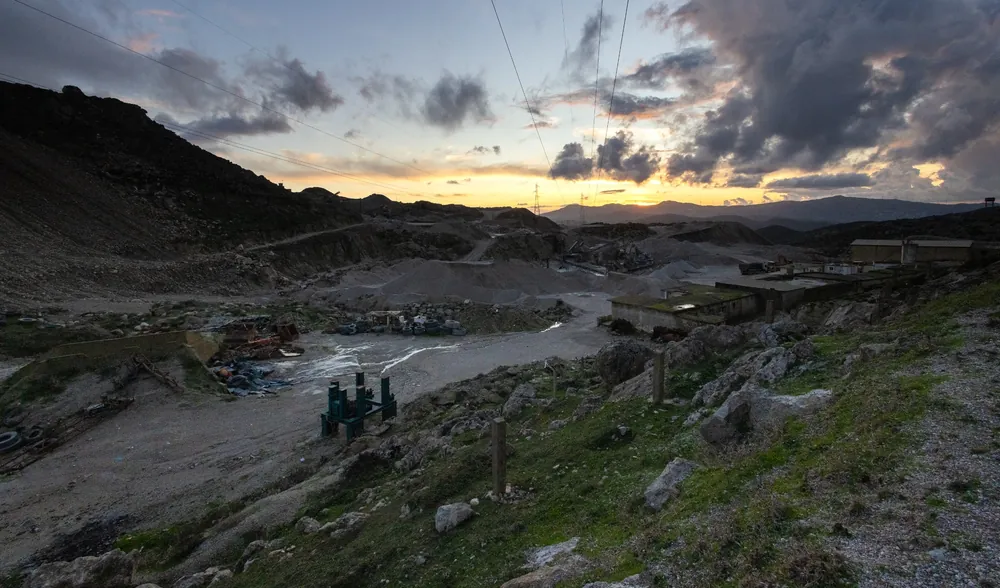
Habitat destruction is the greatest threat facing the North African Fire Salamander (Salamandra algira). Here, habitat of the subspecies tingitana, fragmented by quarries.
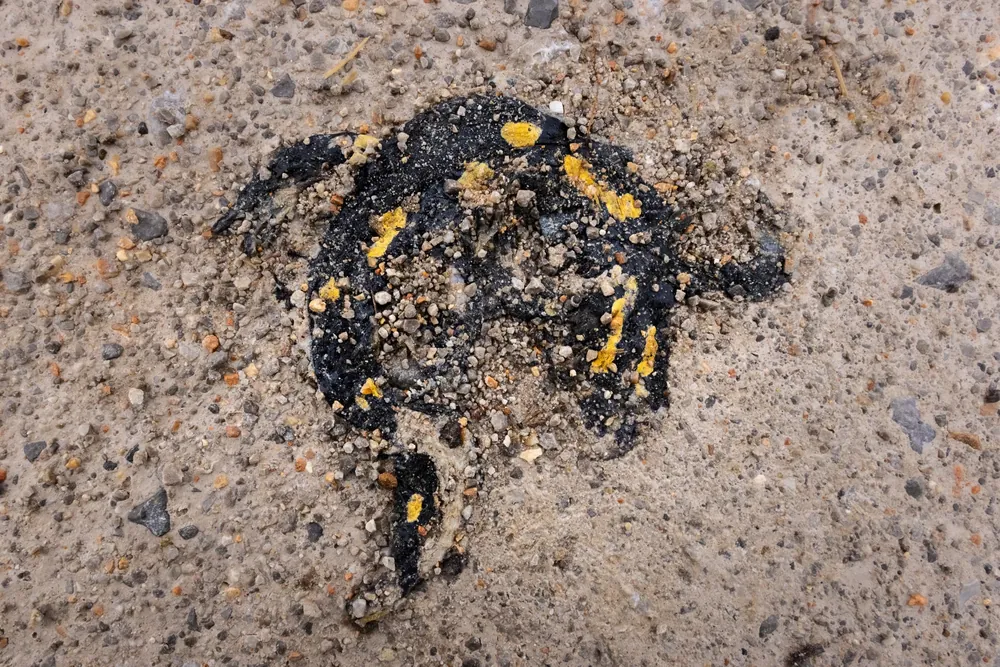
Road development and increasing traffic around key habitats could also constitute a further, far from negligible threat.
Maps
- Bons, J., & Geniez, P. (1996). Amphibiens et reptiles du Maroc (Sahara Occidental compris). Atlas biogéographique. Asociación Herpetológica Española.
- Martínez del Mármol, G., Harris, D. J., Geniez, P., de Pous, P., & Salvi, D. (2019). Amphibians and Reptiles of Morocco. Frankfurt Contributions to Natural History, 74. Edition Chimaira.
Species account
- Ait El Cadi, R., Laghzaoui, E.-M., Crottini, A., Slimani, T., Bosch, J., & El Mouden, E.H. (2019). Occurrence of Batrachochytrium dendrobatidis in the Tensift region, with comments on its spreading in Morocco. Acta Herpetologica, 14(2): 109-115.
- Ben Hassine, J., & Escoriza, D. (2014). New ecological data on the family Salamandridae in the Maghreb. Herpetological Review, 45(2): 193-197.
- Beukema, W., de Pous, P., Donaire-Barroso, D., Bogaerts, S., Toxopeus, A.G., De Bie, C.A.J.M., Roca, J., & Carranza, S. (2010). Biogeography and contemporary climatic differentiation among Moroccan Salamandra algira. Biological Journal of the Linnean Society, 101: 626-631.
- Beukema, W., de Pous, P., Donaire-Barroso, D., Bogaerts, S., Garcia-Porta, J., Escoriza, D., Arribas, O.J., El Mouden, E.H., & Carranza, S. (2013). Review of the systematics, distribution, biogeography and natural history of Moroccan amphibians. Zootaxa, 3661(1): 1-60.
- Bogaerts, S., Donaire-Barroso, D., Pasmans, F., Böhme, W., & Carranza, S. (2013). Do North African Fire Salamanders, Salamandra algira, occur in Tunisia? Herpetological Notes, 6: 301-306.
- Boudajbir, C., Martínez-Freiría, F., Chergui, B., Fahd, S., & Brito, J.C. (2025). Atlas of amphibians and reptiles in the Moroccan section of the Mediterranean Intercontinental Biosphere Reserve: distribution patterns and habitat use. Basic and Applied Herpetology, 39: 27-43.
- Dinis, M., & Velo-Antón, G. (2017). How little do we know about the reproductive mode in the North African Salamander, Salamandra algira? Pueriparity in divergent mitochondrial lineages of S. a. tingitana. Amphibia-Reptilia, 38: 540-546.
- Dinis, M., Merabet, K., Martínez-Freiría, F., Steinfartz, S., Vences, M., Burgon, J.D., Elmer, K.R., Donaire, D., Hinckley, A., Fahd, S., Joger, U., Fawzi, A., Slimani, T., & Velo-Antón, G. (2019). Allopatric diversification and evolutionary melting pot in a North African Palearctic relict: the biogeographic history of Salamandra algira. Molecular Phylogenetics and Evolution, 130: 81-91.
- Donaire-Barroso, D., & Bogaerts, S. (2001). Observations on viviparity of Salamandra algira in North Morocco. In: Herpetologia Candiana. S.E.H., Irakleio, pp. 147-151.
- Donaire-Barroso, D., & Bogaerts, S. (2003). A new subspecies of Salamandra algira Bedriaga, 1883 from northern Morocco. Podarcis, 4: 84-100.
- El Kourchi, Y., Fahd, S., Escoriza, D., & Ben Hassine, J. (2021). Salamandra algira (Atlas Fire Salamander): larval diet. African Herp News, 78: 57-58.
- Escoriza, D., & Ben Hassine, J. (2014). Microclimatic variation in multiple Salamandra algira populations along an altitudinal gradient: phenology and reproductive strategies. Acta Herpetologica, 9(1): 33-41.
- Escoriza, D., & Ben Hassine, J. (2017). Habitat structure and presence of Salamandra algira in the Edough Peninsula, north-eastern Algeria. African Journal of Herpetology, 66(2): 154-168.
- Escoriza, D., & Ben Hassine, J. (2025). Microenvironment, reproductive tactics and morphology in Mediterranean Salamandra. Canadian Journal of Zoology, 103: 1-12.
- Escoriza, D., & Comas, M.M. (2007). Description of a new subspecies of Salamandra algira Bedriaga, 1883 from the Beni Snassen massif (Northeast Morocco). Salamandra, 43: 77-90.
- Escoriza, D., Comas, M.M., Donaire, D., & Carranza, S. (2006). Rediscovery of Salamandra algira Bedriaga, 1883 from the Beni Snassen massif (Morocco) and phylogenetic relationships of North African Salamandra. Amphibia-Reptilia, 27: 448-455.
- Gippner, S., Strowbridge, N., Šunje, E., Capstick, M., Amat, F., Bogaerts, S., Merabet, K., Preißler, K., Galán, P., Martínez-Solano, I., Bonato, L., Steinfartz, S., Velo-Antón, G., Dufresnes, C., Elmer, K.R., & Vences, M. (2024). The effect of hybrids on phylogenomics and subspecies delimitation in Salamandra, a highly diversified amphibian genus. Salamandra, 60(2): 105–128.
- Hernández, A. (2017). Les Urodèles du Maroc: Pleurodeles waltl, Salamandra algira tingitana, S. algira splendens et S. algira spelaea (Caudata: Salamandridae). Situla, 29: 30-48.
- Hernández, A. (2019). First observations on cave breeding in Salamandra algira splendens from north-eastern Morocco. The Herpetological Bulletin, 149: 34-37.
- Hernández, A., & Escoriza, D. (2017). Easternmost record of Salamandra algira splendens in Morocco. Boletín de la Asociación Herpetológica Española, 28(1): 60-61.
- Hernández, A., & Escoriza, D. (2019). A new subspecies of African fire salamander Salamandra algira (Urodela, Salamandridae) from the Middle Atlas Mountains, Morocco. ZooKeys, 893: 143-158.
- IUCN SSC Amphibian Specialist Group (2009). Salamandra algira. The IUCN Red List of Threatened Species 2009 (assessed 2008; VU B1ab(iii)+2ab(iii)).
- Kingdom of Morocco (2010). Law No. 22-07 relating to protected areas (Dahir No. 1-10-123, 16 July 2010). Official Bulletin of the Kingdom of Morocco.
- Kingdom of Morocco (2011). Law No. 29-05 on the protection of wild flora and fauna species and the control of their trade (Dahir No. 1-11-84, 2 July 2011; implementing Decree No. 2-12-484, 21 May 2015). Official Bulletin, 21 July 2011.
- Martínez-Medina, F.J. (1997). Nueva localidad de Salamandra algira en el extremo norte de la Península Tingitana (Ceuta).
- Merabet, K., Sanchez, E., Dahmana, A., Bogaerts, S., Donaire, D., Steinfartz, S., Joger, U., & Vences, M. (2016). Phylogeographic relationships and shallow mitochondrial divergence of Algerian populations of Salamandra algira. Amphibia-Reptilia, 37: 1-8.
- Raffaëlli, J. (2013). Les Urodèles du Monde, 2nd ed. Penclen éditions, 480 pp, via Hernández & Escoriza (2019).
- Reinhard, S., Renner, S., & Kupfer, A. (2015). Age and fecundity in Salamandra algira (Caudata: Salamandridae). Salamandra, 51: 19-24.
- Reques, R., Pleguezuelos, J.M., Busack, S.D. et al. (2013). Amphibians of Morocco, including Western Sahara: a status report. Basic and Applied Herpetology, 27: 23-50.
- Sánchez-Vialas, A., Escoriza, D., Jiménez-Robles, O., & Martínez del Mármol, G. (2016). New reports on predation of Salamandra algira larvae in Morocco. Boletín de la Asociación Herpetológica Española, 27(2): 30-33.
- Vences, M., Sanchez, E., Hauswaldt, J.S. et al. (2014). Nuclear and mitochondrial multilocus phylogeny and survey of alkaloid content in true salamanders of the genus Salamandra (Salamandridae). Molecular Phylogenetics and Evolution, 73: 208-216.
How to cite
Ruffieux, C., & Vuillemin, R. (2026). North African Fire Salamander (Salamandra algira). In: Castella, C., Iallaten, H., Ruffieux, C., & Vuillemin, R. (Eds.), Fauna Morocco. The Free Encyclopedia: Reptiles & Amphibians of Morocco. Available from https://fauna-morocco.org/encyclopedia/caudata/salamandra-algira.html (accessed 4 September 2026).
Published
27 July 2026
Last updated
22 September 2026
Authors
Colin Ruffieux
Rayane Vuillemin
Reviewers
Clément Castella
Haytam Iallaten
Mohamed Taha Aissaoui
Photography
Rayane Vuillemin
Methodology
Each account is a scientific synthesis: we compile the literature, read each paper in full, verify facts against their original sources when possible, and flag uncertainties for expert review. It is written first in English, reviewed by the team, then translated into French and Arabic. Every claim is referenced, and accounts are updated as knowledge advances. If you spot a mistake or an omission, please get in touch so we can fix it.