Colubrids of Morocco
The snakes you actually meet
Not one of Morocco's colubrids is dangerous to people. They are the country's largest snake family, with 12 species spread across every habitat, from mountain forest to irrigation channels and Saharan sand, and they are the snakes most often found around houses, gardens and old walls. Between them they cover a remarkable range of diets and lifestyles: fish hunters, egg eaters, burrowers that swim through sand.
species
to humans
Harmless, they are sadly very often killed out of fear. A colubrid that flattens its head and strikes with a closed mouth passes for a venomous snake, a Moorish Viper for instance. The roads and the water reservoirs they fall into also kill large numbers of colubrids. Learning to tell a harmless colubrid from a venomous viper takes only a minute: our identification guide shows you how.
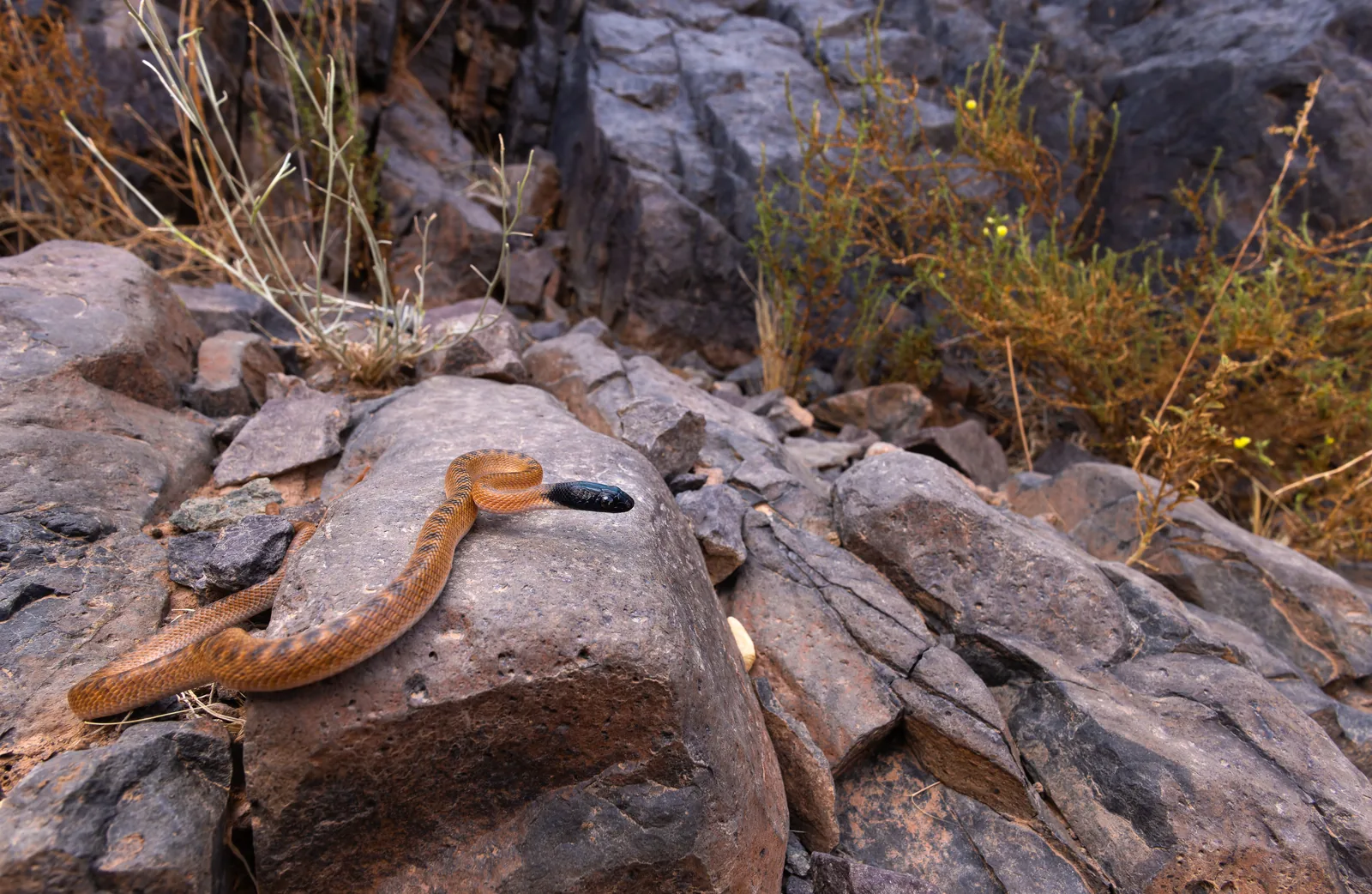
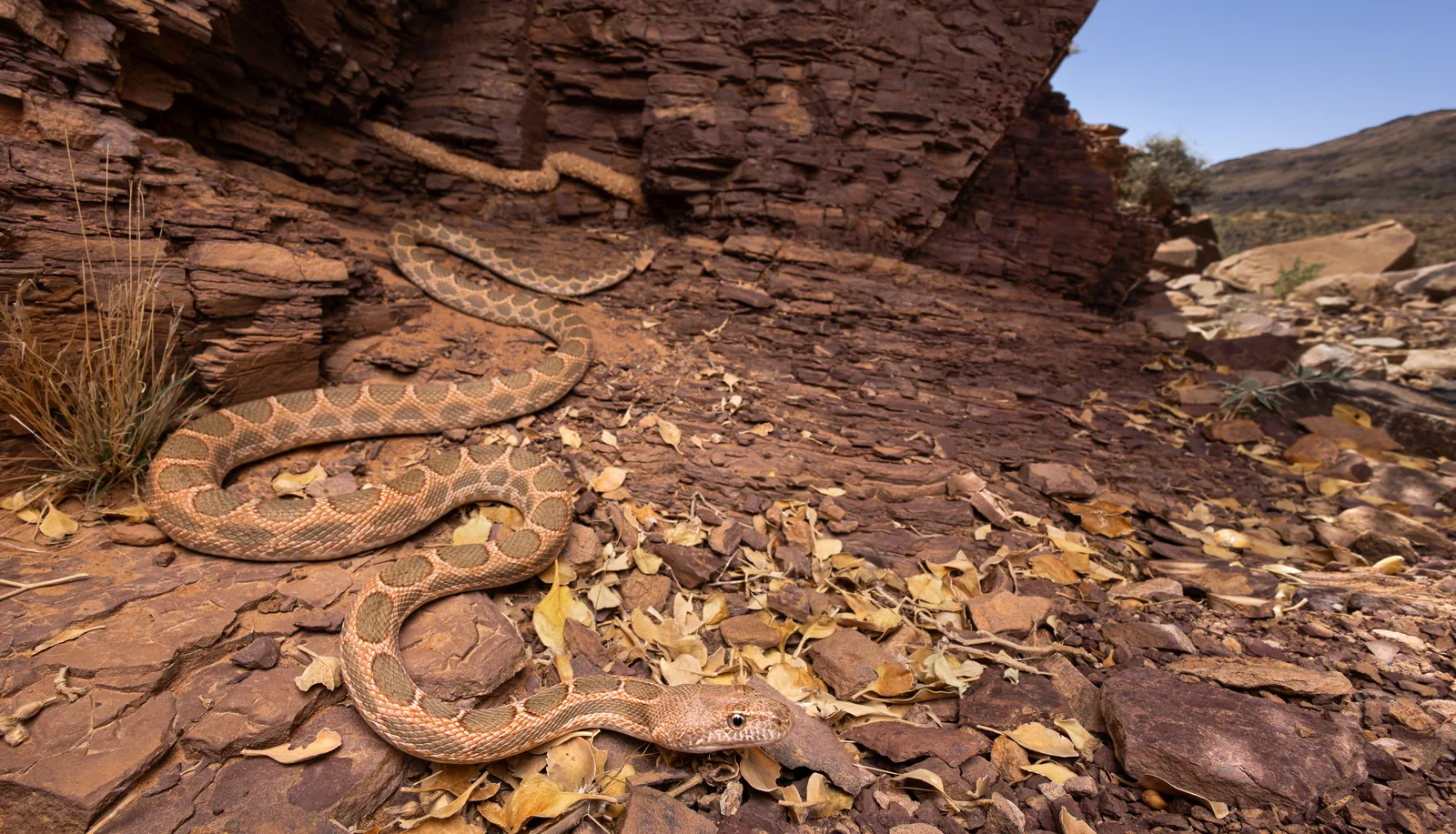
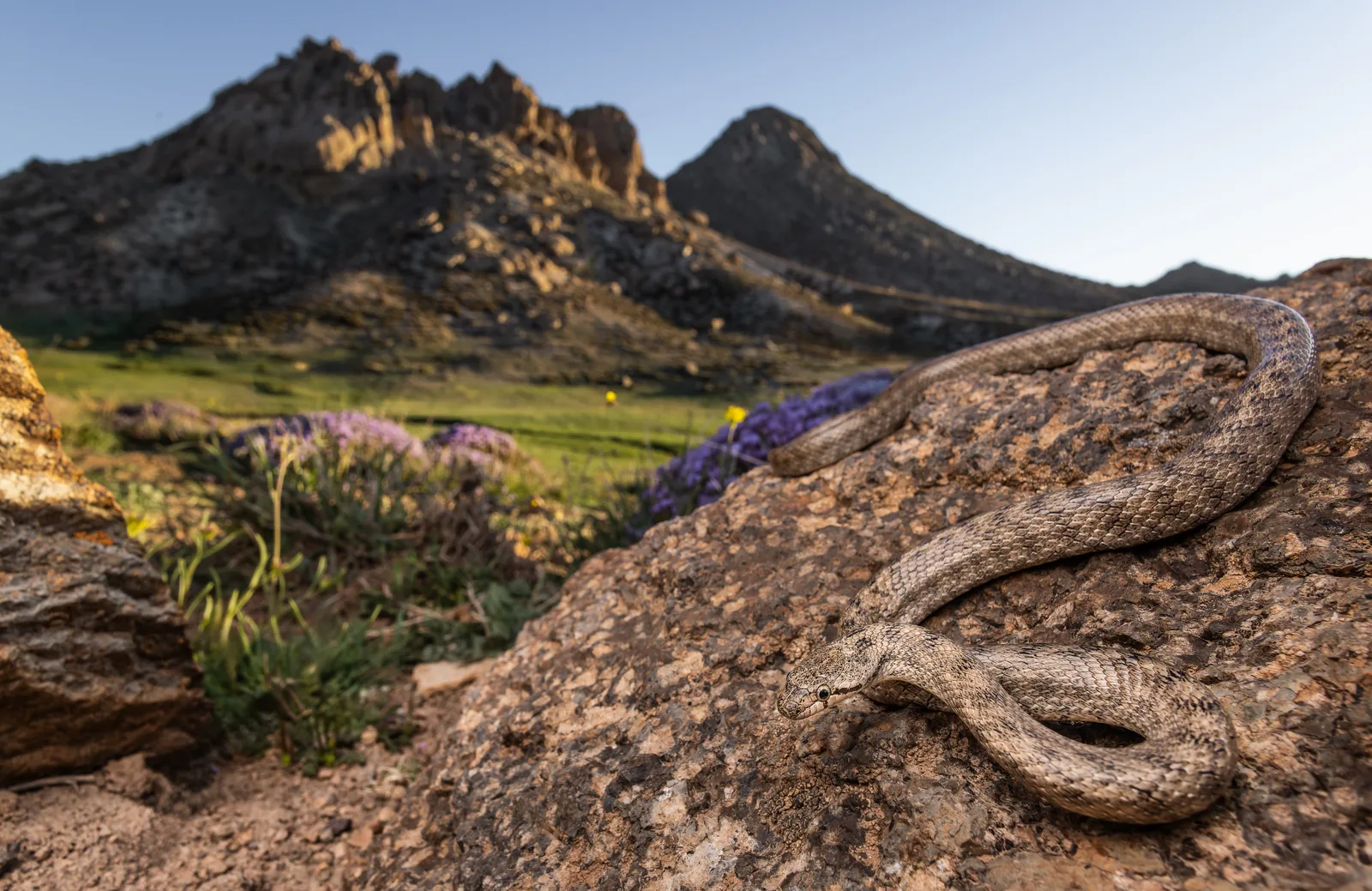 Telescopus tripolitanusNorth African Catsnake
How to identify a colubrid in Morocco
Morocco's twelve Colubrids are harmless. Keep your distance, this guide is for identification, not to encourage the handling of harmless species.
1 Is it really a colubrid?
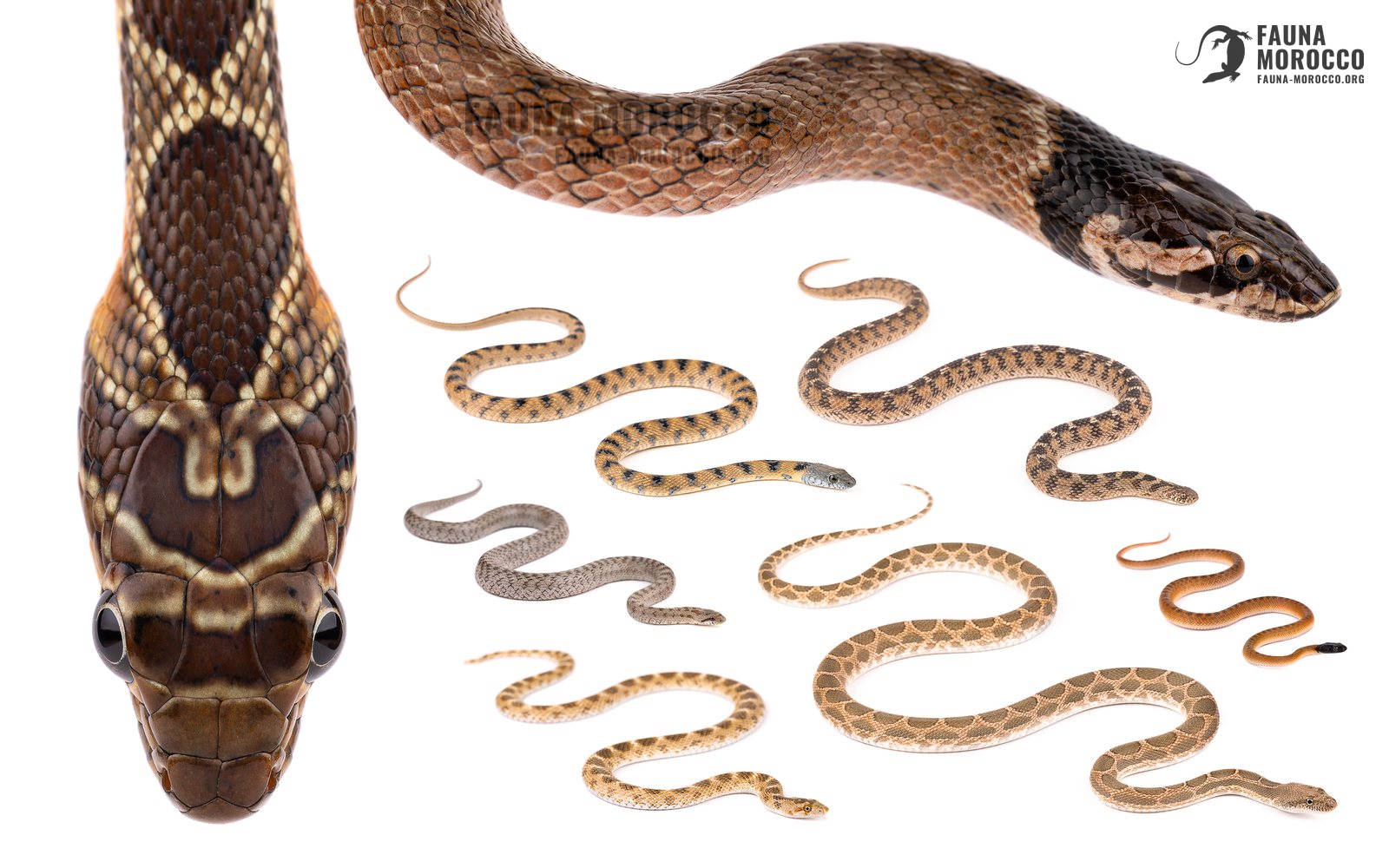 COLLAGE: Three quick checks
Three quick checks
- Large, symmetrical plates on top of the head
- Round pupil in most species
- Slender body, often fast and alert
2 Which group?
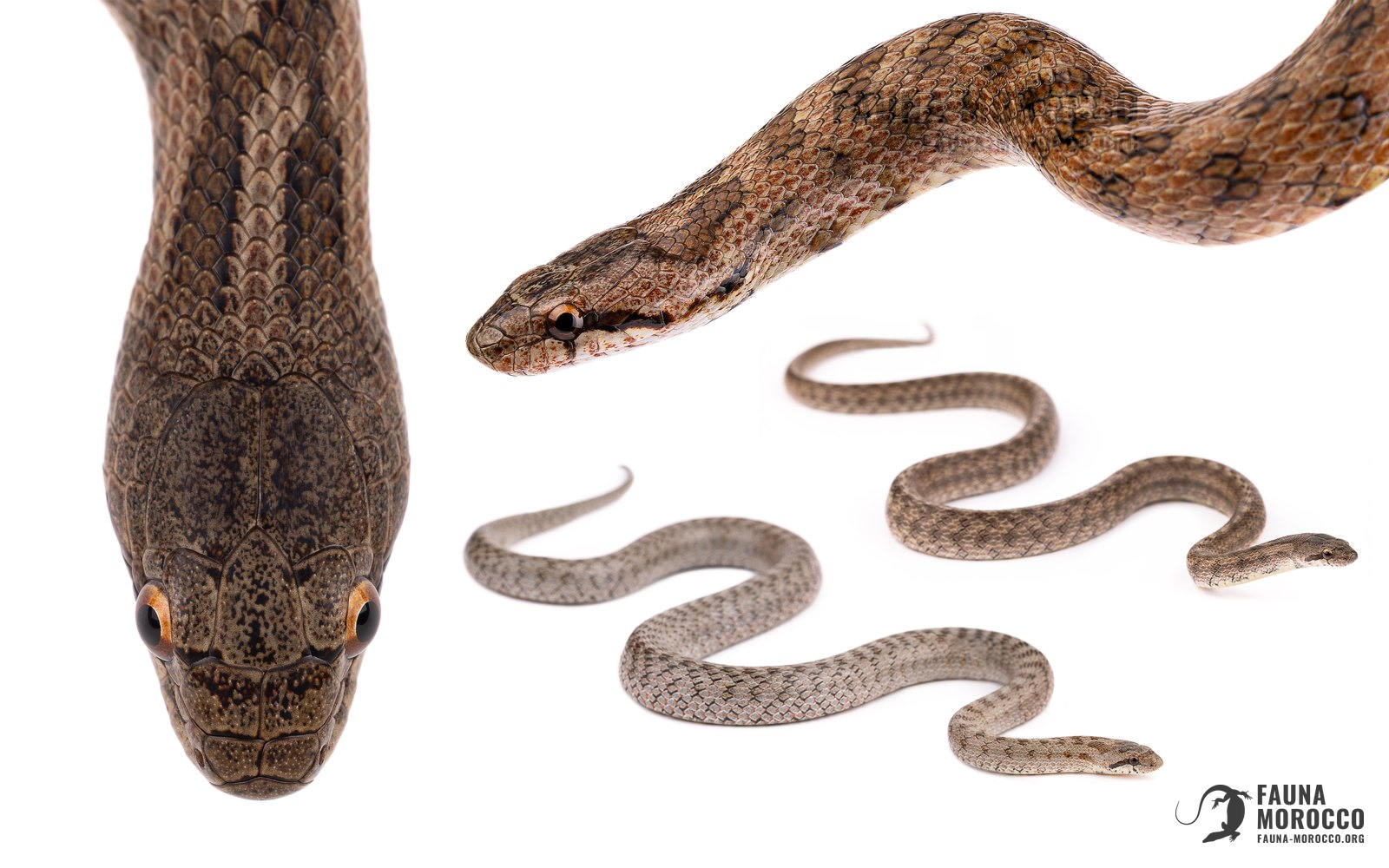
Smooth Snake
Coronella · 1 species
- Rounded snout, triangular scale at the snout tip
- Small dark blotches all over the body
- Dark line joining the eyes across the head
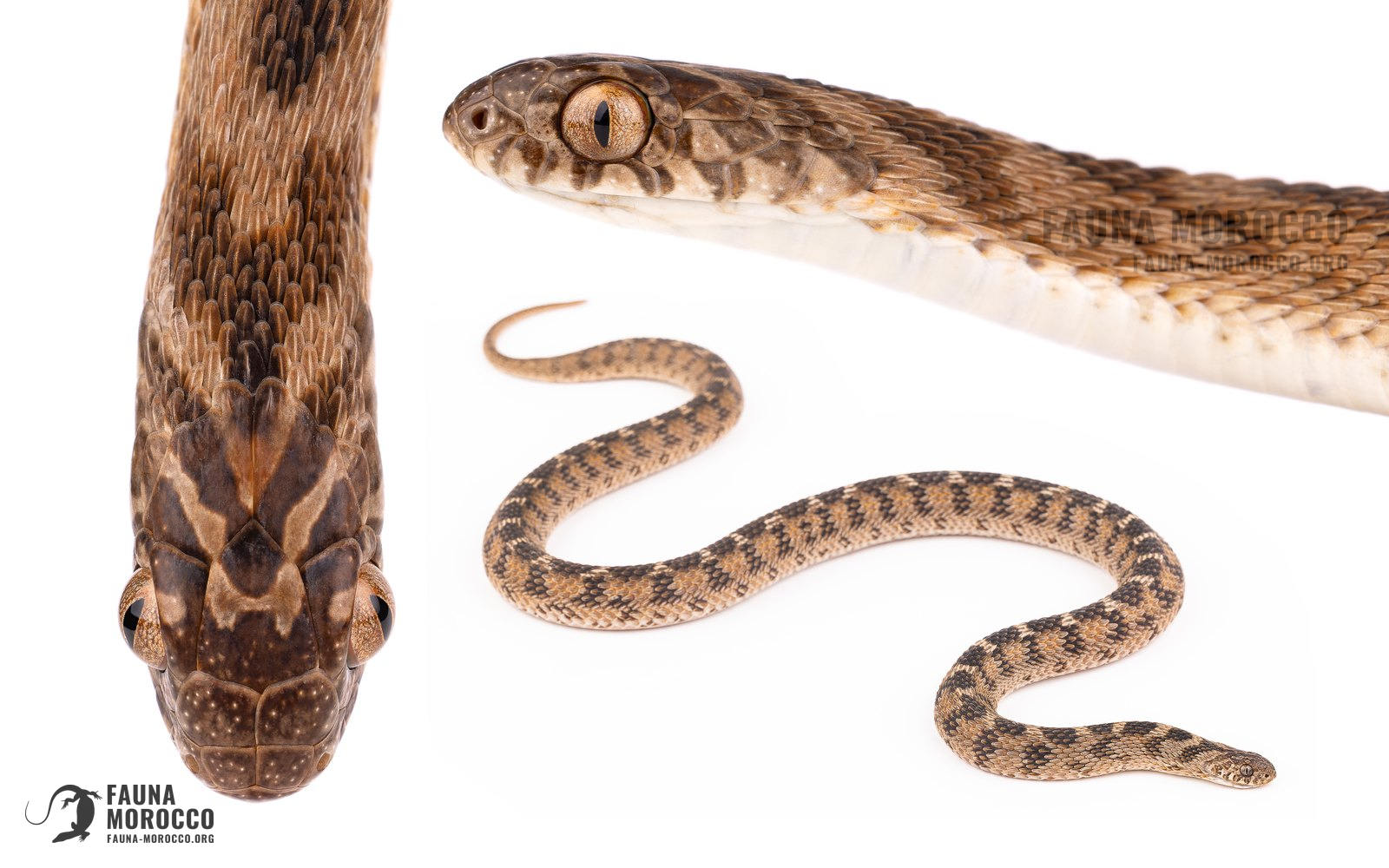
Egg Eater
Dasypeltis · 1 species
- Strongly rounded snout, head narrower than the body
- Alternating black and white markings on the back
- Keeled scales that rasp when coiled
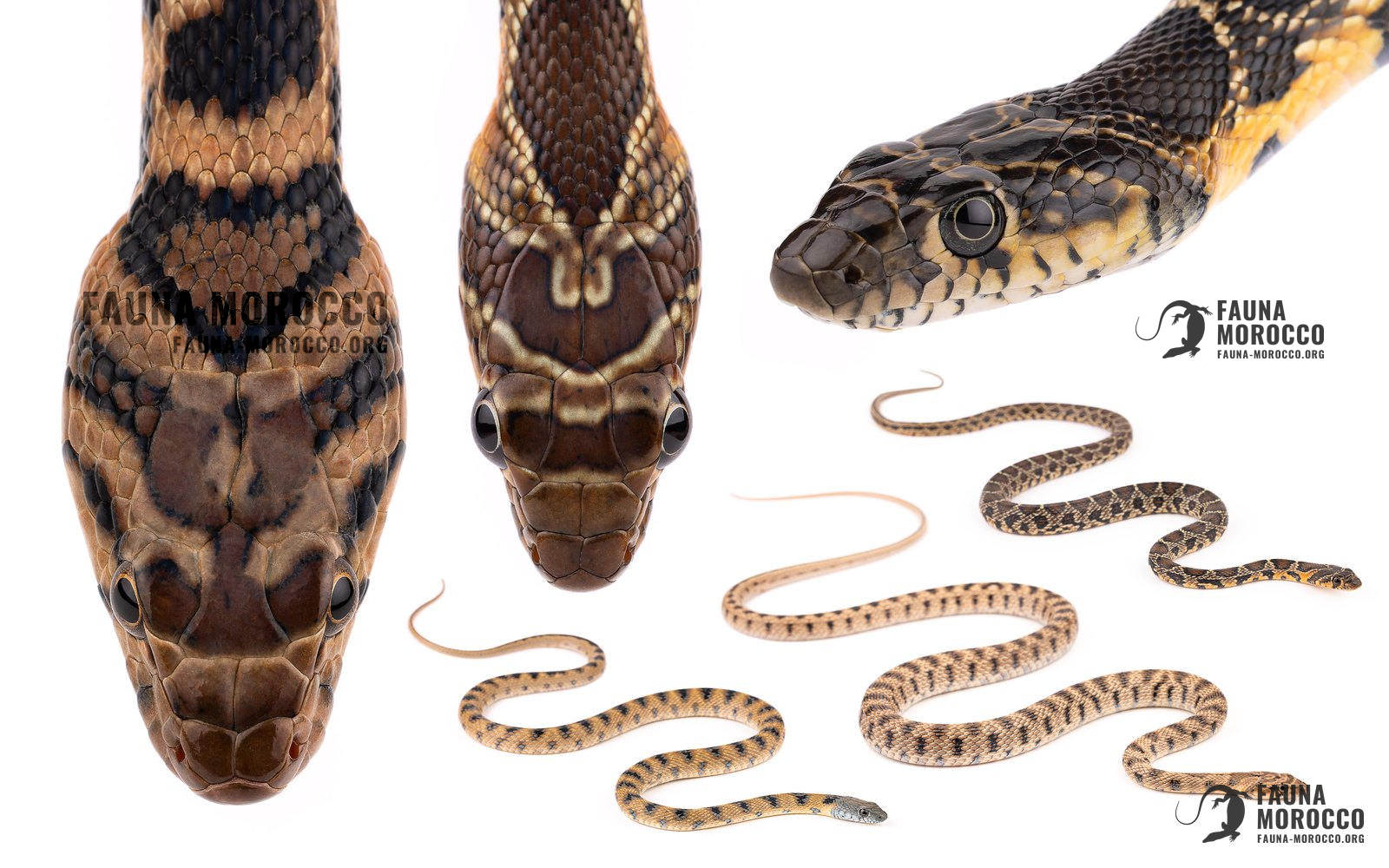
Whip Snakes
Hemorrhois · 2 species
- Unbroken dark line along the top of the tail
- Regular dark blotches along the back
- Large and powerful, often over a metre
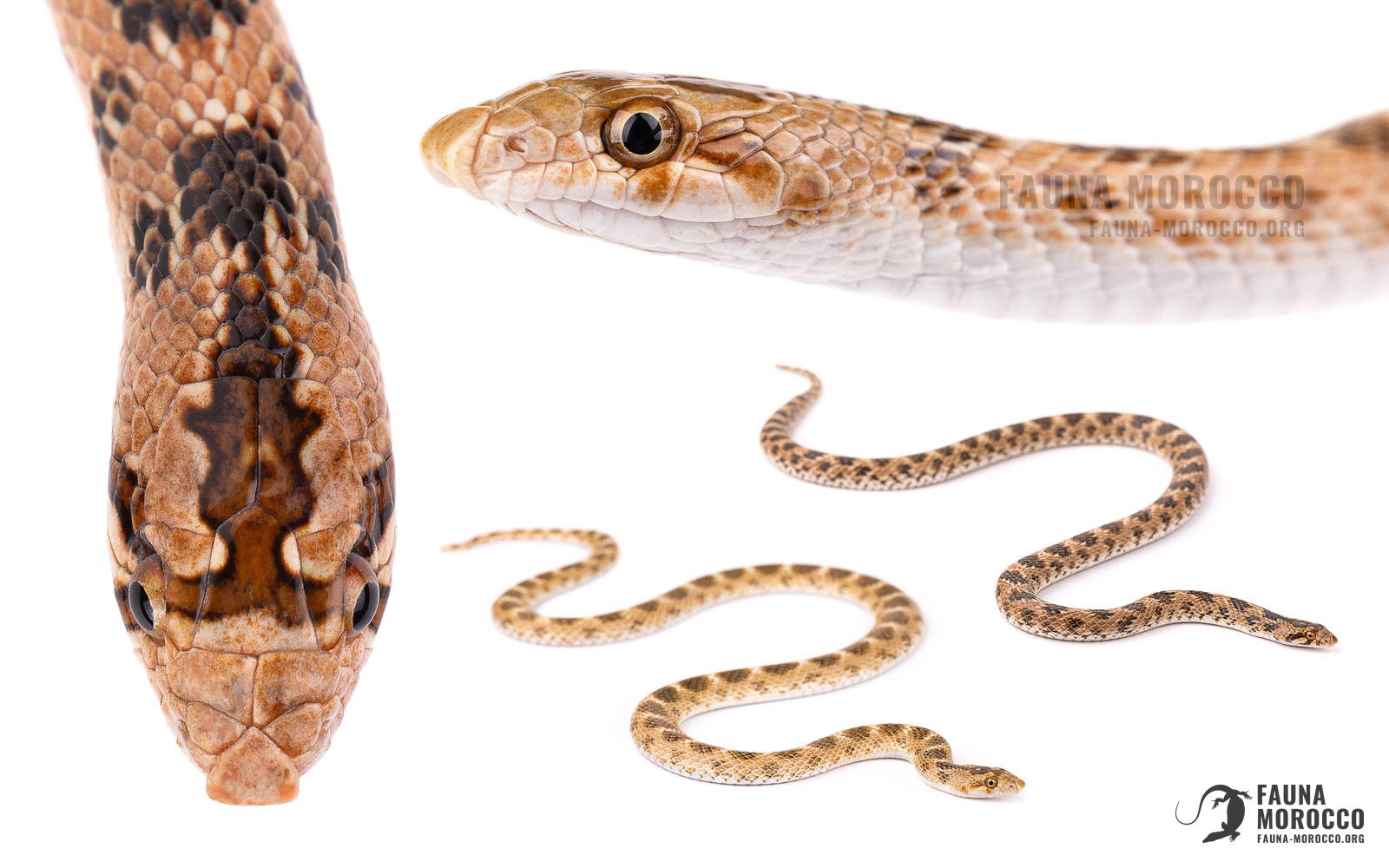
Awl-headed Snake
Lytorhynchus · 1 species
- Prominent shovel-like snout scale
- Sandy coloration with dark saddle blotches
- Small, under 50 cm
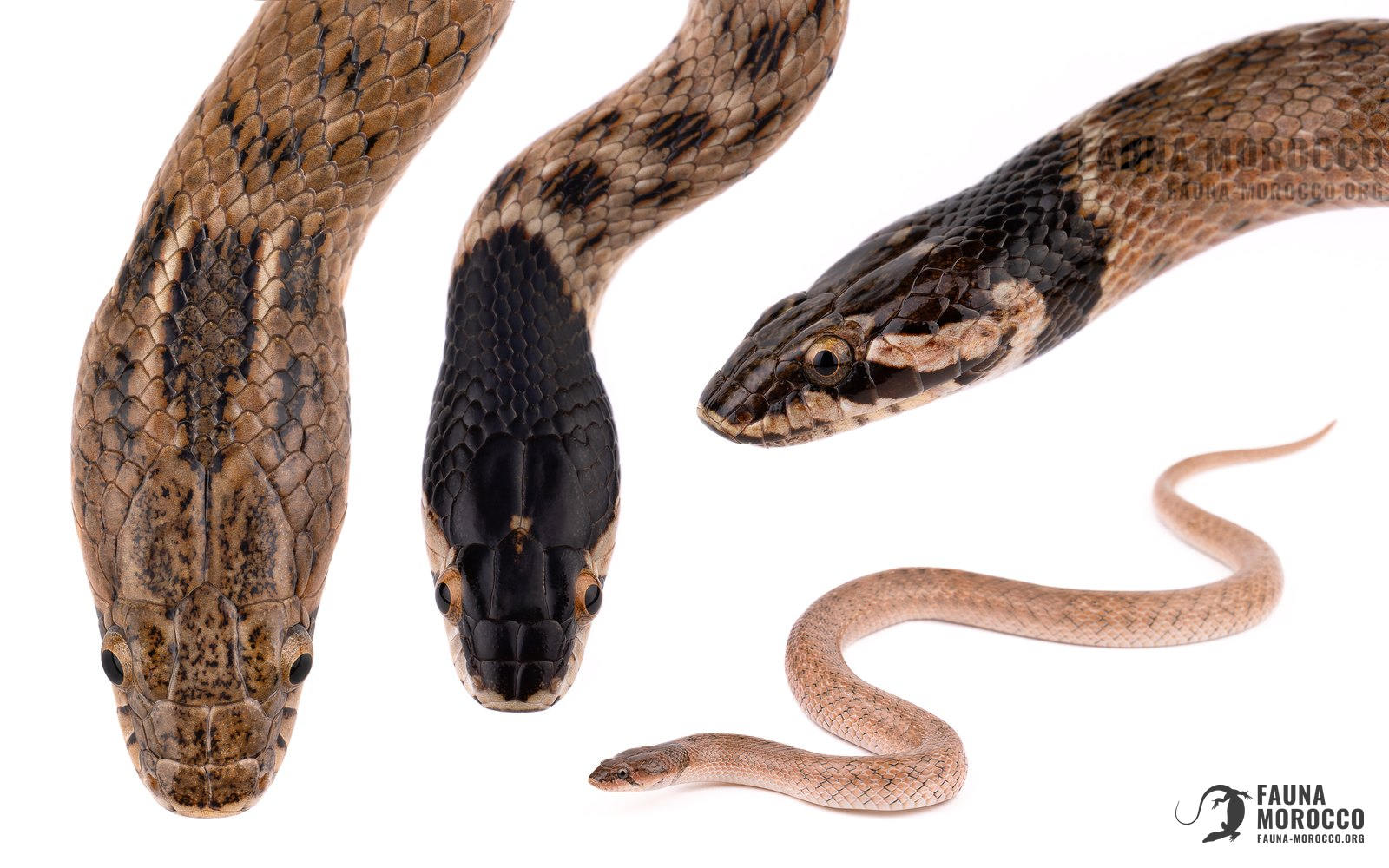
False Smooth Snakes
Macroprotodon · 2 species
- Dark collar behind the head
- Pale upper lip, often a dark line behind the eye
- Flat snout, no triangular scale at the tip
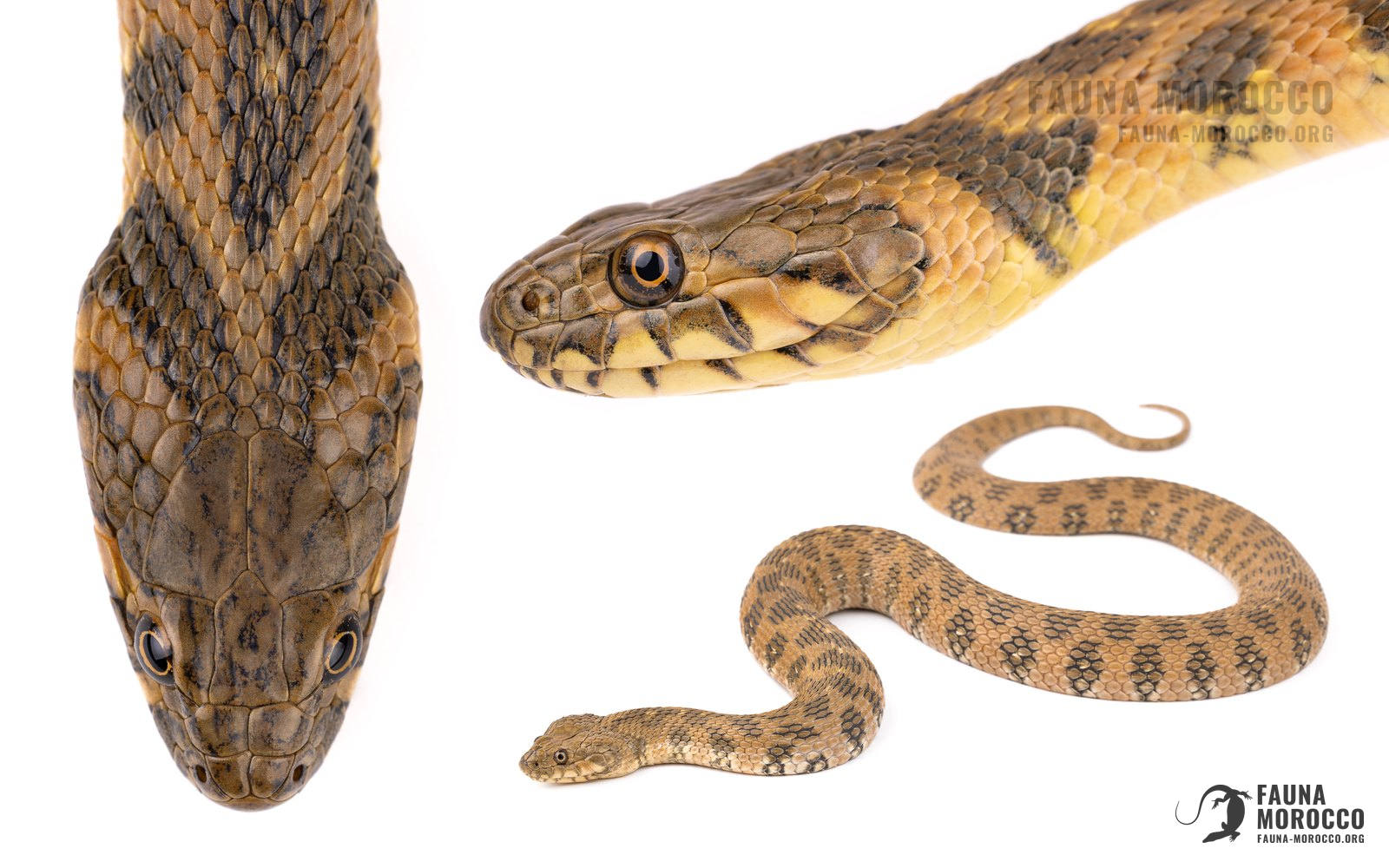
Water Snakes
Natrix · 2 species
- Keeled scales, dull when out of water
- Large eyes
- Viperine Water Snake: zigzag along the back
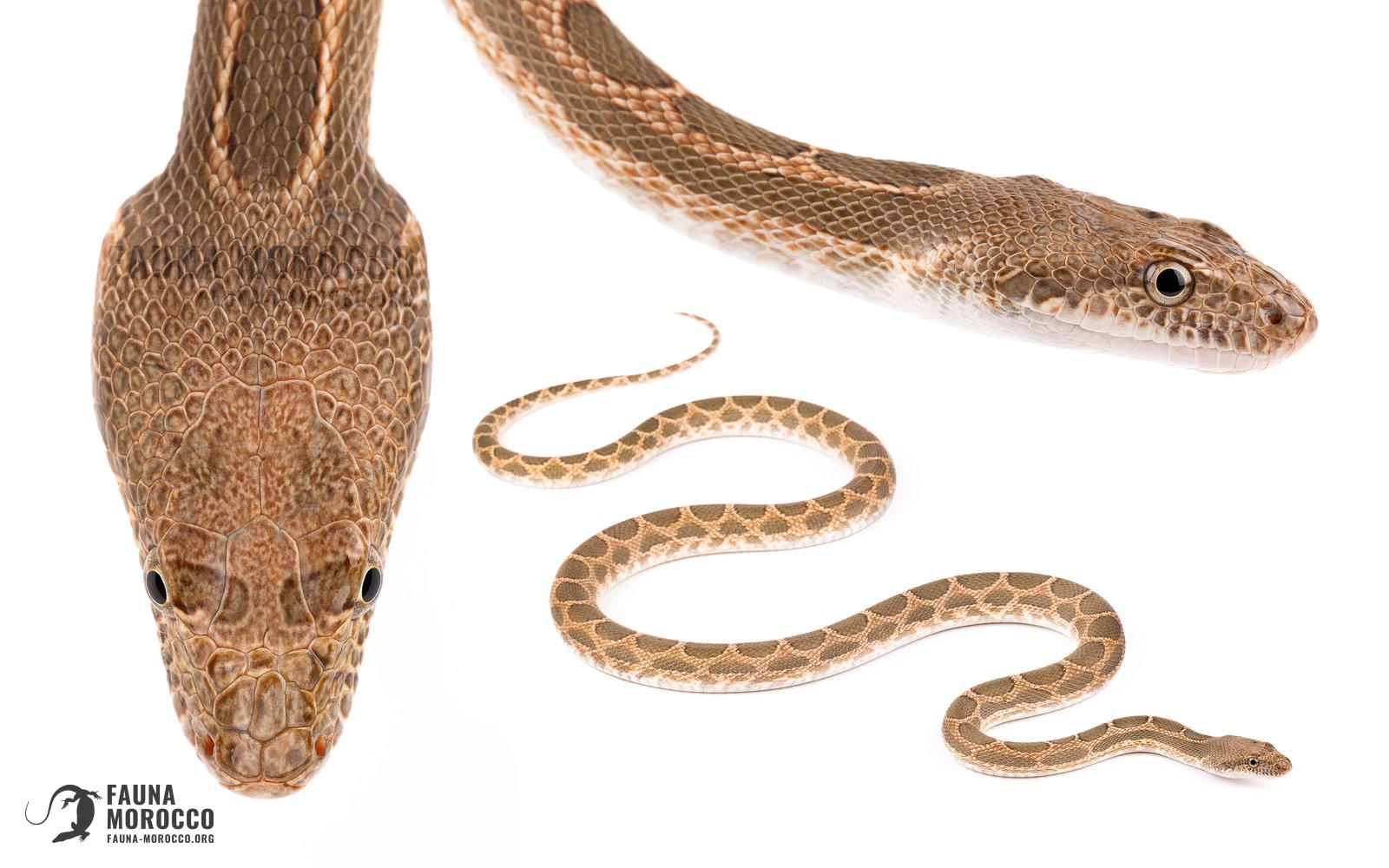
Diadem Snakes
Spalerosophis · 2 species
- Many small scales below the eye
- Large, round eyes
- Robust body, blotched or banded
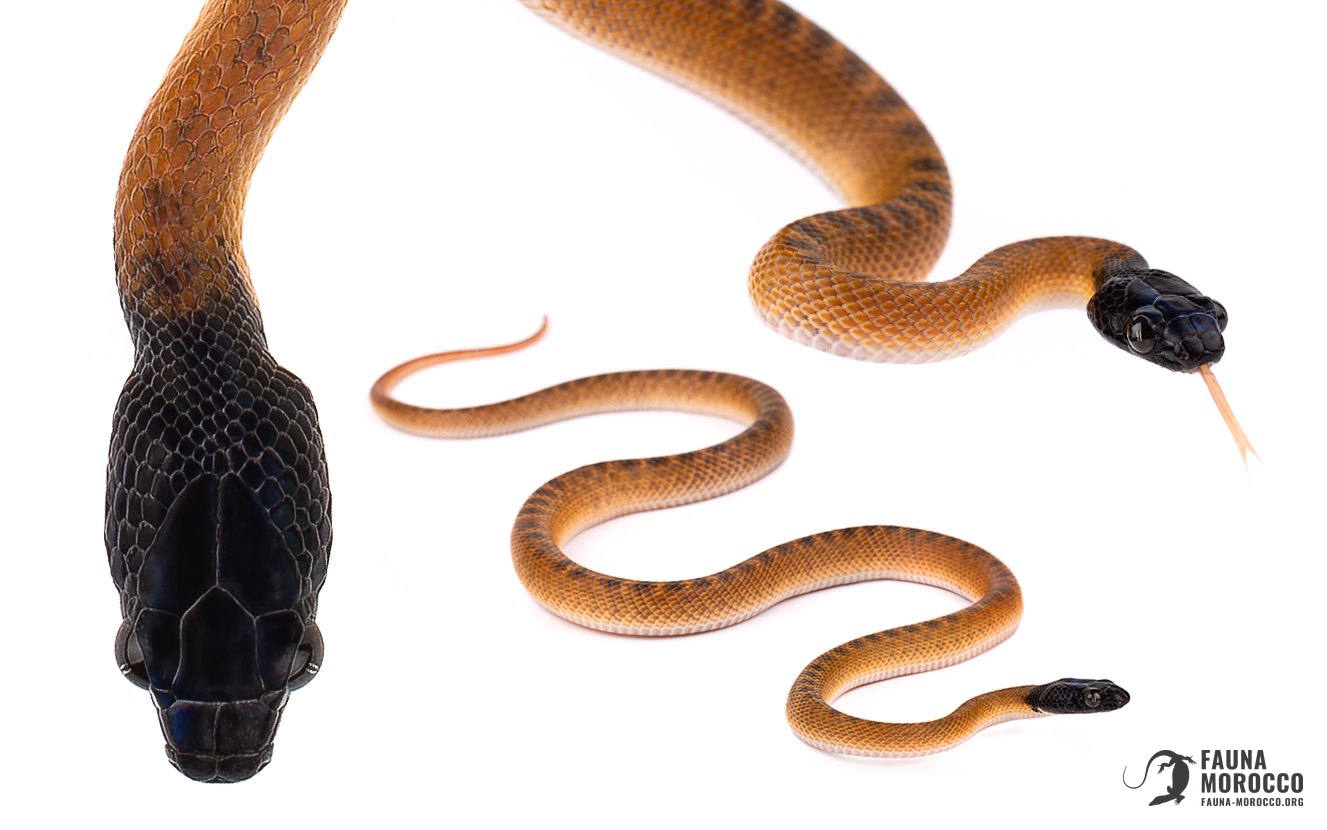
Catsnake
Telescopus · 1 species
- Vertical pupil, large eye
- All-black head
- Sandy body with dark crossbars
Venomous or harmless?
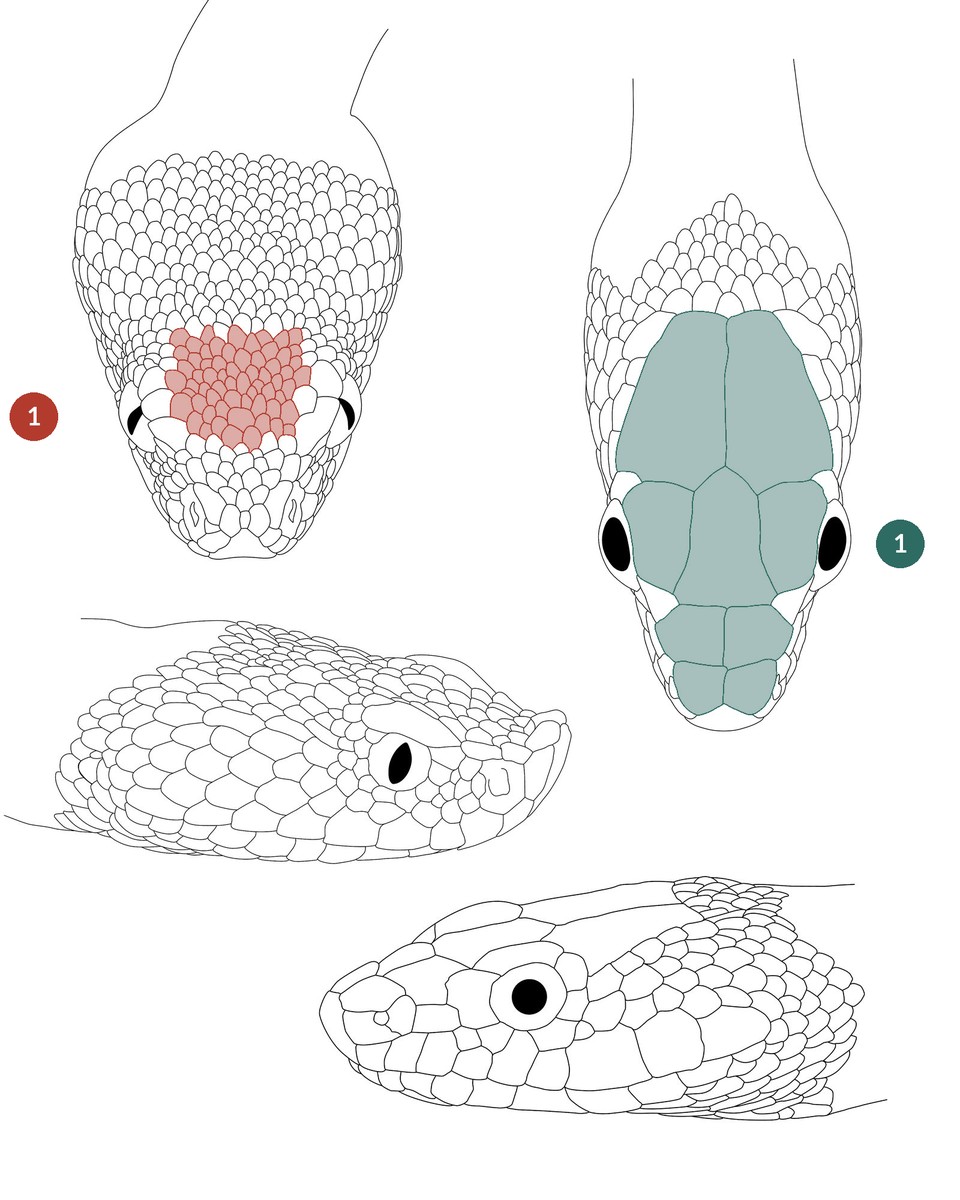
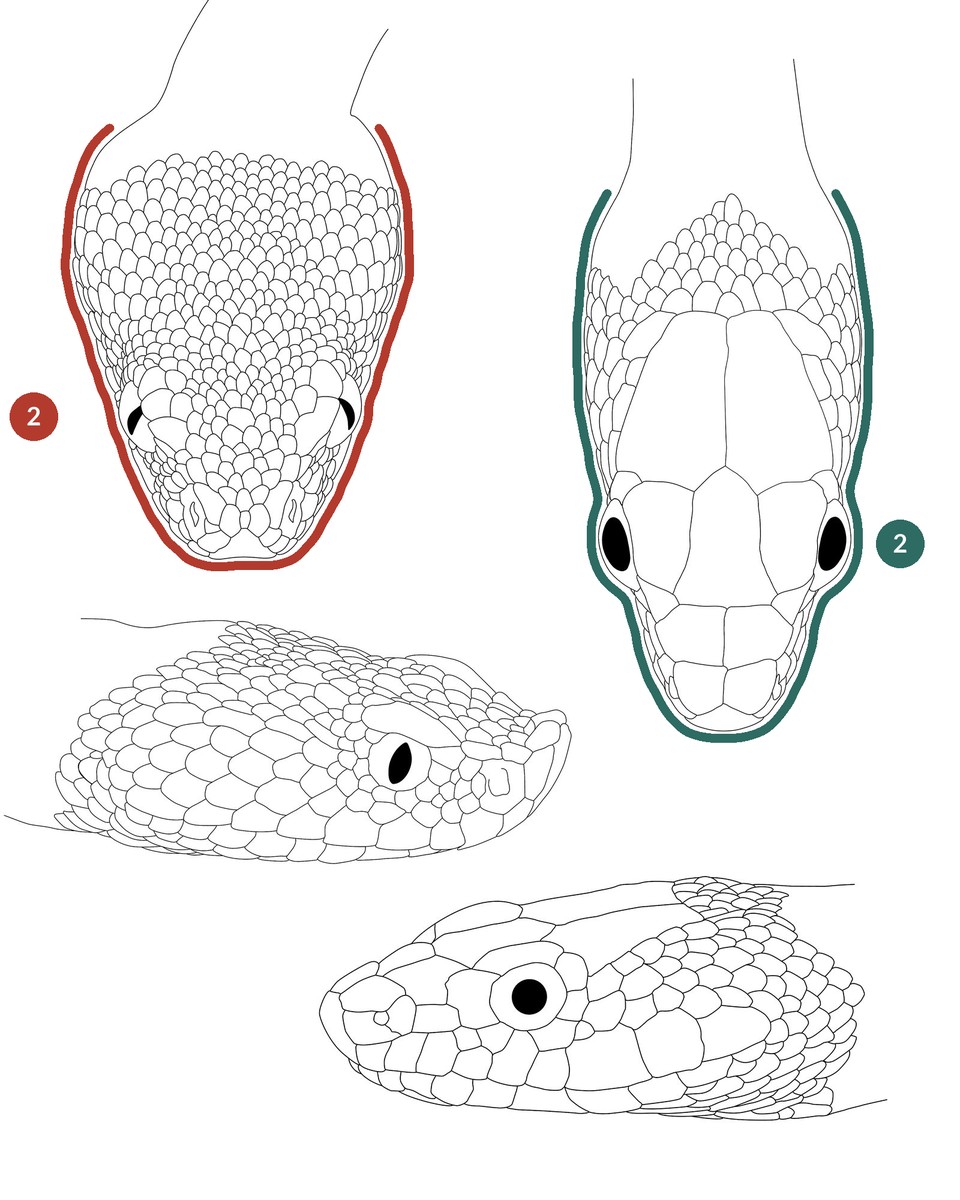
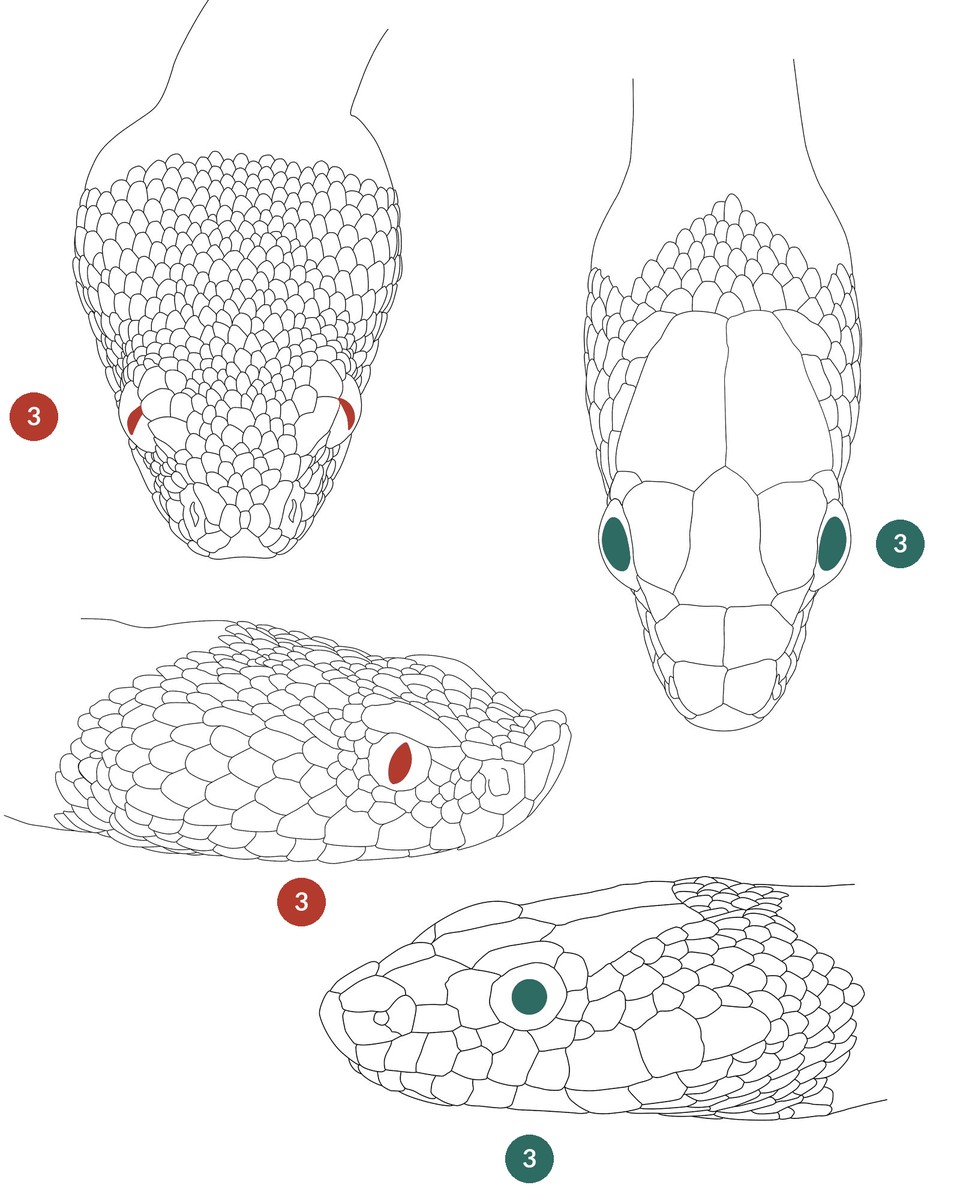
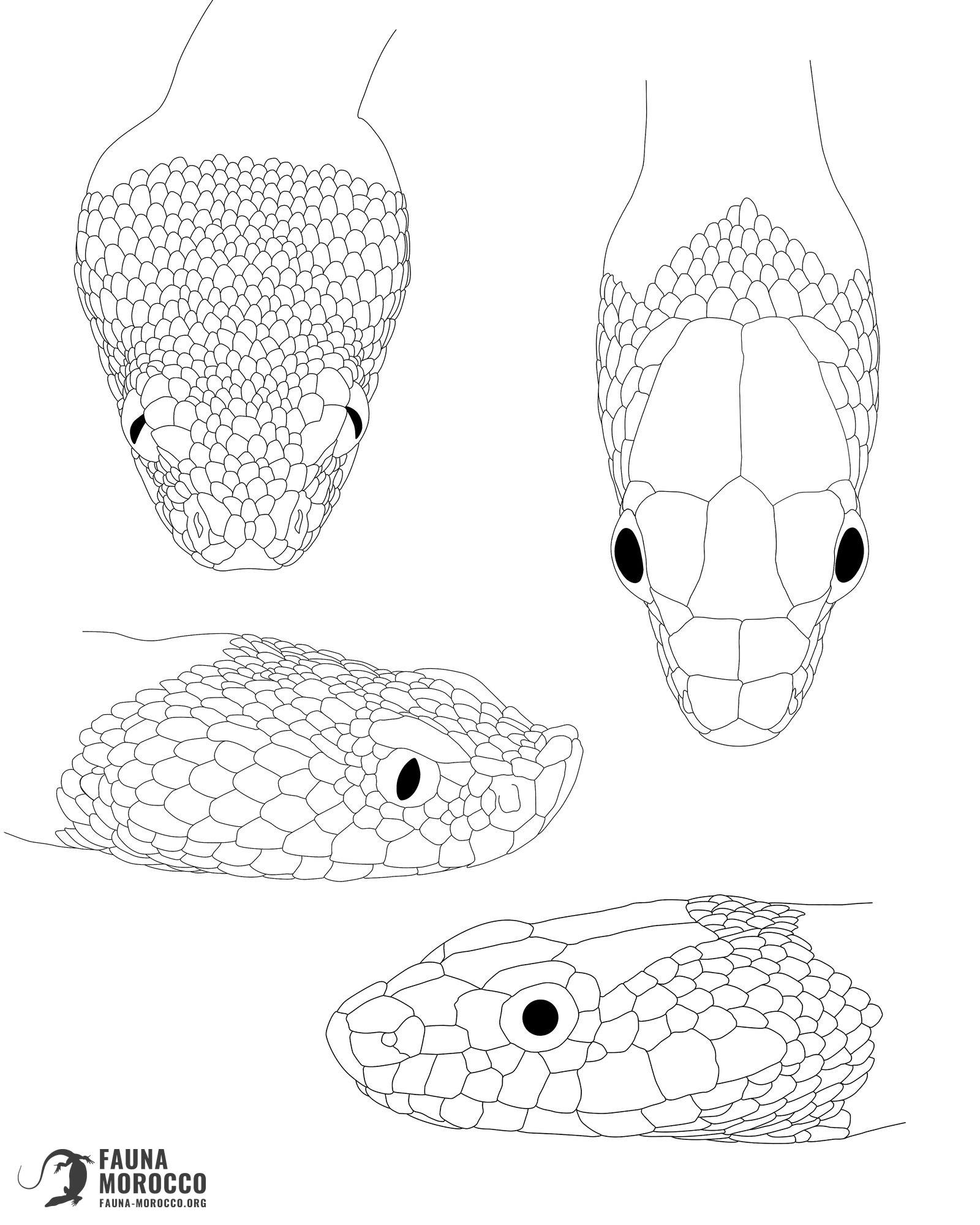
Colubrids of Morocco
Are colubrids dangerous? Are any of them venomous?
No. Morocco's 12 colubrid species are all harmless to people. A few of them, the two False Smooth Snakes, the Southern Smooth Snake and the North African Catsnake, have small fangs set at the back of the mouth and a very weak venom that works on lizards, not on humans. To check whether a snake you have seen is non-venomous, use our venomous or harmless guide.
How do I tell a colubrid from a viper?
Look at the top of the head and at the eye. Colubrids carry a few large, symmetrical plates on the crown, a slim body and, in most species, a round pupil. Vipers have many small irregular head scales, a broad triangular head and a vertical, slit-like pupil.
One exception is worth knowing: the North African Catsnake (Telescopus tripolitanus) is a harmless colubrid with a vertical pupil, so the head scales stay the most reliable clue. Our identification guide and venomous or harmless guide walk you through it.
Which snake is in my garden or in the walls of my house?
In most of the north it is the Horseshoe Whip Snake (Hemorrhois hippocrepis), a fast, harmless colubrid that follows rodents into gardens, ruins and old walls, and in the south its counterpart the Algerian Whip Snake (Hemorrhois algirus). They bluff loudly when cornered and can bite if grabbed, but they are not venomous and are completely harmless.
Give the animal a clear way out, keep children and pets back, and it will leave on its own. Killing it is illegal under law 29-05.
There is a snake in the river or in the pool. Is it a water viper?
Almost certainly not. The Viperine Water Snake (Natrix maura) is a harmless colubrid that hunts fish and tadpoles and carries a zigzag pattern along the back. When threatened it flattens its head, hisses and strikes with a closed mouth, a pure bluff that has earned it its name and a great deal of undeserved killing.
In the far north you may also meet the Red-eyed Grass Snake (Natrix astreptophora), which plays dead instead.
How many colubrids live in Morocco, and which ones?
Twelve species in eight genera, the largest snake family in the country: two whip snakes, two water snakes, two diadem snakes, two False Smooth Snakes, the Southern Smooth Snake, the Awl-headed Snake, the Sahel Egg Eater and the North African Catsnake. The full list, with Arabic names, is in the checklist on this page.
Is there really a snake that eats only eggs?
Yes. The Sahel Egg Eater (Dasypeltis sahelensis) swallows bird eggs whole, cracks them on bony spines inside its spine, then spits out the shell. It has almost no teeth and cannot hurt you. Its defence is theatre: it coils, rubs its scales together to make a rasping sound and strikes with an empty mouth, a very convincing viper impression.
What is the largest colubrid in Morocco?
The Horseshoe Whip Snake and the diadem snakes (Spalerosophis sp.) are the bulkiest, and large adults can approach 1.5 metres. The longest snakes in the country are not colubrids: they are the Montpellier Snakes (Malpolon sp.), psammophiids that can pass 2 metres.
What should I do if a colubrid bites me?
Clean the wound with soap and water, as you would for any small cut. No antivenom, no tourniquet, nothing to cut or suck. See a doctor if the wound looks infected or if your vaccinations are not up to date. If you are not sure the snake was harmless, treat it as a viper bite and follow the guide on our snakes page.
How do you say "colubrid" in Arabic and Moroccan Darija?
Standard Arabic uses حنش (hanch) for this kind of snake, as opposed to أفعى (af'a) for a viper. In Moroccan Darija a colubrid is l'hanch, and hearing that word rather than lafaa is usually good news. Several species carry their own Darija names, which change from region to region.
Haven’t found an answer to your question?
Ask usThe 12 colubrids of Morocco
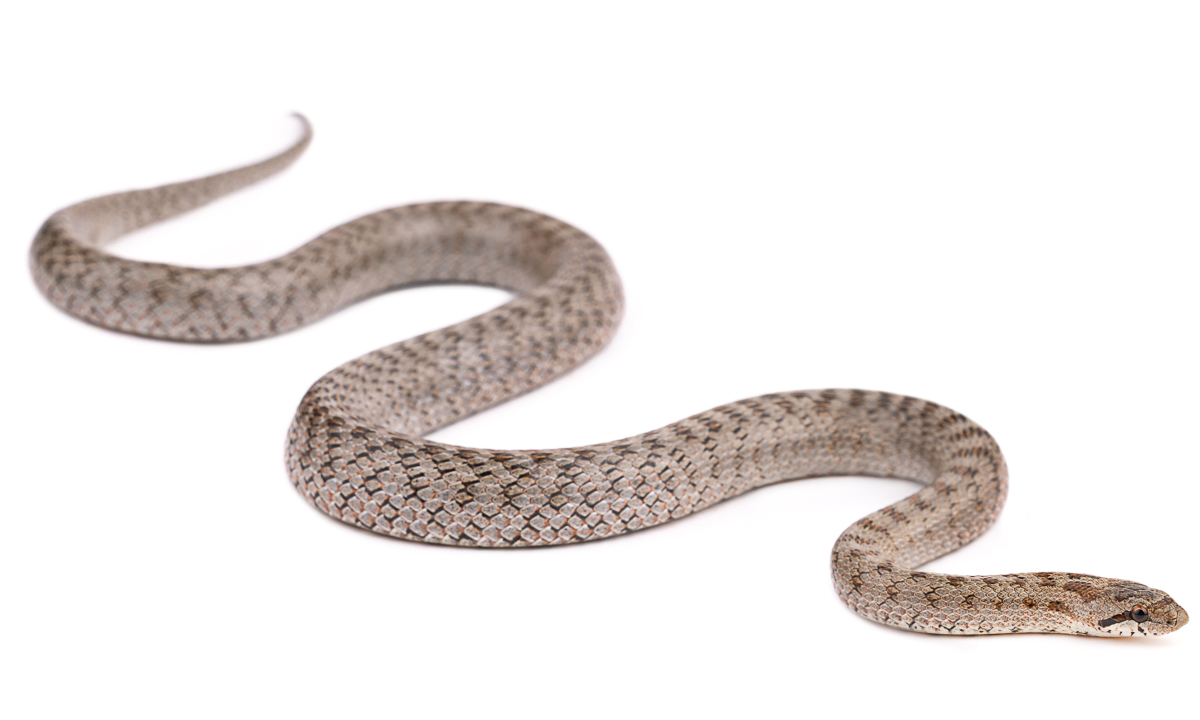
Smooth Snake
Coronella
1 species in Morocco
- Southern Smooth Snake (C. girondica)
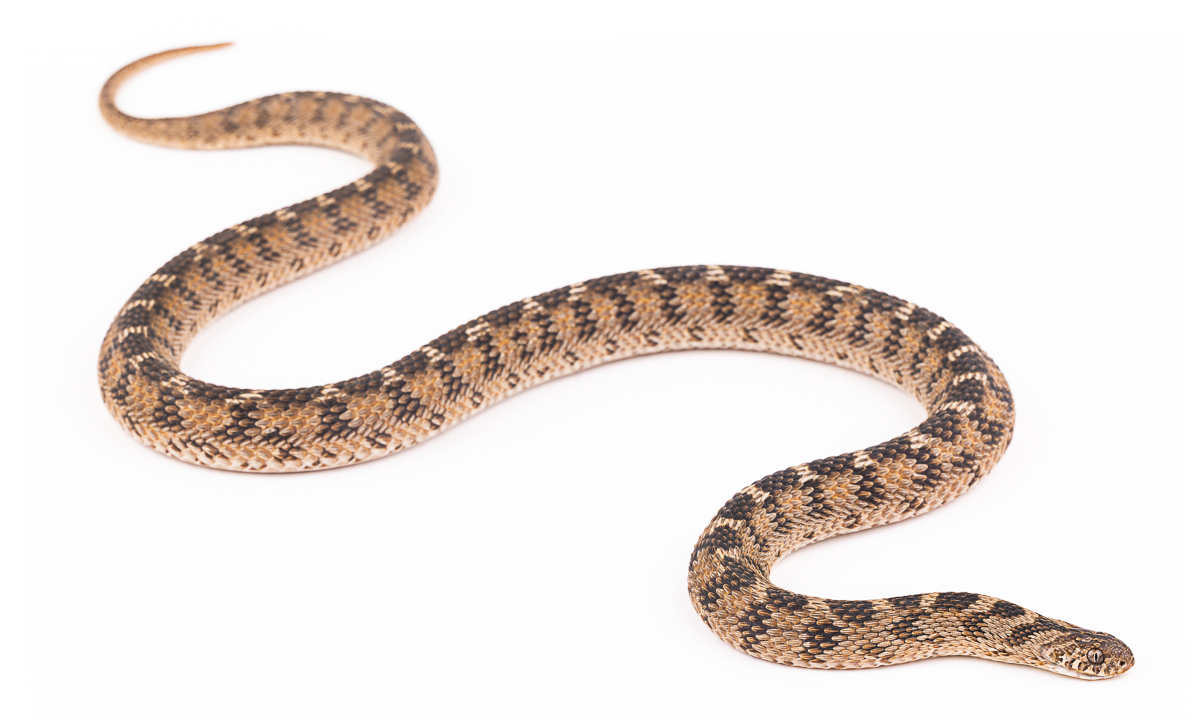
Egg Eater
Dasypeltis
1 species in Morocco
- Sahel Egg Eater (D. sahelensis)
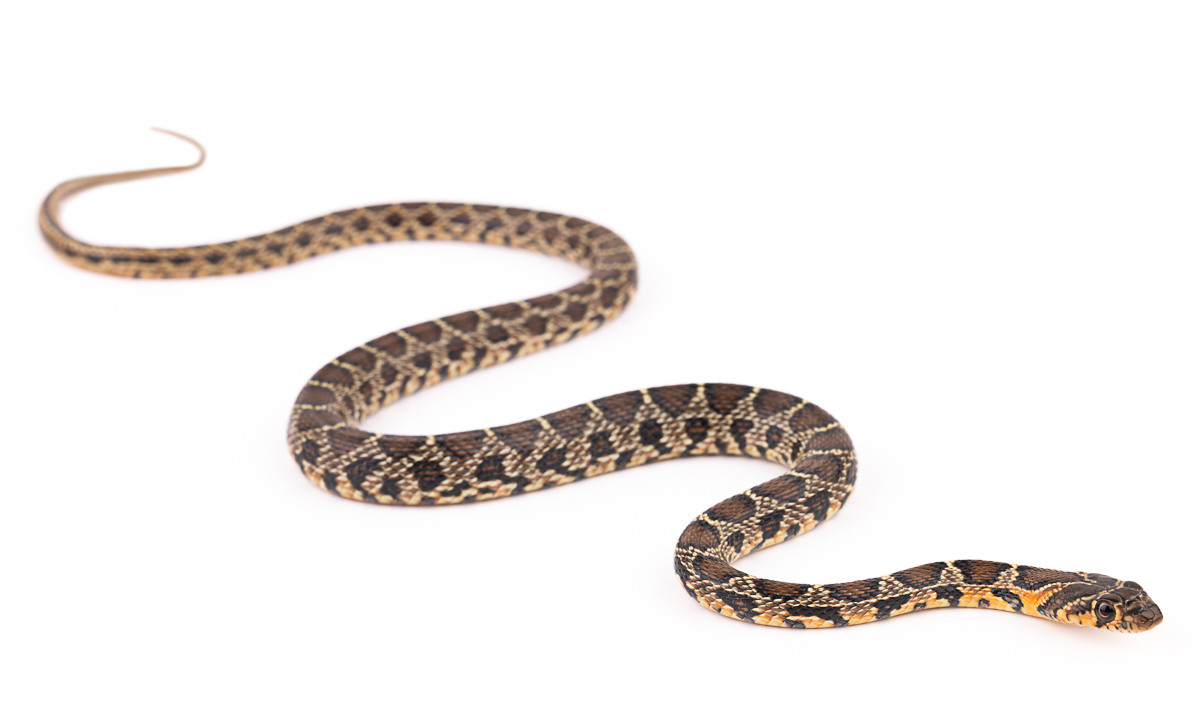
Whip Snakes
Hemorrhois
2 species in Morocco
- Horseshoe Whip Snake (H. hippocrepis)
- Algerian Whip Snake (H. algirus)
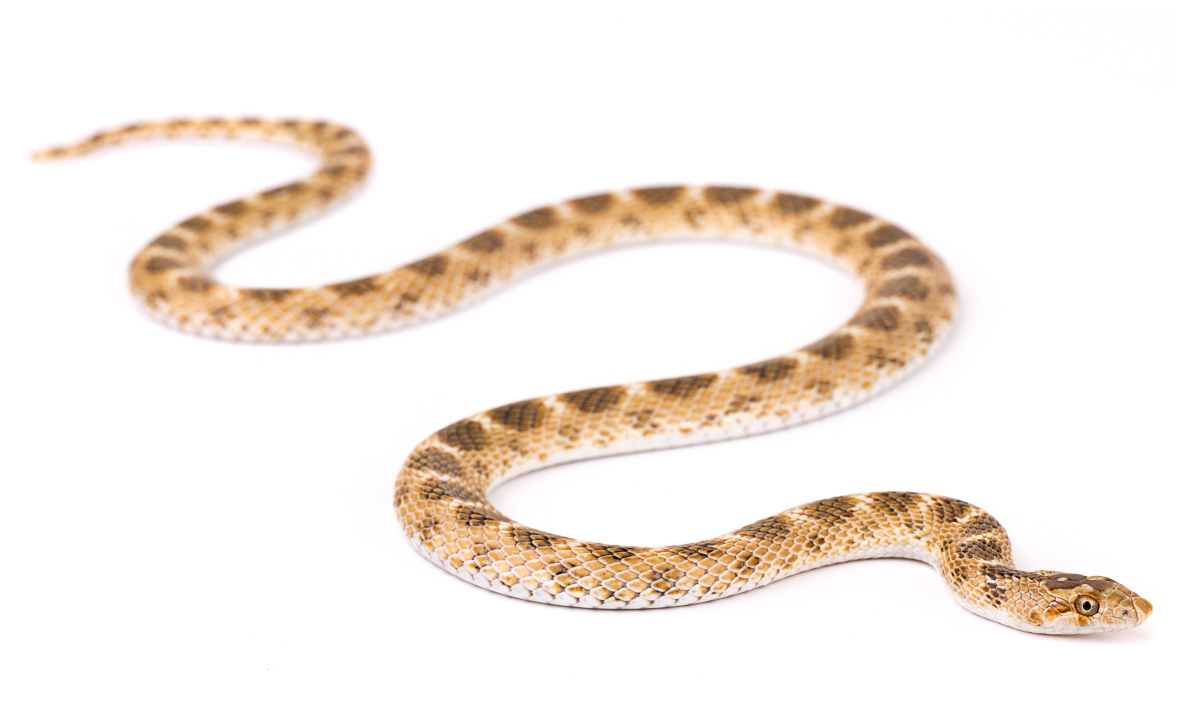
Awl-headed Snake
Lytorhynchus
1 species in Morocco
- Awl-headed Snake (L. diadema)
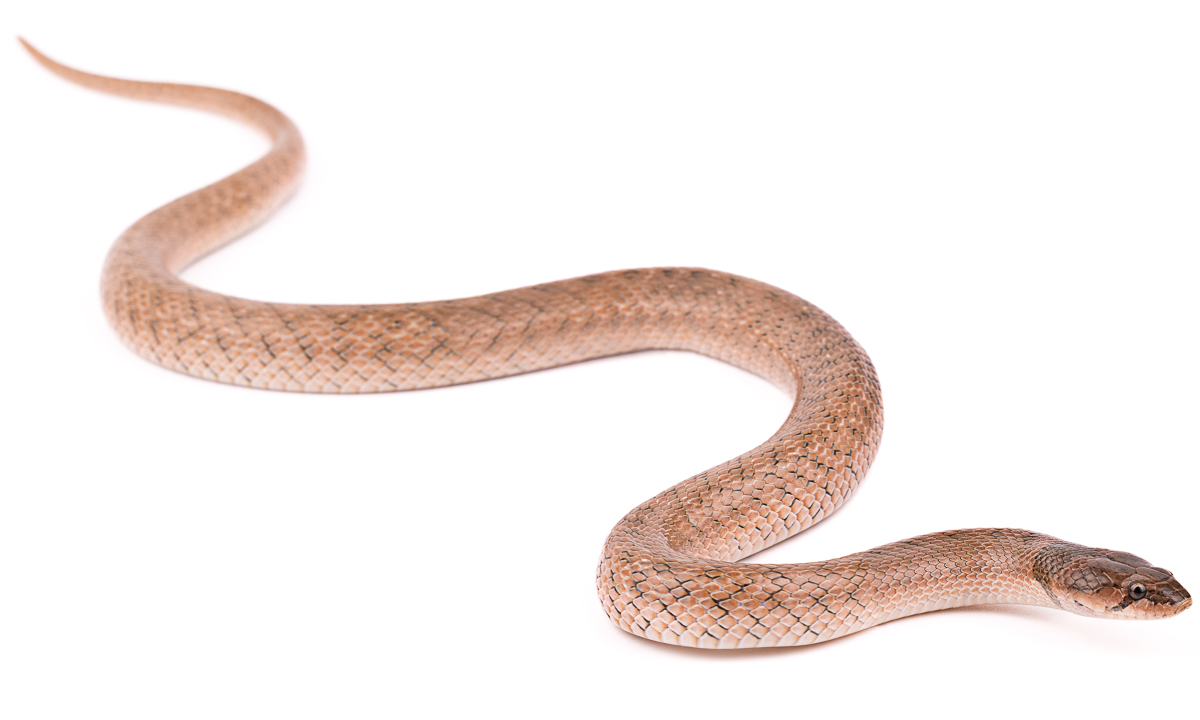
False Smooth Snakes
Macroprotodon
2 species in Morocco
- Western False Smooth Snake (M. brevis)
- Abubaker's False Smooth Snake (M. abubakeri)
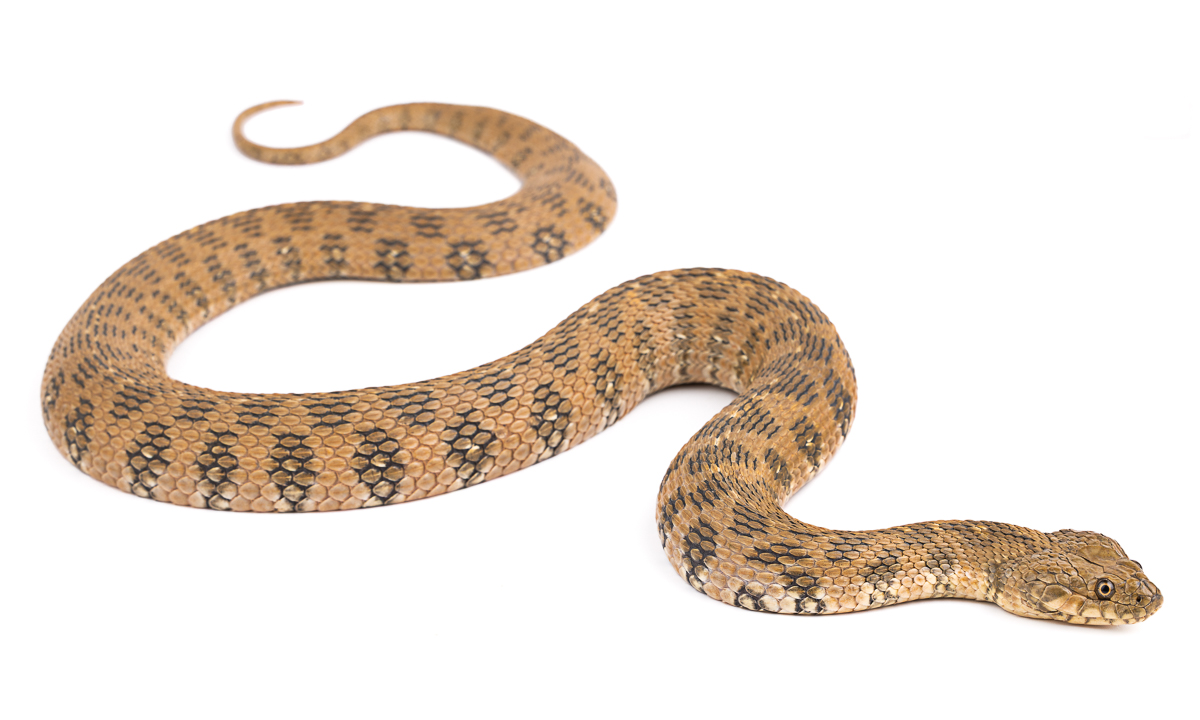
Water Snakes
Natrix
2 species in Morocco
- Viperine Water Snake (N. maura)
- Red-eyed Grass Snake (N. astreptophora)
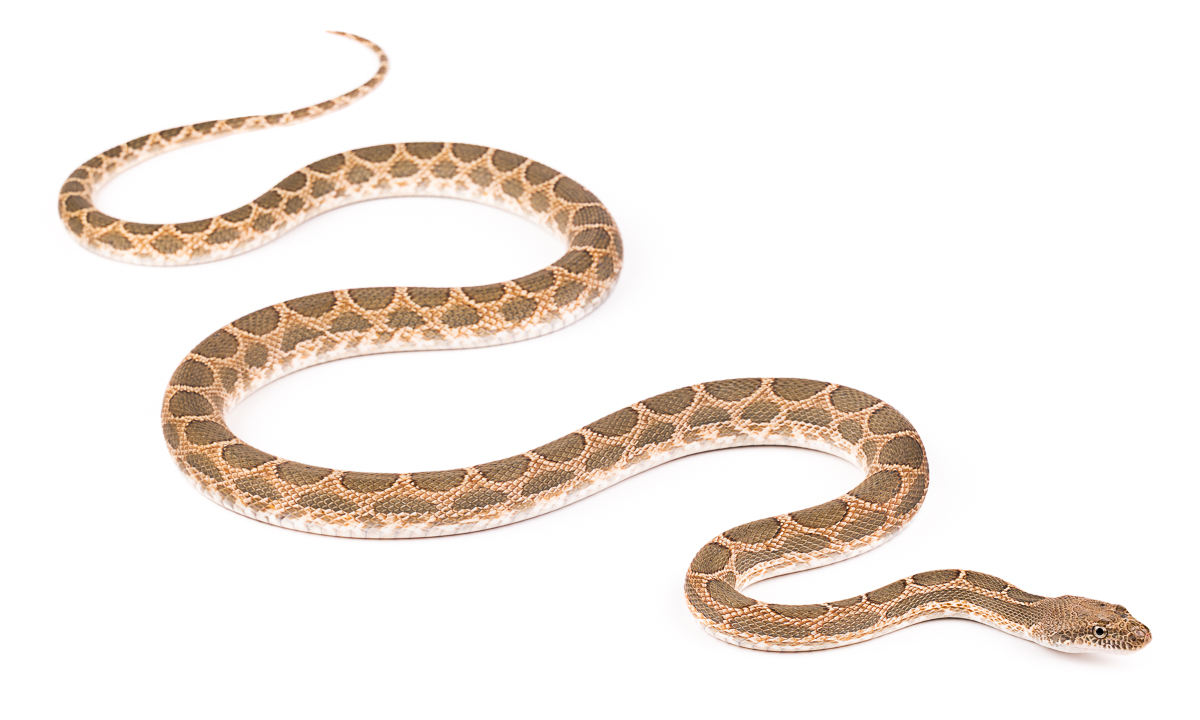
Diadem Snakes
Spalerosophis
2 species in Morocco
- Werner's Diadem Snake (S. dolichospilus)
- Blotched Diadem Snake (S. diadema)
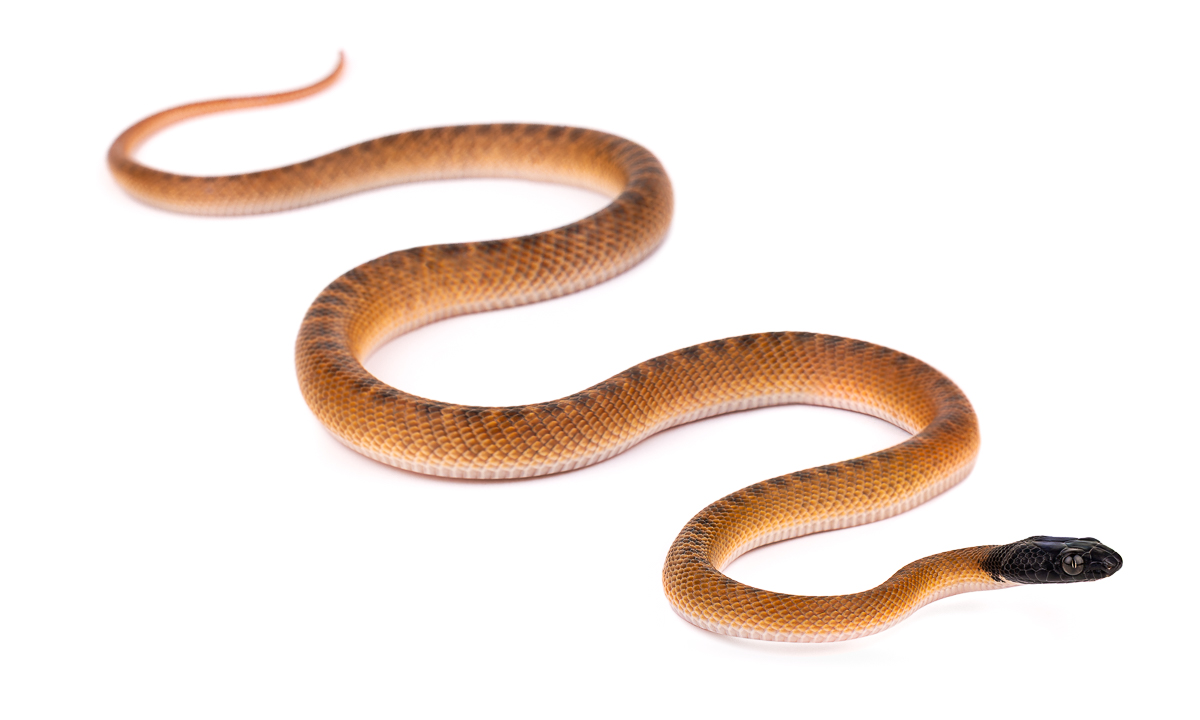
Catsnake
Telescopus
1 species in Morocco
- North African Catsnake (T. tripolitanus)
No species matches that. Try the Latin name, or clear the search.
The full list of Morocco's 12 colubrid species. None is dangerous to people.
Colubridae · 12 species
Coronella girondicaSouthern Smooth Snakeالحنش الأمغرLCComing soonDasypeltis sahelensisSahel Egg Eaterحنش اكل البيضLCComing soonHemorrhois algirusAlgerian Whip Snakeحنش حدوة الحصان الجزائريLCComing soonHemorrhois hippocrepisHorseshoe Whip Snakeحنش حدوة الحصانLCComing soonLytorhynchus diademaAwl-headed Snakeحنش التاج الدفانLCComing soonMacroprotodon abubakeriAbubaker's False Smooth Snakeحنش أبوبكرLCComing soonMacroprotodon brevisWestern False Smooth Snakeالحنش ذو القبعة الغربيLCComing soonNatrix astreptophoraRed-eyed Grass Snakeالحنش المطوقLCNot documentedNatrix mauraViperine Water Snakeحنش الماءLCComing soonSpalerosophis diademaBlotched Diadem Snakeحنش كليفوردLCNot documentedSpalerosophis dolichospilusWerner's Diadem Snakeالحنش الأرقم المغاربيLCComing soonTelescopus tripolitanusNorth African Catsnakeحنش شبيه القطLCComing soonAbout this checklist
Our list follows the most recent reference checklist of Moroccan herpetofauna (Bouazza et al., 2021). We revise and expand it as new studies appear. For a small number of species, we have drawn our own conclusions in light of the latest data (endemism status, species boundaries).