Water Snakes of Morocco
Never far from water
Two snakes of the genus Natrix live in Morocco, and both are completely harmless to humans. The Viperine Water Snake (Natrix maura) is one of the most abundant snakes in the country, found wherever water lasts, from the streams of the Rif to the oases on the edge of the Sahara. The Red-eyed Grass Snake (Natrix astreptophora) is a rare snake of the humid mountains of the north.
Morocco
worldwide
Like most snakes, the Viperine Water Snake is often killed on sight, and its resemblance to vipers, especially the Moorish Viper, only makes matters worse. Cornered, it flattens its head into a triangle, coils and hisses: a bluff that earned it its name, nothing more. If you meet one, leave it alone and let it go on its way.
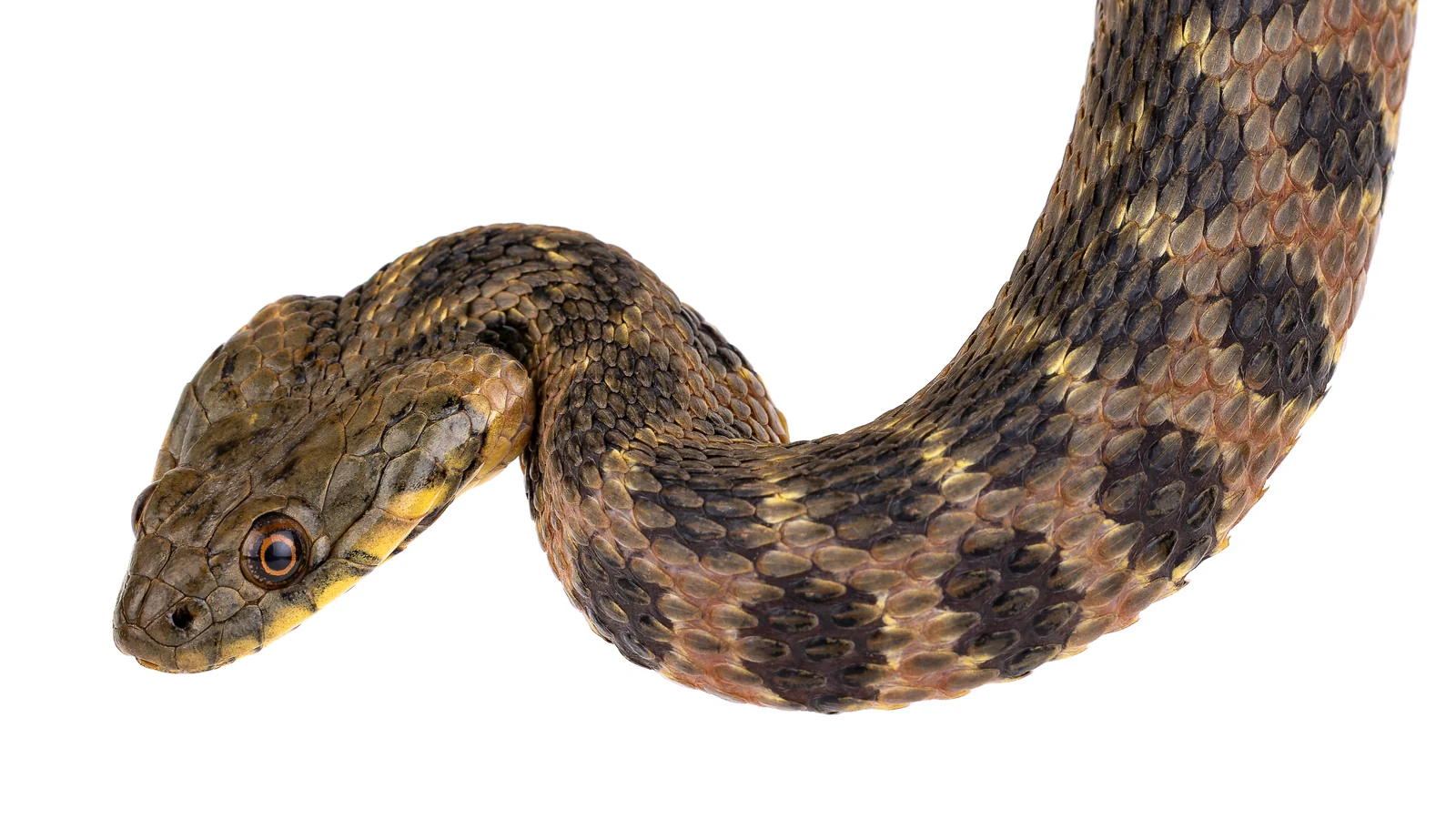 Natrix mauraViperine Water Snake
How to identify a Water Snake in Morocco
Both water snakes are harmless. Please don't catch them: handled, they release a foul-smelling liquid, and most can be identified from a photo.
1 Water snake or viper?
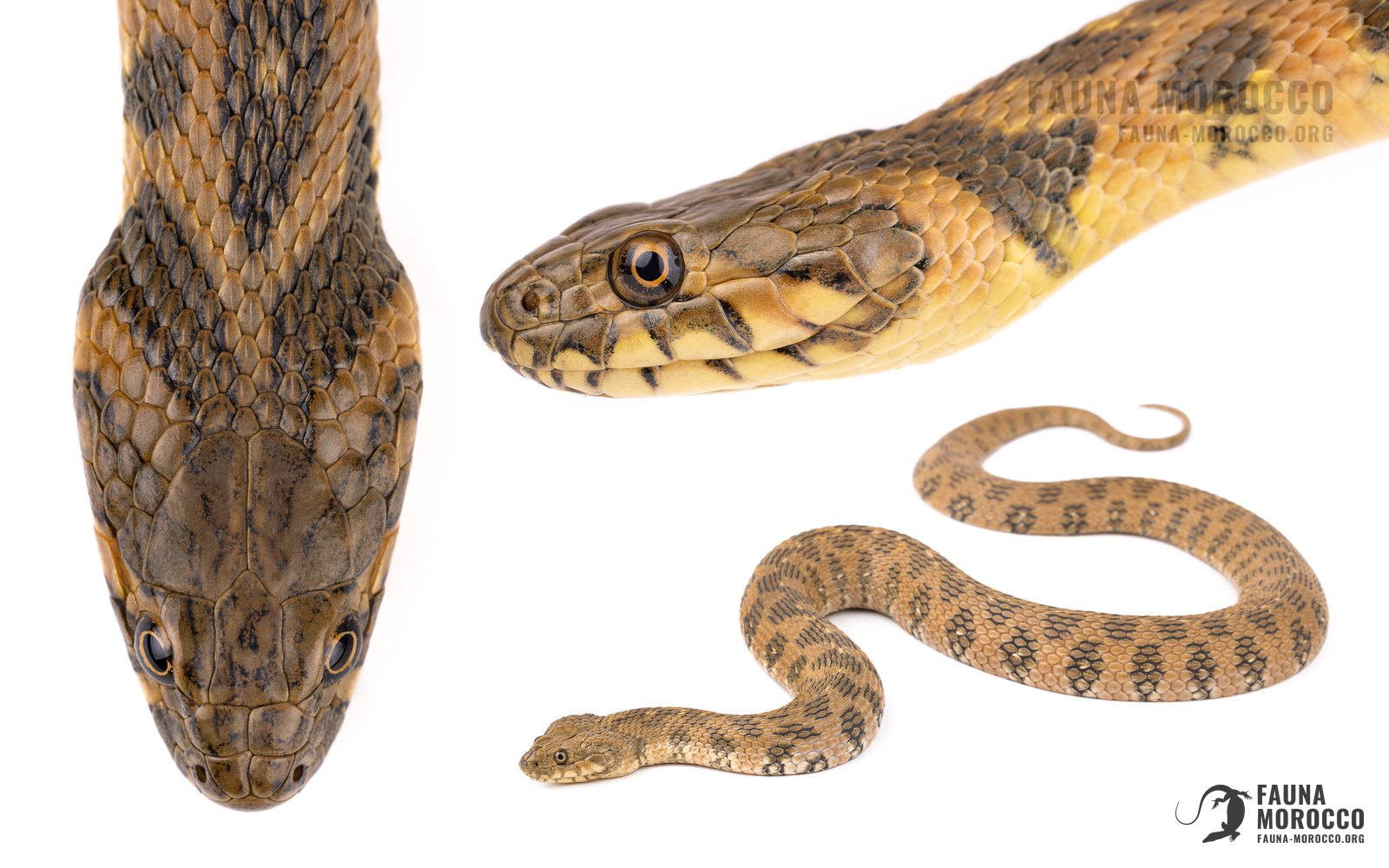 COLLAGE: water snake head, from above and in profile
Three quick checks
- Round pupil: Morocco's vipers all have a vertical pupil
- Large plates on top of the head, where the Moroccan vipers have small scales
- Found in or next to water, often swimming
2 Which water snake?
Viperine Water Snake
Natrix maura
- Zigzag or alternating dark blotches along the back, and dark spots often with a pale centre on the flanks
- Iris orange or cream, with a black ring around the pupil
- Almost always in or right next to water, across the whole country except the true desert

Red-eyed Grass Snake
Natrix astreptophora
- Red or orange eye, the iris filling the whole visible eye
- Grey to brown body with small solid black spots; young snakes often wear a pale collar edged with black
- Rare, in the humid, forested mountains of the north, and often farther from water
Water Snakes of Morocco
Are water snakes dangerous?
No. Both Moroccan water snakes are completely harmless to people.
Cornered, the Viperine Water Snake imitates a viper: it flattens its head into a triangle, coils its body, puffs itself up and hisses. It is pure bluff, and it is where the snake gets its name.
Many are still killed, first simply because they are snakes, and because the Viperine Water Snake already looks a lot like a viper, especially the Moorish Viper (Daboia mauritanica), even before it starts its bluff. If you meet one, leave it alone and let it go on its way.
To learn more, see our Viperine Water Snake account.
How do I tell water snakes from vipers?
Look at the eye and the top of the head. Water snakes have a round pupil, while all of Morocco's vipers have a vertical pupil. The top of a water snake's head is covered with large plates, where Moroccan vipers have small scales.
Water snakes are also almost always found in or right next to water, often swimming. Their zigzag pattern and their viper-like bluff fool many people, but none of these signs lie.
Our venomous or harmless guide walks you through it, and our identification guide shows how to tell the two water snakes apart.
Where do water snakes live in Morocco?
The Viperine Water Snake lives almost everywhere there is permanent fresh water, from sea level up to about 2,700 m on Jbel Sirwa, and is missing only from the true desert. Along oueds and oases it reaches the edge of the Sahara, and the southernmost population of its whole range is at Assa.
The Red-eyed Grass Snake is known from only a few scattered sites in the humid, forested mountains of the north.
What do water snakes eat?
The Viperine Water Snake hunts mainly fish and amphibians in the water, and young ones eat many earthworms and tadpoles. It can swallow prey of up to 80% of its own body size.
The Red-eyed Grass Snake takes a larger share of land frogs and toads.
What makes Moroccan water snakes so special?
In 2025, the Red-eyed Grass Snakes of Morocco were described as a subspecies of their own, Natrix astreptophora soumiafahdae. They differ in colour and pattern from the snakes of Europe and of Algeria and Tunisia, and form a genetic lineage that split from the European one about 5.4 million years ago.
The subspecies is very rare, with a fragmented range, and its describers consider it a unit that needs conservation measures.
The Viperine Water Snake of Morocco also carries its own ancient genetic lineages, which have evolved apart from the European ones for about 5 million years.
Are water snakes threatened in Morocco?
Both species are listed as Least Concern worldwide. The Viperine Water Snake is still one of the most common snakes in the country, but it suffers from water pollution, from oueds drying up and from direct persecution, since it is often mistaken for a viper.
The Red-eyed Grass Snake is very rare in Morocco, and its Moroccan subspecies needs conservation measures.
Haven’t found an answer to your question?
Ask usThe 2 water snakes of Morocco
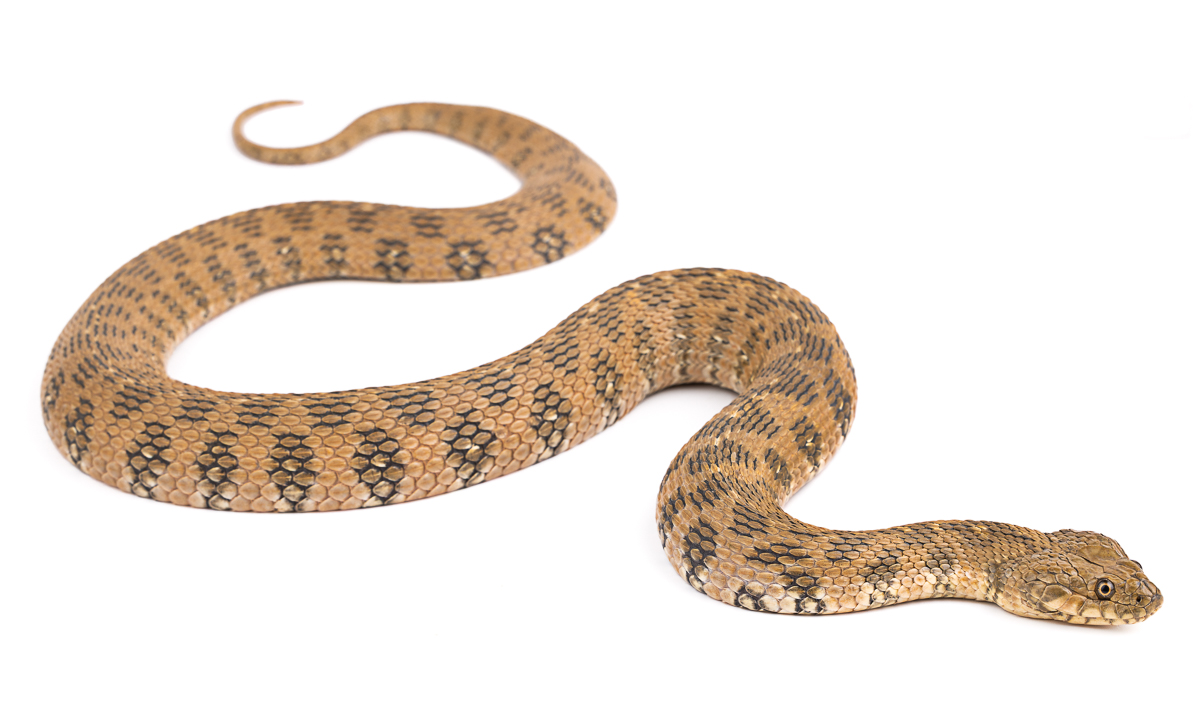

Red-eyed Grass Snake
Natrix astreptophora
Not documented yetNo species matches that. Try the Latin name, or clear the search.
The 2 water snake species of Morocco, both harmless.
About this checklist
Our list follows the most recent reference checklist of Moroccan herpetofauna (Bouazza et al., 2021). We revise and expand it as new studies appear. The Red-eyed Grass Snake was split from the Grass Snake (Natrix natrix) in 2016, and its Moroccan populations were described as a distinct subspecies in 2025 (Martínez del Mármol et al., 2025).