Moorish Tortoise (Testudo graeca)

Moorish Tortoise

Testudo graeca Linnaeus, 1758

Conservation status
VUglobal·LCMorocco
Population trend
Unspecified

The Moorish Tortoise is the only land tortoise in Morocco, and the country sits at the heart of the western part of its range. It lives in a wide variety of environments throughout the country, from agricultural fields to forests. Its future is less secure than its wide range suggests. Moroccan tortoises are collected as pets, and thousands still pass through city markets every year.

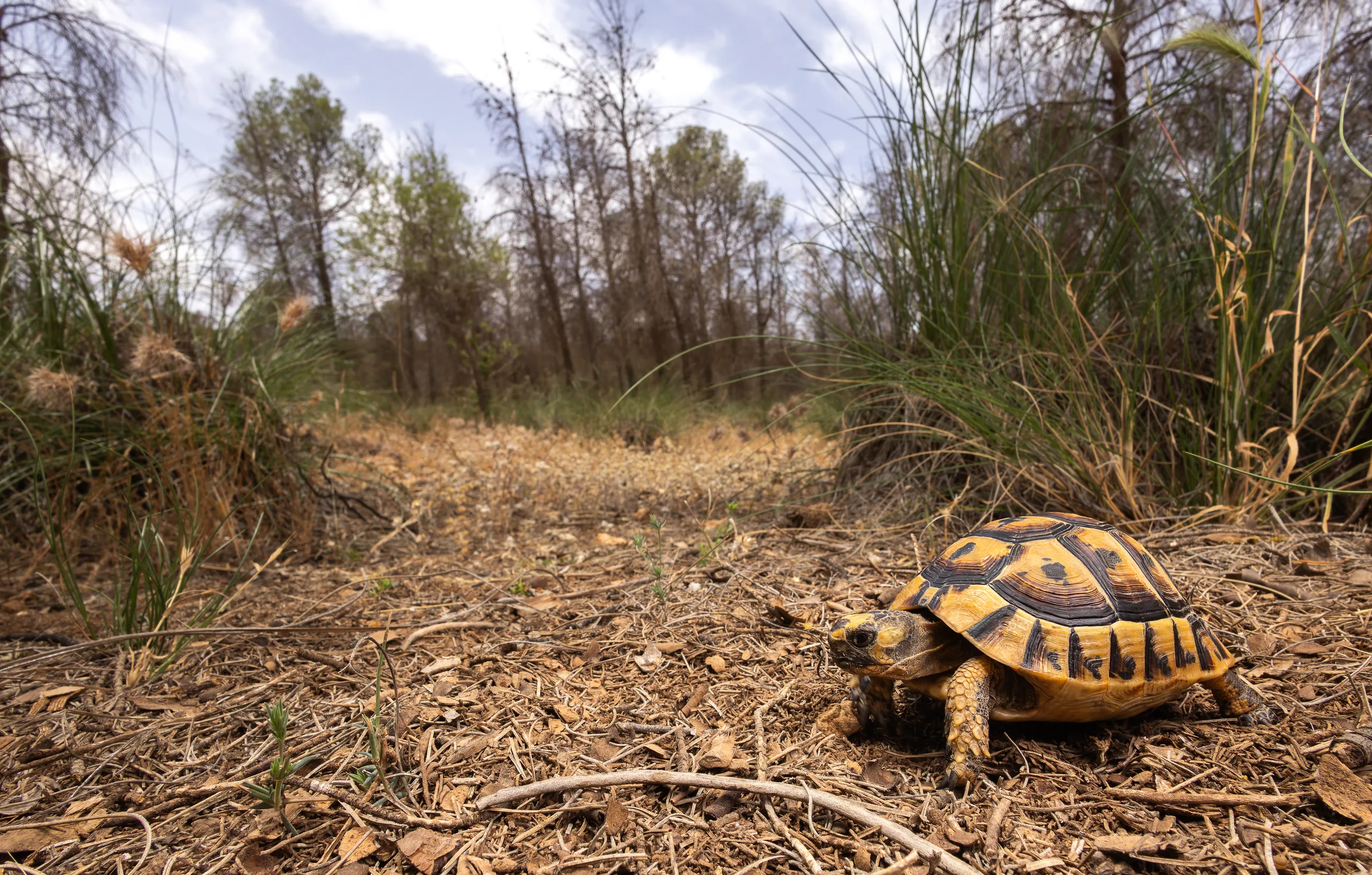
The Moorish Tortoise (Testudo graeca) is a medium-sized land tortoise with a high, domed shell. In Morocco, females from seven localities averaged 15.9 cm and 783 g, and males 14.4 cm and 506 g24. The largest Moroccan tortoises on record, both found south of Missour, are a female of 25.5 cm and 2,990 g and a male of 20.0 cm and 1,250 g51.

The head is rounded and dark, with scattered yellow scales, and the dark beak ends in three small points12. The limbs carry large overlapping scales, with five claws on the forelimbs and four on the hindlimbs12. A horny spur on the back of each thigh gives the species its other English name, Spur-thighed Tortoise. However, these spurs are often missing or reduced in the Souss Valley34, although only 23% of tortoises lacked them in the Admine forest7. North of the High Atlas, they are apparently always present35.

The carapace ranges from yellowish and pale olive to brown or reddish brown, each plate usually edged in black and often with a central black spot12. The plastron (the flat underside of the shell) is yellowish with black blotches12.

Sexual dimorphism is marked. Females are about 20% longer than males and more domed7. Males have a longer, thicker tail, with the cloacal opening about midway along it, whereas it lies near the base of the tail in females26. The rear part of the male plastron is concave, the two plates at its rear end form a deeper notch, and the plate above the tail is curved26. The sexes cannot be told apart below about 11 cm2651.

Hatchlings from central Morocco measure 3.6 cm and weigh 13 g on average, with a soft, almost round shell19. Juveniles of the two Atlantic subspecies (Testudo graeca graeca and Testudo graeca marokkensis) usually lack the central dark spot on each plate12.

Size, shape and colouration vary between Moroccan populations. Colouration becomes paler towards the south26. In the Souss Valley, new shell growth is tinged pink, matching the red soil26, and the dark pattern breaks into fine streaks on a sandy ground34. Coastal tortoises near Essaouira are relatively dark52. Tortoises from the arid Jbilet hills north of Marrakech are smaller, lighter and flatter than those from the coast near Essaouira or from the Souss Valley7. These differences do not match the genetic structure and may reflect growth responses to local conditions7.

The species has one of the widest ranges of any tortoise in the western Palaearctic13. Genetic analyses of animals from across North Africa showed that North African and Spanish tortoises form a group of their own13. Within North Africa, this group split into several regional lineages between about 1.4 and 0.7 million years ago, probably when repeated dry phases broke up the vegetation that tortoises need1314. Two of these lineages occur in Morocco, one of them split into two sub-lineages13, and the three are treated as subspecies12.

Three subspecies are recognised in Morocco1250:

  • Testudo graeca graeca in the south-west.
  • Testudo graeca marokkensis in the north-west.
  • Testudo graeca whitei east of the Moulouya basin.

Until the end of the 20th century, all Moroccan tortoises were assigned to a single subspecies, T. g. graeca35. The Souss Valley population was then described as Testudo graeca soussensis34, and T. g. marokkensis and Testudo graeca lamberti were described from central and north-western Morocco on the basis of shell shape and colour pattern35. Genetic analyses later showed that T. g. lamberti and T. g. marokkensis share the same lineage, and the two were merged under T. g. marokkensis13. The tortoise on which the original description of the species was based came from Agadir, in the Souss Valley42. The name T. g. graeca therefore belongs to the Souss Valley tortoises, and T. g. soussensis became its synonym42. The current world checklist names the north-eastern populations T. g. whitei50. Moroccan papers published before 2020 use T. g. soussensis for the Souss Valley Tortoise and T. g. graeca for the north-eastern subspecies, so subspecies names in the literature must be read with their date in mind1342.

As the only land tortoise in Morocco, the species is easy to identify. Unlike the two native freshwater turtles, the Mediterranean Pond Turtle (Mauremys leprosa) and the European Pond Turtle (Emys orbicularis), it has no webbed toes and a highly domed shell.
The Moorish Tortoise ranges over about 6,500 km from the Moroccan Atlantic coast to eastern Iran13. In western Europe, isolated populations occur in southern Spain, Mallorca and Sardinia12. The population of south-eastern Spain is old and genetically diverse, whereas those of Mallorca and Sardinia were introduced recently by people14. Tortoises in south-western Spain most probably also arrived with people rather than across the sea13.

In Morocco, the species occurs from sea level to 2,090 m in the High Atlas1. Its southern limit lies in the Anti-Atlas6, at the edge of the Sahara34. South-east of the High Atlas, the species is poorly known. The Ouarzazate basin is usually included in its range, east to Boumalne du Dadès42, but a survey there found no tortoises in the wild, only captive animals said to come from the region34. One tortoise was found east of Ouarzazate, far from any town, though it may have been released15. Further east, the records near Erfoud and Alnif are doubtful and the one from Figuig is very unlikely42. The boundaries between the three subspecies follow the main relief, with the Moulouya and Souss valleys as the main barriers14, although the Moulouya remains permeable13:

  • Testudo graeca graeca occupies the south-west, from the Anti-Atlas, where it reaches 1,600 m52, and the coast around Guelmim38. Its northern boundary runs north of the High Atlas, roughly from Essaouira to Marrakech1314. Its range has shifted northwards since the last glacial period2.
  • Testudo graeca marokkensis occupies the north-west, between this boundary and the lower Moulouya1314. An arid steppe belt around the Chemaia plateau and further east lacks tortoises and separates it from T. g. graeca35. Its range has contracted since the last glacial period2.
  • Testudo graeca whitei occupies the north-east, from the lower Moulouya eastwards1314. Tortoises sampled at the mouth of the Moulouya belong to its genetic lineage13. Its range continues well beyond the Algerian border and extends south along the Moulouya41. It has expanded from refuges on the Mediterranean coast since the last glacial period2.

The Moulouya may even act as a corridor where lineages mix13. In the Rif, the range is interrupted between an isolated population near Al Hoceima and those around Nador35. This gap and the Chemaia steppe belt have been regarded as genuine absences rather than survey gaps35. However, the climate of the Taza and Al Hoceima region is suitable, and the lack of records may also reflect low survey effort, local conditions or incomplete recolonisation after past dry periods1. Interviews with shepherds across Morocco raised the number of known locations from 129 to 323, which shows how incomplete field surveys still are, even for such a well-studied reptile37.

In Morocco, the Moorish Tortoise occurs under climates ranging from humid to arid, in cork oak forests, warm scrub, coastal dunes, steppes and farmland, on plains as well as in the mountains12. In the north, it most often occurs in mosaics of natural vegetation and cropland28, and in the Middle Atlas it inhabits scrub and forests12 (pers. obs.). The three subspecies differ in their climatic requirements and habitats:

  • Testudo graeca graeca is restricted to semi-arid areas, occurs most often where annual rainfall is about 300 mm and is almost absent above 500 mm2. It inhabits Argan (Argania spinosa) woodland, coastal dunes, olive scrub and farmland723. In the Souss Valley, tortoises occur mostly in gardens, fields and along stone walls rather than in the argan forest34. There, large irrigation projects have lowered the water table and dried out the land outside irrigated areas. Tortoises have moved into the irrigated farmland, where they live mainly in hedges of Prickly Pear (Opuntia ficus-indica) and Jujube (Ziziphus lotus) around small fields4.
  • Testudo graeca marokkensis is rare below 300 mm of annual rainfall and favours wetter areas2. In the Maâmora, it inhabits open Cork Oak (Quercus suber) forest on sandy soil45.
  • Testudo graeca whitei tolerates both semi-arid and humid conditions2. In the north-east, it inhabits dune and semi-arid scrub12 (pers. obs.).

In the arid Jbilet north of Marrakech, T. g. graeca inhabits open, stony ground11 dotted with Jujube bushes22. It occurs only where the bushes are taller than 1.25 m and spends most of its time beneath them22. On this hard ground, tortoises rest half-buried in thick vegetation5 or shelter in scrapes, lizard burrows or under stone slabs52.

The Moorish Tortoise is active by day, mainly in spring and autumn22. Activity peaks in spring, the main mating season22. Tortoises are easiest to find in the morning while basking, and they retreat to the shade in the afternoon25. In active tortoises, body temperature averages 29.8 °C and ranges from 22 to 35 °C29.

Overheating is a life-threatening risk for the Moorish Tortoise30. Free-ranging tortoises do not exceed a body temperature of 37.5 °C, and 40 °C is considered critical30. In April around Marrakech, adults could not walk more than about 1 km without risk of overheating, and radio-tracked tortoises made trips of no more than 0.5 km between refuges30. From late May to early September, all radio-tracked tortoises stayed under large bushes, mostly motionless and partly buried22.

The annual cycle differs between regions:

  • Southern Morocco: tortoises do not hibernate, and active animals were found in mid-December, at air temperatures of 24 to 27 °C4. They aestivate (rest through the hot, dry season) from June to September, longer in drought years, when daytime temperatures can exceed 48 °C4.
  • Northern Morocco: the cycle is reversed, with up to five months of hibernation in the cold, wet winter and peak activity in spring and early summer4. Even there, tortoises may emerge to feed on sunny winter days25.
  • Central Morocco: both long hibernation and aestivation are reported7.

Aestivating tortoises emerge during or just after summer storms and drink at length from pools in the soil. They then empty their bladder and store dilute urine, which provides a water reserve until the next rain53.

In Morocco, the Moorish Tortoise feeds on plants and is highly selective. In the central Jbilet in spring 2002, 34 plant species were found in droppings11. Five of them made up about 70% of the diet: Lesser Hawkbit (Leontodon saxatilis), Small Mallow (Malva parviflora), a milkvetch (Astragalus cruciatus), Burr Medic (Medicago hispida) and a bird’s-foot trefoil (Lotus arenarius)11. Legumes (Fabaceae) made up 27% of the diet11. Common plants such as a spiny eryngo (Eryngium ilicifolium) were avoided1118.

In the dry springs of 2011 and 2012, five or six species made up about 90% of the tortoise's diet, including Bermuda Grass (Cynodon dactylon) and Egyptian Sage (Salvia aegyptiaca). The preferred plants were those richest in water and protein relative to potassium17. Tortoises have no salt glands, so excess potassium must be excreted in the urine, at a cost in water and nitrogen17.

The diet is varied in spring but narrows to five plant species in summer and seven in autumn and winter18. In summer, once the plants have dried out, most tortoises stop feeding18. Near Agadir, tortoises living along field margins also eat Prickly Pear and crops such as beans, lucerne, potato leaves, tomatoes, lettuce, courgettes and cabbage4.

Whether the tortoise eats animal matter is debated. Fragments of insects and snails were found in 13 to 21% of droppings near Marrakech1117. In the Souss Valley, droppings contain fragments of snail shell, probably eaten as a source of calcium4. Another study found no animal remains and describes the tortoise as strictly herbivorous18.

Most predation falls on eggs and hatchlings. In the Souss Valley, hedgehogs, rats and birds of prey take hatchlings, although the species were not identified4. Near Essaouira and in the central Jbilet, shrikes impale them on spiny bushes3. In the Maâmora forest, the Common Raven (Corvus corax) kills many young tortoises45.

Ravens usually peck a hole through the carapace or plastron45. Other hatchlings there were trampled, probably by livestock, or died after heavy winter rain47. The Montpellier Snake (Malpolon monspessulanus), the Golden Eagle (Aquila chrysaetos) and the Wild Boar (Sus scrofa) are also listed as predators41. No natural predator is thought able to kill adults5.

Moroccan tortoises carry many ticks, almost all of one species, Hyalomma aegyptium2346. Ticks were found on 78% of tortoises from seven localities23 and on over 90% in the Maâmora forest46. Males carry the most ticks and juveniles the fewest2346.

Resting tortoises lie half-buried under thick, spiny shrubs, where they are very hard to detect5. Threatened tortoises withdraw their head and limbs into the shell. Handled tortoises, especially when turned upside down, often urinate and sometimes hiss8. During the dry season, losing this water reserve under stress could threaten the weakest tortoises53.

In Morocco, mating takes place mainly in early spring, with a second period in autumn. Near Marrakech, it runs from March to early May and from late October to early November19. In the Souss Valley, the second period falls in September, just after aestivation4.

Egg-laying lasts about six weeks, from late May to early July194. Mean clutch size ranges from 3 to 6 eggs1948. The eggs are hard-shelled, white and slightly elongated, about 3.6 by 3.0 cm and 19 g19. Females lay in soft soil, usually under plants22447. Hatchlings emerge in September447.

Older females breed more successfully. In the Maâmora forest, females aged 23 to 31 years produced on average three times as many hatchlings as females aged 14 to 20 years, and all females produced fewer hatchlings after a dry autumn47. Hatchlings of older females also survived better47.

Growth is fast up to 10 years and slows sharply after 10 to 12 years51. Males mature at about 6 to 8 years and females at 8 to 10 years51. Both sexes mature from about 10 cm in carapace length1048.

Elsewhere in the range, the male rams the female's shell, follows her and bites her forelimbs or head before climbing on her back, and females may turn sharply to throw him off8. Females store sperm and can fertilise later clutches without mating again, and 20% of clutches have more than one father39. Females lay one to four clutches a year, 21 to 29 days apart9. In semi-natural conditions, with temperatures between 15 and 41 °C, incubation lasts 82 to 140 days21. Sex depends on incubation temperature. In the laboratory, eggs incubated at 26.5 °C and 29.5 °C produced males, and eggs at 31.5 °C produced females33.

On private land in the Maâmora forest, protected from collection for over ten years, females up to 31 years old were recorded47. Elsewhere in the range, the oldest tortoise found in north-eastern Algeria was 24 years old40. In captivity, a female hatched in an Algiers garden in 1905 lived in English gardens until 1969, reaching 63 years31.

The Moorish Tortoise is listed as Vulnerable on the IUCN Red List, but the assessment dates from 1996 and needs updating49. The species is still common in much of its Moroccan range12, and the 2010 national assessment placed it in Least Concern36. Local declines are nonetheless severe. In the central Jbilet, density fell from 5.9 tortoises per hectare in 20035 to 2.7 in 2012, a loss of 54%16. In parts of north-western and central Morocco, populations are estimated to have fallen by 90% between 1900 and 198427.

In Morocco, the main threats to the Moorish Tortoise are:

  • Collection for international export. For many years, Morocco was a major source of live tortoises for the European pet market20. In the late 1960s, over 300,000 live tortoises a year were exported from Morocco to Britain. Shepherds collected them for weekly markets, and dealers in Casablanca shipped 10,000 to 25,000 every fortnight25. Morocco stopped bulk exports after ratifying CITES in 197820. In the 1990s, shells were still made into bellows and banjo-like instruments for tourists, and this trade was estimated to use at least 10,000 tortoises a year20. Repeated collection depletes populations quickly: two people caught 60% of the adults of a Jbilet population in three months5.
  • Collection as household pets in Morocco. The live trade is now mostly domestic: many tortoises are taken from the wild by residents to keep at home or sold in local markets3244. In 2013 and 2014, an estimated 3,500 to 7,000 tortoises were sold each year in Moroccan markets, two thirds of them young animals under 10 cm32. Around Rabat, 55% of 480 residents surveyed kept or had kept tortoises, and 42% of the owners had taken them from the wild themselves. Over 83,000 tortoises are estimated to be kept in Rabat alone44. In the Maâmora forest, density reaches 17 to 23 tortoises per hectare in fenced private areas, compared with 5 per hectare in nearby public areas43. Nearly half of the owners release their tortoises into the forest, which can spread disease and mix distant populations44. Some tortoises turn up in the middle of towns, where they were probably released (pers. obs.).
  • Loss of shrub cover. In arid areas, tortoises survive the summer heat only under large bushes22. Overgrazing and wood cutting destroy the Jujube bushes and argan undergrowth that provide shade, food and nest sites30422. Livestock eat the same plants as tortoises11, and sparse cover exposes young tortoises to ravens45.
  • Agricultural intensification. Most Moroccan tortoises live in habitats used by people, where more intensive farming and pesticides are a general threat35. In the Souss Valley, for example, mechanised ploughing kills aestivating tortoises and clears Jujube, and pesticide residues remain on the foliage eaten by the tortoises4.
  • Drought and climate change. Rainfall is the main factor limiting the range of the species in North Africa1. Dry years reduce the plants that tortoises prefer17 and the number of hatchlings47. Tortoises depend on summer rain to restore their water reserves53.
  • Road traffic. Many tortoises are run over by vehicles while crossing roads in Morocco443 (pers. obs.).
  • Wells and cisterns. Tortoises fall into open wells and cisterns and drown38 (pers. obs.).

Since 1975, the Moorish Tortoise has been listed in Appendix II of CITES, which regulates its international trade44. Since 2011, Moroccan Law 29-05 also limits the capture and trade of wild animals of species listed in CITES Appendix II, including this tortoise12. Populations occur in several national parks, including Souss-Massa, Tazekka, Ifrane, Khénifra, Talassemtane, Bouhachem and Beni Snassen12.

Maps

  • Bons, J., & Geniez, P. (1996). Amphibiens et reptiles du Maroc (Sahara occidental compris). Atlas biogéographique. Asociación Herpetológica Española
  • Martínez del Mármol, G., Harris, D. J., Geniez, P., de Pous, P., & Salvi, D. (2019). Amphibians and Reptiles of Morocco. Frankfurt Contributions to Natural History, 74. Edition Chimaira.
  • GBIF.org (19 October 2026) GBIF Occurrence Download https://doi.org/10.15468/dl.7xkfm3
  1. Anadón, J. D., Giménez, A., Graciá, E., Pérez, I., Ferrández, M., Fahd, S., El Mouden, H., Kalboussi, M., Jdeidi, T., Larbes, S., Rouag, R., Slimani, T., Znari, M., & Fritz, U. (2012). Distribution of Testudo graeca in the western Mediterranean according to climatic factors. Amphibia-Reptilia, 33, 285–296. https://doi.org/10.1163/156853812X643710
  2. Anadón, J. D., Graciá, E., Botella, F., Giménez, A., Fahd, S., & Fritz, U. (2015). Individualistic response to past climate changes: niche differentiation promotes diverging Quaternary range dynamics in the subspecies of Testudo graeca. Ecography, 38, 956–966. https://doi.org/10.1111/ecog.01163
  3. Barje, F., Slimani, T., El Mouden, E. H., Lagarde, F., Bonnet, X., & Ben Kaddour, K. (2005). Shrewd shrikes and spiny shrubs: a calamity for hatchling Moorish tortoises (Testudo graeca graeca). Amphibia-Reptilia, 26, 113–115.
  4. Bayley, J. R., & Highfield, A. C. (1996). Observations on ecological changes threatening a population of Testudo graeca graeca in the Souss Valley, southern Morocco. Chelonian Conservation and Biology, 2(1), 36–42.
  5. Ben Kaddour, K., Slimani, T., El Mouden, E. H., Lagarde, F., & Bonnet, X. (2006). Population structure, population density and individual catchability of Testudo graeca in the central Jbilets (Morocco). Vie et Milieu, 56(1), 49–54.
  6. Bons, J., & Geniez, P. (1996). Amphibiens et reptiles du Maroc (Sahara occidental compris). Atlas biogéographique. Asociación Herpetológica Española.
  7. Carretero, M. A., Znari, M., Harris, D. J., & Macé, J. C. (2005). Morphological divergence among populations of Testudo graeca from west-central Morocco. Animal Biology, 55(3), 259–279.
  8. Díaz-Paniagua, C., & Andreu, A. C. (2009). Tortuga mora – Testudo graeca. In A. Salvador & A. Marco (Eds.), Enciclopedia Virtual de los Vertebrados Españoles. Museo Nacional de Ciencias Naturales. http://www.vertebradosibericos.org/
  9. Díaz-Paniagua, C., Keller, C., & Andreu, A. C. (1996). Clutch frequency, egg and clutch characteristics, and nesting activity of spur-thighed tortoises, Testudo graeca, in southwestern Spain. Canadian Journal of Zoology, 74, 560–564.
  10. El Mouden, E. H., Slimani, T., & Ben Kaddour, K. (2002). Croissance et dimorphisme sexuel chez la tortue mauresque (Testudo graeca graeca L. 1758). Chelonii, 3, 325–330 — via Ben Kaddour et al. (2006)5.
  11. El Mouden, E. H., Slimani, T., Ben Kaddour, K., Lagarde, F., Ouhammou, A., & Bonnet, X. (2006). Testudo graeca graeca feeding ecology in an arid and overgrazed zone in Morocco. Journal of Arid Environments, 64, 422–435. https://doi.org/10.1016/j.jaridenv.2005.06.010
  12. Escoriza, D., Díaz-Paniagua, C., Andreu, A., & Ben Hassine, J. (2022). Testudo graeca Linnaeus 1758 (Western Subspecies Clade: Testudo g. graeca, T. g. cyrenaica, T. g. marokkensis, T. g. nabeulensis, T. g. whitei) – Mediterranean Spur-thighed Tortoise, Moorish Tortoise, Libyan Tortoise, Moroccan Tortoise, Tunisian Tortoise, Souss Valley Tortoise. In A. G. J. Rhodin et al. (Eds.), Conservation Biology of Freshwater Turtles and Tortoises. Chelonian Research Monographs, 5(16), 117.1–117.18. https://doi.org/10.3854/crm.5.117.western.graeca.v1.2022
  13. Fritz, U., Harris, D. J., Fahd, S., Rouag, R., Graciá Martínez, E., Giménez Casalduero, A., Široký, P., Kalboussi, M., Jdeidi, T. B., & Hundsdörfer, A. K. (2009). Mitochondrial phylogeography of Testudo graeca in the Western Mediterranean: old complex divergence in North Africa and recent arrival in Europe. Amphibia-Reptilia, 30, 63–80.
  14. Graciá, E., Vargas-Ramírez, M., Delfino, M., Anadón, J. D., Giménez, A., Fahd, S., Corti, C., Jdeidi, T. B., & Fritz, U. (2017). Expansion after expansion: dissecting the phylogeography of the widely distributed spur-thighed tortoise, Testudo graeca (Testudines: Testudinidae). Biological Journal of the Linnean Society, 121, 641–654.
  15. Harris, D. J., Carretero, M. A., Brito, J. C., Kaliontzopoulou, A., Pinho, C., Perera, A., Vasconcelos, R., Barata, M., Barbosa, D., Carvalho, S., Fonseca, M. M., Pérez-Lanuza, G., & Rato, C. (2008). Data on the distribution of the terrestrial herpetofauna of Morocco: records from 2001–2006. The Herpetological Bulletin, 103, 19–28.
  16. Hichami, N. (2017). Ecophysiology & conservation ecology of the Souss Valley tortoises, Testudo graeca soussensis Pieh, 2001, in an arid area of west central Morocco [PhD thesis]. Cadi Ayyad University, Marrakech — via Znari & Hichami (2018)52.
  17. Hichami, N., & Znari, M. (2023). Interannual variations in diet and nutritional value of plants consumed by the Souss Valley tortoises, Testudo graeca graeca, in west-central Morocco: are they really selective foragers? Amphibia-Reptilia, 44, 167–181. https://doi.org/10.1163/15685381-bja10127
  18. Hichami, N., & Znari, M. (2024). Seasonal variations in the food habits of the Souss Valley tortoise, Testudo greaca graeca, in an arid area of west-central Morocco. Herpetological Conservation and Biology, 19(3), 429–439.
  19. Hichami, N., Znari, M., Naimi, M., & Namous, S. (2016). Clutch, egg and hatchling characteristics in the Souss Valley tortoises, Testudo graeca soussensis Pieh, 2001 (Testudines: Testudinidae) from an arid steppe-land of west-central Morocco. African Journal of Herpetology, 65(1), 21–32. https://doi.org/10.1080/21564574.2015.1136701
  20. Highfield, A. C., & Bayley, J. R. (1996). The trade in tortoise-derived souvenir products in Morocco. Traffic Bulletin, 16, 33–35. Web version read: Tortoise Trust, https://www.tortoisetrust.org/articles/banjo.html
  21. Krüger, E. (2007). Near-natural incubation of Testudo graeca soussensis Pieh, 2000, eggs. Radiata, 16, 42–48 — via Hichami et al. (2016)19.
  22. Lagarde, F., Louzizi, T., Slimani, T., El Mouden, H., Ben Kaddour, K., Moulherat, S., & Bonnet, X. (2012). Bushes protect tortoises from lethal overheating in arid areas of Morocco. Environmental Conservation, 39(2), 172–182. https://doi.org/10.1017/S0376892911000634
  23. Laghzaoui, E.-M., Bouazza, A., Abbad, A., & El Mouden, E. H. (2022). Cross-sectional study of ticks in the vulnerable free-living spur-thighed tortoise Testudo graeca (Testudines: Testudinidae) from Morocco. International Journal of Acarology, 48(1), 76–83. https://doi.org/10.1080/01647954.2021.2024595
  24. Laghzaoui, E.-M., Sergiadou, D., Perera, A., Harris, D. J., Abbad, A., & El Mouden, E. H. (2020). Absence of Hemolivia mauritanica (Apicomplexa: Haemogregarinidae) in natural populations of Testudo graeca in Morocco. Parasitology Research, 119, 4281–4286. https://doi.org/10.1007/s00436-020-06869-z
  25. Lambert, M. R. K. (1969). Tortoise drain in Morocco. Oryx, 10, 161–166. https://doi.org/10.1017/S0030605300008164
  26. Lambert, M. R. K. (1982). Studies on the growth, structure and abundance of the Mediterranean spur-thighed tortoise, Testudo graeca, in field populations. Journal of Zoology, 196, 165–189.
  27. Lambert, M. R. K. (1995). Tortoise situation in northern Africa. In D. Ballasina (Ed.), Red Data Book on Mediterranean chelonians (pp. 1–19). Edagricole — via Segura & Acevedo (2019)43.
  28. Mediani, M., Brito, J. C., & Fahd, S. (2015). Atlas of the amphibians and reptiles of northern Morocco: updated distribution and patterns of habitat selection. Basic and Applied Herpetology, 29, 81–107. https://doi.org/10.11160/bah.14009
  29. Meek, R., & Jayes, A. S. (1982). Body temperatures and activity patterns of Testudo graeca in North West Africa. British Journal of Herpetology, 6, 194–197 — via Escoriza et al. (2022)12.
  30. Moulherat, S., Delmas, V., Slimani, T., El Mouden, E. H., Louzizi, T., Lagarde, F., & Bonnet, X. (2014). How far can a tortoise walk in open habitat before overheating? Implications for conservation. Journal for Nature Conservation, 22, 186–192. https://doi.org/10.1016/j.jnc.2013.11.004
  31. Moysey, F. (1962) — via Lambert (1982)26.
  32. Nijman, V., & Bergin, D. (2017). Trade in spur-thighed tortoises Testudo graeca in Morocco: volumes, value and variation between markets. Amphibia-Reptilia, 38, 275–287. https://doi.org/10.1163/15685381-00003109
  33. Pieau, C. (1975). Temperature and sex differentiation in embryos of two chelonians, Emys orbicularis L. and Testudo graeca L. In R. Reinboth (Ed.), Intersexuality in the animal kingdom (pp. 332–339). Springer-Verlag.
  34. Pieh, A. (2000). Testudo graeca soussensis, eine neue Unterart der Maurischen Landschildkröte aus dem Sousstal (Südwest-Marokko). Salamandra, 36(4), 209–222.
  35. Pieh, A., & Perälä, J. (2004). Variabilität der Maurischen Landschildkröten (Testudo graeca Linnaeus, 1758 – Komplex) im zentralen und nordwestlichen Marokko mit Beschreibung zweier neuer Taxa. Herpetozoa, 17(1/2), 19–47.
  36. Pleguezuelos, J. M., Brito, J. C., Fahd, S., Feriche, M., Mateo, J. A., Moreno-Rueda, G., Reques, R., & Santos, X. (2010). Setting conservation priorities for the Moroccan herpetofauna: the utility of regional red lists. Oryx, 44(4), 501–508. https://doi.org/10.1017/S0030605310000992
  37. Pujante-Expósito, N., Fahd, S., Felber, F. J., Rodríguez-Caro, R. C., Graciá, E., Semaha, M. J., & Giménez, A. (2025). Use of local ecological knowledge as a source of information on the distribution of Testudo graeca in North Africa. In E. Graciá, R. C. Rodríguez-Caro & A. Giménez (Eds.), Conservation of Mediterranean tortoises under global change (pp. 20–25). Asociación Herpetológica Española.
  38. Rizzo, V. (2020). Testudo graeca Linnaeus 1758. In G. Martínez, R. León, O. Jiménez-Robles, J. P. González De la Vega, V. Gabari, B. Rebollo, A. Sánchez-Tójar, J. R. Fernández-Cardenete & J. Gállego (Eds.), Moroccoherps. Amphibians and reptiles of Morocco and Western Sahara. Version 10/05/2020. Retrieved 12 October 2026, from https://www.moroccoherps.com/ficha/testudo_graeca/
  39. Roques, S., Díaz-Paniagua, C., & Andreu, A. C. (2004). Microsatellite markers reveal multiple paternity and sperm storage in the Mediterranean spur-thighed tortoise, Testudo graeca. Canadian Journal of Zoology, 82, 153–159. https://doi.org/10.1139/Z03-228
  40. Rouag, R., Benyacoub, S., Luiselli, L., El Mouden, E. H., Tiar, G., & Ferrah, C. (2007). Population structure and demography of an Algerian population of the Moorish tortoise, Testudo graeca. Animal Biology, 57(3), 267–279.
  41. Schleich, H. H., Kästle, W., & Kabisch, K. (1996). Amphibians and reptiles of North Africa. Koeltz Scientific Books — via Escoriza et al. (2022)12 and Rizzo (2020)38.
  42. Schweiger, M., & Gemel, R. (2020). Where do you come from, stranger? A scientific-historical digression with discussion on nomenclature and taxonomy of Testudo graeca Linnaeus, 1758. Herpetozoa, 33, 31–38. https://doi.org/10.3897/herpetozoa.33.e39155
  43. Segura, A., & Acevedo, P. (2019). The importance of protected and unprotected areas for the Mediterranean spur-thighed tortoise demography in northwest Morocco. Amphibia-Reptilia, 40, 361–371. https://doi.org/10.1163/15685381-20191143
  44. Segura, A., Delibes-Mateos, M., & Acevedo, P. (2020a). Implications for conservation of collection of Mediterranean spur-thighed tortoise as pets in Morocco: residents' perceptions, habits, and knowledge. Animals, 10, 265. https://doi.org/10.3390/ani10020265
  45. Segura, A., Jiménez, J., & Acevedo, P. (2020b). Predation of young tortoises by ravens: the effect of habitat structure on tortoise detectability and abundance. Scientific Reports, 10, 1874. https://doi.org/10.1038/s41598-020-58851-5
  46. Segura, A., Rodríguez, O., Ruiz-Fons, F., & Acevedo, P. (2019). Tick parasitism in the Mediterranean spur-thighed tortoise in the Maamora forest, Morocco. Ticks and Tick-borne Diseases, 10(2), 286–289. https://doi.org/10.1016/j.ttbdis.2018.11.002
  47. Segura, A., Rodríguez-Caro, R. C., Graciá, E., & Acevedo, P. (2021). Differences in reproductive success in young and old females of a long-lived species. Animals, 11, 467. https://doi.org/10.3390/ani11020467
  48. Slimani, T., El Mouden, E. H., & Ben Kaddour, K. (2002). Structure et dynamique d'une population de Testudo graeca graeca L. 1758 dans les Jbilets centrales, Maroc. Chelonii, 3, 200–207 — via Ben Kaddour et al. (2006)5.
  49. Tortoise & Freshwater Turtle Specialist Group (1996). Testudo graeca. The IUCN Red List of Threatened Species 1996: e.T21646A9305693. https://doi.org/10.2305/IUCN.UK.1996.RLTS.T21646A9305693.en
  50. Turtle Taxonomy Working Group (2025). Turtles of the world: annotated checklist and atlas of taxonomy, synonymy, distribution, and conservation status (10th ed.). In A. G. J. Rhodin et al. (Eds.), Conservation Biology of Freshwater Turtles and Tortoises. Chelonian Research Monographs, 10, 1–575. https://doi.org/10.3854/crm.10.checklist.atlas.v10.2025
  51. Znari, M., Germano, D. J., & Macé, J. C. (2005). Growth and population structure of the Moorish tortoise (Testudo graeca graeca) in westcentral Morocco: possible effects of over-collecting for the tourist trade. Journal of Arid Environments, 62, 55–74. https://doi.org/10.1016/j.jaridenv.2004.11.013
  52. Znari, M., & Hichami, N. (2018). Biology, life history traits and conservation of the vulnerable Souss Valley tortoise in arid areas of west central Morocco. In D. R. Aguillón Gutiérrez (Ed.), Reptiles and amphibians. IntechOpen. https://doi.org/10.5772/intechopen.74855
  53. Znari, M., & Hichami, N. (2024). Adaptation to seasonal change in osmotic stressors in the Souss Valley tortoise Testudo graeca graeca, in an arid steppe-land of west-central Morocco: allostasis vs. homeostasis. Journal of Arid Environments, 221, 105137. https://doi.org/10.1016/j.jaridenv.2024.105137

How to cite

Ruffieux, C., & Vuillemin, R. (2026). Moorish Tortoise (Testudo graeca). In: Castella, C., Iallaten, H., Ruffieux, C., & Vuillemin, R. (Eds.), Fauna Morocco. The Free Encyclopedia: Reptiles & Amphibians of Morocco. Available from https://fauna-morocco.org/encyclopedia/testudines/testudo-graeca.html (accessed 8 November 2026).

Published

8 November 2026

Last updated

8 November 2026

Authors

Colin Ruffieux
Rayane Vuillemin

Reviewers

Haytam Iallaten
Mohamed Taha Aissaoui

Photography

Rayane Vuillemin

Methodology

Each account is a scientific synthesis: we compile the literature, read each paper in full, verify facts against their original sources when possible, and flag uncertainties for expert review. It is written first in English, reviewed by the team, then translated into French and Arabic. Every claim is referenced, and accounts are updated as knowledge advances. If you spot a mistake or an omission, please get in touch so we can fix it.