Mediterranean Pond Turtle (Mauremys leprosa)

Mediterranean Pond Turtle

Mauremys leprosa (Schweigger, 1812)

Conservation status
LCglobal·NTEurope
Population trend
Unknown

The Mediterranean Pond Turtle is abundant throughout Moroccan waters. From the Mediterranean coast to the oases of the Lower Drâa, it lives in most rivers, ponds and other bodies of water, and across much of the country it is the only freshwater turtle. It copes with conditions few other Moroccan reptiles would survive. In some polluted rivers it is the only aquatic vertebrate left.

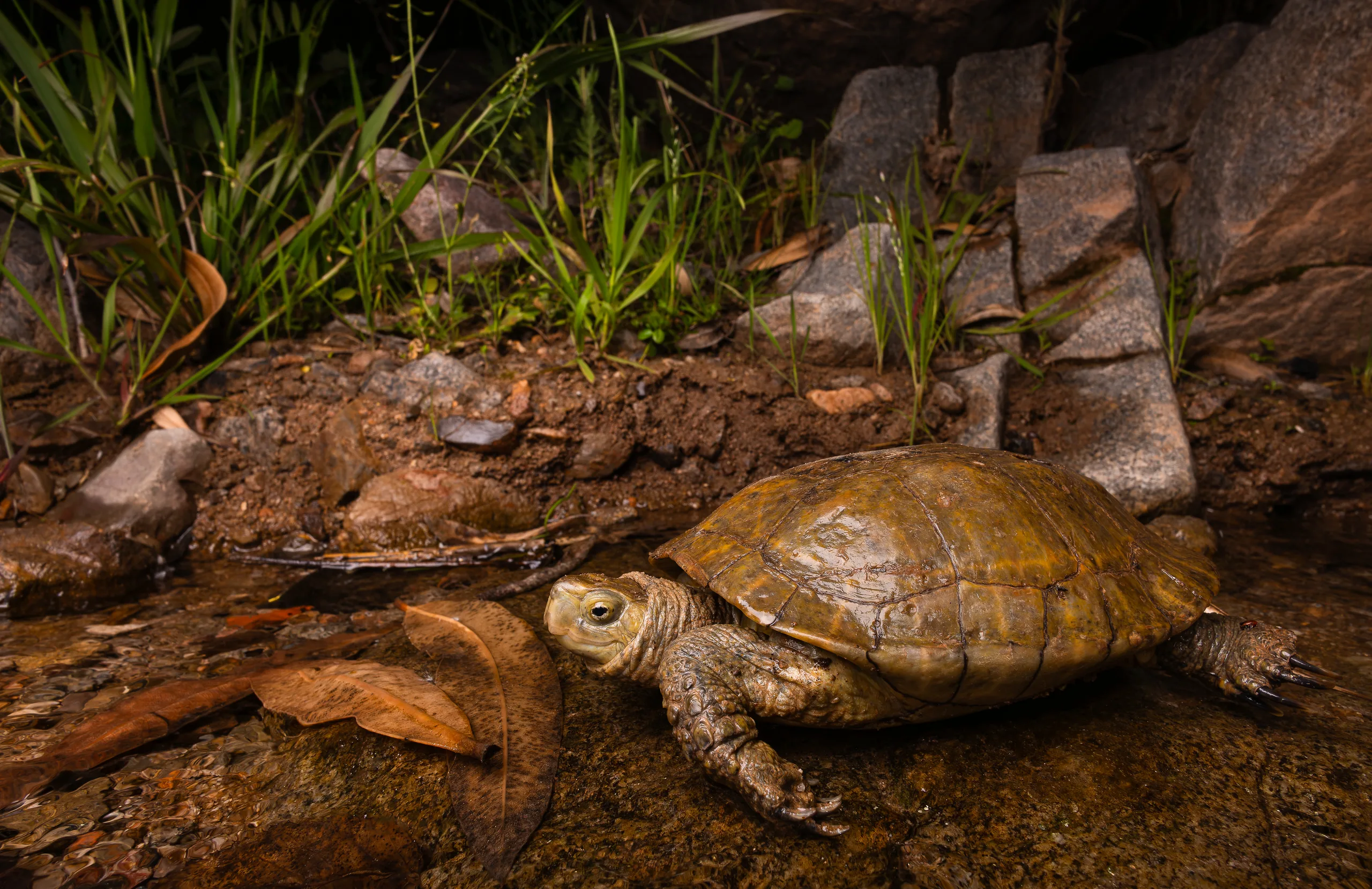
The Mediterranean Pond Turtle (Mauremys leprosa) is a small to medium-sized freshwater turtle. Across the range, in rivers that flow all year and are rich in food, females reach up to 25 cm and males 20 cm, whereas in oueds that dry out they rarely exceed 18 cm and 17 cm respectively30. In Morocco, the largest turtles measured by the same author were a 194 mm female and a 196 mm male30. A larger sample of 262 turtles from 13 Moroccan sites included a 257 mm female and a 203 mm male41. Turtles in polluted, food-rich rivers can grow particularly large, and the largest turtles caught by one team across Morocco came from the sewers of Fez9. The carapace is low, oval and smooth-edged, with a ridge along the midline in young animals that usually disappears in adults3. The webbed feet are adapted to swimming.

The head is short and broad, and becomes more massive with age. It is olive to olive-grey, with a yellow or orange spot between the eye and the ear, and four or five yellow to orange stripes running from the neck towards the eye3. Eye colour differs between the two subspecies, and the iris colour fades or darkens with age in both6:

  • Mauremys leprosa leprosa: north of the Atlas, the iris is yellow, crossed by a dark bar or cross630.
  • Mauremys leprosa saharica: towards the south-western edge of the range, the yellow is replaced by turquoise to intense sky blue, with or without the bar, and hatchlings already have blue eyes6. South of the High Atlas, most turtles have blue or bluish eyes30, although yellowish eyes with a dark bar have been reported from the Ziz valley8. Along the Oued Noun, eye colour shifts from yellowish near the coast to blue-green upstream of Guelmim6. The iris shows no blue in the Souss6 but is blue on the Oued Massa10.

The carapace of adults is tan to olive, often with a broken stripe along the midline, and some populations carry large yellow to orange blotches edged with black3. The plastron (the lower shell) is yellowish-brown, uniform in most adults, sometimes blotched or heavily darkened3. The limbs are olive with yellow or orange stripes, and all markings fade with age340.

Sexual dimorphism varies strongly between Moroccan populations. Females are usually larger, but the gap varies a lot, since in some populations both sexes are the same size and in others females are nearly twice as long as males2623. At Oued Ksob on the Atlantic coast, both sexes averaged about 100 mm, whereas in the Drâa valley females averaged 196 mm and males 102 mm26. Males have a slightly concave plastron and a longer tail, females a flat plastron and a higher shell333.

Hatchlings measure 22 to 32 mm and have an almost circular shell, which becomes more elongate with growth33. Juveniles carry yellowish spots or orange to red streaks on the shell, and dark blotches edged with yellow on the plastron3.

In 1996 and 1998, seven subspecies were described from Morocco, mainly on the basis of juvenile colour patterns and, for the turtles of the Drâa basin, their blue eyes396. Genetic analyses of turtles from across the range then showed one major split, which follows the Atlas Mountains in Morocco. Most of the proposed subspecies did not match genetic groups, and their diagnostic colours are largely lost with age11. Two subspecies are now recognised: Mauremys leprosa leprosa from southern France to Morocco north of the Atlas, and Mauremys leprosa saharica from Libya and Tunisia west to Morocco43. The name leprosa does not refer to algae on the shell, but to wart-like growths on the type specimen, a young female probably kept in poor conditions6.

Later work showed that Morocco holds every genetic group of the species and the highest genetic diversity. The species therefore probably arose in north-western Morocco and spread from there in two waves, one east to Tunisia and one north into Iberia45. The oldest Moroccan fossil of the genus, very close to the living species, comes from late Pliocene deposits near Casablanca15. The two subspecies were first separated by the High Atlas. During the Middle Pleistocene, the southern subspecies spread north, and both now meet in the Rif and the Middle Atlas4543. The southern-type turtles found north of the Atlas, first suspected to be released animals11, are a natural part of these populations45. Moroccan and Iberian turtles are genetically very close, as the Strait of Gibraltar has not stopped turtles from crossing between the two continents11745.

The Mediterranean Pond Turtle (Mauremys leprosa) can be mistaken for the much rarer European Pond Turtle (Emys orbicularis). The simplest difference is on the head and neck. The Mediterranean Pond Turtle has yellow to orange stripes, whereas the European Pond Turtle has yellow spots and never distinct stripes. The carapace of the European Pond Turtle is black with small yellow dots or lines40. This pattern is sometimes missing, and the carapace alone is then not enough to identify it (pers. obs.).
The Mediterranean Pond Turtle (Mauremys leprosa) occurs in France, Spain, Portugal, Morocco, Algeria, Tunisia and western Libya, with isolated relict populations in Mauritania and Niger318. It generally occurs below 1 100 m but has been recorded up to 1 800 m in Morocco4.

In Morocco, it is widespread27, and records in the north are continuous enough for its distribution there to be well known31. Its northern and western limits are the Mediterranean coast between Tangier and Ceuta and the Atlantic coast from Asilah to the Massa estuary1119. Southwards, it reaches the Lower Drâa between Guelmim and Tan-Tan1163023, and eastwards the Moulouya basin, Taourirt and the Ziz valley22823. There is no published record from the Atlantic Sahara40. The two subspecies are distributed as follows:

  • Mauremys leprosa leprosa occurs in the north and west, from the Rif to the Marrakech and Essaouira regions1120. Turtles of the Souss valley carry a haplotype of the southern lineage11, so the two subspecies probably meet between Essaouira and Agadir, but no contact zone has been described there.
  • Mauremys leprosa saharica occurs in the oueds south and east of the Atlas, from the Souss and the Noun to the Ziz and Guir1123. In the Drâa and Noun basins, populations are scattered and isolated by dry land627, and the southern limit follows the rainfall needed to keep surface water22. Whether the gaps between oases reflect true absence or low survey effort is not known. The subspecies also occurs further north, around Taza, in the Middle Atlas and in the Rif43. These northern populations are natural, and both subspecies now occur together in the Rif and the Middle Atlas45. Its range also extends to north-eastern Morocco, including the Beni Snassen, and on into northern Algeria and Tunisia4543.

In Morocco, the Mediterranean Pond Turtle (Mauremys leprosa) inhabits almost every kind of water body, from sea level to 1 800 m: permanent and temporary rivers, mountain streams, natural lakes, dam reservoirs, springs, irrigation channels, oasis pools and coastal wetlands41626192333. Many live in streams that are dry for much of the year16. The water may be clear, silty, eutrophic (nutrient-rich), brackish or heavily polluted30. In most of the country, it is the only freshwater turtle19.

North of the Atlas, it occurs from coastal lakes and intermittent streams on the Atlantic coast to lakes of the Middle Atlas at 1 604 m2619. In the Middle Atlas, it locally shares water bodies with the European Pond Turtle (Emys orbicularis), and sometimes outnumbers it1930. On the Tizguit river near Ifrane, over 300 Mediterranean Pond Turtles were seen for about 20 European Pond Turtles30. It thrives in degraded water, from brackish rivers in the Middle Atlas to polluted rivers in the Rif30. Near Marrakech, turtle density is about eight times higher in a river carrying treated sewage and run-off from a large open dump, with almost entirely destroyed banks, than in a nearby natural river9. There, the turtle is the most common, often the only, aquatic vertebrate359. Sewers are therefore considered the best place to see the species in Morocco9.

South of the Atlas, the Saharan subspecies inhabits oases, gueltas (rock pools), reservoirs and intermittent oueds, including eutrophic river pools and dam lakes26192330. In an oasis of the Lower Drâa basin, turtles live only in the least salty pond, which is about a quarter as salty as seawater, and are absent from the saltier ponds nearby24. Dead turtles were found repeatedly in a saltier pond of the same oasis, and many live turtles carry a pale salt crust on the shell3024. Elsewhere on the Lower Drâa, several dozen turtles were observed in muddy water among thousands of young North African Green Frogs (Pelophylax saharicus)30.

In Morocco, the Mediterranean Pond Turtle (Mauremys leprosa) is active by day and by night. On sunny days it basks on banks and rocks. At night it walks along the bottom or floats at the surface40. We often found turtles out of the water, a few metres up the bank, either basking or just resting (pers. obs.). In one desert irrigation channel in the south, the sand around the water reached 45 to 60 °C, yet the turtles stayed between 24 and 29.5 °C, close to the temperature of the water32. In late summer, as ponds and oueds dry, turtles crowd into the remaining pools and then bury themselves among rocks until the rains return42.

Elsewhere in the range, activity depends on climate, and winter dormancy can be interrupted in mild winters3. In northern Algeria, turtles were inactive in January and much less active in August1. In Spain, dormancy generally lasts from late November to February or early April3.

The diet of the Mediterranean Pond Turtle (Mauremys leprosa) has not been studied systematically in Morocco. Elsewhere it feeds mainly on animal prey, but turns to plants when prey runs short327. Stomachs examined in northern Algeria held mostly aquatic insects (midge, mosquito and hoverfly larvae, water boatmen, backswimmers and diving beetles), plus a few ants and bees, small crustaceans, Reedmace (Typha angustifolia) and Mosquitofish (Gambusia holbrooki)1. In Spain, the diet also includes crayfish, snails, worms, tadpoles, frogs, newts, small fish, toad eggs and carrion3. Juveniles reportedly eat mostly invertebrates, and adults more plants40.

What we know for Morocco comes from scattered observations. In the south, turtles have been seen eating pondweed33. In the sewers of Marrakech, where insects, fish and amphibians are almost absent, turtles feed on human waste, including meal leftovers in paper or plastic bags and disposable nappies9. In southern Morocco, turtles have even been seen eating human excrement42.

Few predators of the Mediterranean Pond Turtle (Mauremys leprosa) have been recorded in Morocco. In the Middle Atlas, the Eurasian Otter (Lutra lutra) eats young turtles, taking only part of the flesh21. Near Mohammedia, Cattle Egrets (Bubulcus ibis), Grey Herons (Ardea cinerea) and Glossy Ibises (Plegadis falcinellus) were seen catching hatchlings, and nests are sometimes raided, probably by weasels or foxes37. Elsewhere, juveniles are thought to be taken by adult turtles, birds of prey and rodents40. The leech Placobdella costata is common on Moroccan turtles, on up to 80% of animals at some sites, without affecting their body condition19. Leeches probably transmit blood parasites, found in 27% of turtles north of the Atlas but none south of it20.

In northern Algeria, the African Golden Wolf (Canis lupaster) probably raids nests and its scats held turtle remains, although predation could not be told apart from scavenging1. There, 15% of turtles carried healed limb wounds, attributed to Golden Wolves, Wild Boars or rats1. Range-wide, recorded predators include herons, White Storks, Egyptian Vultures, Eagle Owls, Black Kites, Wild Boar, Red Foxes, Egyptian Mongooses and Eurasian Otters3.

The Mediterranean Pond Turtle (Mauremys leprosa) relies first on flight. In natural Moroccan habitats, turtles are easily spotted from a distance but escape quickly as soon as they sense a threat9 (pers. obs.). They also hide under rocks or in dense vegetation29. If grabbed, they withdraw into their shells (pers. obs.) and release a strong smell30, produced by musk glands near the bridge, the part of the shell joining the carapace and plastron12.

Near Marrakech, the Mediterranean Pond Turtle (Mauremys leprosa) mates in winter, unlike most turtles of temperate regions, which mate in spring and autumn34. There, courtship and mating peaked in February, when rainfall is highest and temperatures lowest34. Winter rains may reconnect the isolated pools of drying rivers and so help turtles find mates34. Females as small as 124 mm carry eggs35. Eggs grow from November to February, ovulation starts in April or May, and shelled eggs are carried from mid-April to July34.

In Marrakech, clutches contain 3 to 13 eggs, 9.7 on average35. This clutch size is high for the species and may reflect the rich food supply of polluted water35. In a polluted estuary in north-eastern Algeria, one female carried 16 eggs, the largest clutch recorded for the species13. Eggs measured on average 31.5 by 20.0 mm and weighed 7.5 g, and larger females laid both more and wider eggs35. Nests are dug from late afternoon to evening and are up to 6 cm deep40. Females can walk a long way from the water to nest. In Morocco, we followed the tracks of one female for about 150 to 200 m (pers. obs.).

Elsewhere in the range, males swim in circles around the female during courtship, and rival males clash shells3. In more natural habitats, females lay once a year in most populations, between May and August, with mean clutches of 3.8 to 9.6 eggs3. Incubation lasts 55 to 108 days in Europe, and hatchlings can overwinter in the nest3. In natural habitats, females mature at about 7 to 8 years3.

The species lives for decades. Near Tiznit, growth-ring counts suggest that the largest male was over 23 years old and the largest female over 2033. In Doñana, Spain, the oldest wild animal documented was 35 years old17.

The Mediterranean Pond Turtle (Mauremys leprosa) was last assessed globally in 1996, as Least Concern3. In Europe, it was reassessed in 2023 as Near Threatened, with a suspected decline27. In Morocco, it was listed as Least Concern in 201036, an assessment now more than 15 years old. Morocco holds about 23% of the global range of the species36. The species copes well with pollution, but its abundance in sewers hides the poor state of many Moroccan rivers9. In the most polluted ones, it is often the last aquatic vertebrate left9. In the sewers of Marrakech, juveniles made up only 8% of captures, against 34% in a natural reach upstream9. The reasons for this difference are unknown, as survival could not be measured9. Juveniles were nevertheless present at both sites, which suggests that both populations reproduce well enough to persist9.

The main threats to the species in Morocco are:

  • Water abstraction for irrigation and from springs and wells, which dries up mountain rivers in northern Morocco, and organic pollution from livestock and urban sewage5.
  • Drought, dams and salinisation in the pre-Saharan oases, considered the main threat to the Saharan subspecies. Since the Mansour Eddahbi dam was built in 1972, river regulation has degraded the aquatic habitats of the Lower Drâa, where overuse of water has salinised water and soil25. Turtles tolerate water a quarter as salty as the sea, but stop feeding in saltier water, and dehydrate to a critical level after about two months out of water24.
  • Isolation of the southernmost populations, which are small, separated by desert and carry distinct genetic variants1122. Across North Africa, populations are increasingly fragmented, mainly because of aridity27.
  • Pet trade and translocation, with North African animals now preferred in the trade and released in Europe27.

The species is recorded in at least four national parks (Souss-Massa, where blue-eyed turtles live in the Massa River, Ifrane, Talassemtane and Khénifra) and at least nine Ramsar wetlands, such as Merja Sidi Boughaba, the Lower Loukkos, the Oued Tizguite and the Middle Drâa101444. A ministerial decree has protected it from hunting since 19623, and it is listed as a protected species under Law 29-05 on the protection of wild flora and fauna38. Range-wide, protecting aquatic habitats and the surrounding banks is considered the most efficient action, whereas captive breeding and reintroduction are not priorities3. For the southern populations, conservation measures for the turtles and their habitats are urgently needed24. The main gaps remain a national assessment more recent than 2010, surveys of the oases of the Drâa and Noun basins to tell true absence from low survey effort, a study of the diet in Moroccan habitats, and data on juvenile survival9.

Maps

  • Bons, J., & Geniez, P. (1996). Amphibiens et Reptiles du Maroc (Sahara Occidental compris). Atlas biogéographique. Asociación Herpetológica Española, Barcelona.
  • Martínez del Mármol, G., Harris, D. J., Geniez, P., de Pous, P., & Salvi, D. (2019). Amphibians and Reptiles of Morocco. Frankfurt Contributions to Natural History, 74. Edition Chimaira.
  • Schweiger, M. (2012). Mauremys leprosa (Schweigger, 1812). In G. Martínez et al. (Eds.), Moroccoherps. Amphibians and Reptiles of Morocco. Version 23/09/2012. Retrieved 5 October 2026, from https://www.moroccoherps.com/en/ficha/mauremys_leprosa/
  • Turtle Taxonomy Working Group [TTWG]. (2025). Turtles of the World: Annotated Checklist and Atlas of Taxonomy, Synonymy, Distribution, and Conservation Status (10th ed.). In A. G. J. Rhodin, J. B. Iverson, P. P. van Dijk, C. B. Stanford, E. V. Goode, K. A. Buhlmann, & R. A. Mittermeier (Eds.), Conservation Biology of Freshwater Turtles and Tortoises. Chelonian Research Monographs, 10, 1-575. https://doi.org/10.3854/crm.10.checklist.atlas.v10.2025
  • GBIF.org (6 October 2026). GBIF Occurrence Download. https://doi.org/10.15468/dl.rarntk
  1. Bakhouche, B., Tiar, G., Djemadi, I., Draidi, K., & Escoriza, D. (2019). Phenology and population structure of the Mediterranean stripe-necked terrapin Mauremys leprosa (Schweigger, 1812) in the Reghaïa Lake (northern Algeria). Basic and Applied Herpetology, 33, 43-51. https://doi.org/10.11160/bah.170
  2. Barata, M., Perera, A., Harris, D. J., van der Meijden, A., Carranza, S., Ceacero, F., García-Muñoz, E., Gonçalves, D., Henriques, S., Jorge, F., Marshall, J. C., Pedrajas, L., & Sousa, P. (2011). New observations of amphibians and reptiles in Morocco, with a special emphasis on the eastern region. Herpetological Bulletin, 116, 4-14.
  3. Bertolero, A., & Busack, S. D. (2017). Mauremys leprosa (Schoepff in Schweigger 1812) – Mediterranean Pond Turtle, Spanish Terrapin, Mediterranean Stripe-necked Terrapin. In A. G. J. Rhodin, J. B. Iverson, P. P. van Dijk, K. A. Buhlmann, P. C. H. Pritchard, & R. A. Mittermeier (Eds.), Conservation Biology of Freshwater Turtles and Tortoises. Chelonian Research Monographs, 5(10), 102.1-19. https://doi.org/10.3854/crm.5.102.leprosa.v1.2017
  4. Bons, J., & Geniez, P. (1996). Amphibiens et Reptiles du Maroc (Sahara Occidental compris). Atlas biogéographique. Asociación Herpetológica Española, Barcelona.
  5. Boudajbir, C., Martínez-Freiría, F., Brahim, C., Fahd, S., & Brito, J. C. (2025). Atlas of amphibians and reptiles in the Moroccan section of the Mediterranean Intercontinental Biosphere Reserve: distribution patterns and habitat use. Basic and Applied Herpetology, 39, 27-43.
  6. Bour, R., & Maran, J. (1998). Taxinomie de Mauremys leprosa (Schweigger, 1812) dans le sud du Maroc : la « Tortue aux yeux bleus » (Reptilia, Chelonii, Geoemydidae). Manouria, 1(2), 22-52.
  7. Busack, S. D., & Lawson, R. (2008). Morphological, mitochondrial DNA and allozyme evolution in representative amphibians and reptiles inhabiting each side of the Strait of Gibraltar. Biological Journal of the Linnean Society, 94, 445-461.
  8. Ducotterd, J.-M., & Bour, R. (2002). Nouvelles données sur les sous-espèces de Mauremys leprosa dans le centre et le sud du Maroc. Manouria, 5(17), 12-21. — via Maran (2010)30.
  9. El Hassani, M. S., El Mouden, E. H., Slimani, T., & Bonnet, X. (2019). Morphological and physiological assessments reveal that freshwater turtle (Mauremys leprosa) can flourish under extremely degraded-polluted conditions. Chemosphere, 220, 432-441. https://doi.org/10.1016/j.chemosphere.2018.12.142
  10. Elbahi, A., Lawton, C., Oubrou, W., El Bekkay, M., Hermas, J., & Dugon, M. (2022). Reptile biodiversity in Souss-Massa National Park: an internationally important hotspot in the Mediterranean region. Biodiversity Data Journal, 10, e79088. https://doi.org/10.3897/BDJ.10.e79088
  11. Fritz, U., Barata, M., Busack, S. D., Fritzsch, G., & Castilho, R. (2006). Impact of mountain chains, sea straits and peripheral populations on genetic and taxonomic structure of a freshwater turtle, Mauremys leprosa (Reptilia, Testudines, Geoemydidae). Zoologica Scripta, 35(1), 97-108. https://doi.org/10.1111/j.1463-6409.2005.00218.x
  12. Gadow, H. (1901). Amphibia and Reptiles. In S. F. Harmer & A. E. Shipley (Eds.), The Cambridge Natural History, Vol. 8. Macmillan. — via Bertolero & Busack (2017)3.
  13. Gahmous, S. A., Tiar, G., Tiar-Saadi, M., Bouslama, Z., & Široký, P. (2022). Reproductive traits demonstrate how well the Mediterranean stripe-necked turtle Mauremys leprosa can flourish under highly degraded-polluted conditions. Biology, 11(11), 1562. https://doi.org/10.3390/biology11111562
  14. GBIF.org (14 July 2026). GBIF Occurrence Download. https://doi.org/10.15468/dl.u22dc8
  15. Gmira, S., Lapparent de Broin, F. de, Geraads, D., Lefèvre, D., Mohib, A., & Raynal, J.-P. (2013). Les tortues du Pliocène d'Ahl al Oughlam (Casablanca, Maroc) et de localités mio-pliocènes avoisinantes. Geodiversitas, 35(3), 691-733.
  16. Harris, D. J., Carretero, M. A., Brito, J. C., Kaliontzopoulou, A., Pinho, C., Perera, A., Vasconcelos, R., Barata, M., Barbosa, D., Carvalho, S., Fonseca, M. M., Pérez-Lanuza, G., & Rato, C. (2008). Data on the distribution of the terrestrial herpetofauna of Morocco: records from 2001-2006. Herpetological Bulletin, 103, 19-28.
  17. Keller, C. (1997). Ecología de poblaciones de Mauremys leprosa y Emys orbicularis en el Parque Nacional de Doñana [PhD thesis]. Universidad de Sevilla. — via Luiselli (2024)27.
  18. Kriska, M. A. (2001). Contribution à l’inventaire chorologique des biocénoses de l’Aïr et du Tamesna nigérien. Mémoires et Travaux de l’EPHE, Institut de Montpellier, 24, 1-525. — via Schweiger (2012)40.
  19. Laghzaoui, E.-M., Abbad, A., & El Mouden, E. H. (2020). Host-parasite association of Placobdella costata (Glossiphoniidae: Hirudinea) and Mauremys leprosa (Geoemydidae: Testudinoidea) in aquatic ecosystems of Morocco. Parasitology Research, 119, 3459-3467. https://doi.org/10.1007/s00436-020-06809-x
  20. Laghzaoui, E.-M., Perera, A., Harris, D. J., & El Mouden, E. H. (2021). Characterization and identification of haemogregarine hemoparasites (Apicomplexa: Adeleina: Hepatozoidae) in natural populations of Mauremys leprosa leprosa and M. leprosa saharica from Morocco. Systematic Parasitology, 98, 547-557. https://doi.org/10.1007/s11230-021-09995-z
  21. Libois, R., Fareh, M., Brahimi, A., & Rosoux, R. (2015). Régime alimentaire et stratégie trophique saisonnière de la Loutre d'Europe, Lutra lutra, dans le Moyen Atlas (Maroc). Revue d'Écologie (La Terre et la Vie), 70(4), 314-327. https://doi.org/10.3406/revec.2015.1794
  22. Loulida, S., Segurado, P., Naimi, M., & Znari, M. (2021a). Niche differentiation among genetic lineages in the Mediterranean Pond turtle, Mauremys leprosa, across its geographical range. Amphibia-Reptilia, 42(2), 227-240. https://doi.org/10.1163/15685381-bja10049
  23. Loulida, S., Znari, M., Naimi, M., & Aabid, A. (2023). Intra- and inter-drainage variation in population structure, body condition, shape morphology and sexual dimorphism in Mauremys leprosa saharica from southern Morocco. Acta Herpetologica, 18(2), 87-103. https://doi.org/10.36253/a_h-11579
  24. Loulida, S., Znari, M., Naimi, M., & Bendami, S. (2019). Tolerance to salinity and dehydration in the Sahara Desert blue-eyed turtle, Mauremys leprosa saharica (Testudines: Geoemydidae) from a brackish pond in the Lower Draa basin, southern Morocco. African Journal of Herpetology, 68(1), 58-76. https://doi.org/10.1080/21564574.2019.1645746
  25. Loulida, S., Znari, M., Naimi, M., & Bendami, S. (2021b). Population structure and body size of the Sahara blue-eyed pond turtle Mauremys leprosa saharica, from an isolated pond in the Lower Draa Basin, southern Morocco. Environmental Science and Pollution Research. https://doi.org/10.1007/s11356-020-12331-5
  26. Lovich, J. E., Znari, M., Ait Baamrane, M. A., Naimi, M., & Mostalih, A. (2010). Biphasic geographic variation in sexual size dimorphism of turtle (Mauremys leprosa) populations along an environmental gradient in Morocco. Chelonian Conservation and Biology, 9(1), 45-53. https://doi.org/10.2744/CCB-0788.1
  27. Luiselli, L. (2024). Mauremys leprosa (Europe assessment). The IUCN Red List of Threatened Species 2024: e.T158468A207995085. https://dx.doi.org/10.2305/IUCN.UK.2024-1.RLTS.T158468A207995085.en
  28. Mabrouki, Y., Ben Ahmed, R., Taybi, A. F., & Rueda, J. (2019). An annotated checklist of the leech (Annelida: Hirudinida) species of the Moulouya River basin, Morocco, with several new distribution records and a historical overview. African Zoology. https://doi.org/10.1080/15627020.2019.1671218
  29. Maran, J. (1996). L'émyde lépreuse Mauremys leprosa (Schweigger, 1812). Communauté d'Intérêts pour Tortues en Suisse Bulletin, 7, 16-42. — via Bertolero & Busack (2017)3.
  30. Maran, J. (2010). Observations sur la distribution des tortues du Maroc (Chelonii : Emydidae, Geoemydidae et Testudinidae). Chéloniens, 19, 4-22.
  31. Mediani, M., Brito, J. C., & Fahd, S. (2015). Atlas of the amphibians and reptiles of northern Morocco: updated distribution and patterns of habitat selection. Basic and Applied Herpetology, 29, 81-107. https://doi.org/10.11160/bah.14009
  32. Meek, R. (1983). Body temperatures of a desert population of the stripe-necked terrapin, Mauremys caspica. British Journal of Herpetology, 6, 335-337.
  33. Meek, R. (1987). Aspects of the population ecology of Mauremys caspica in north west Africa. The Herpetological Journal, 1, 130-136.
  34. Naimi, M., Znari, M., Loulida, S., Ait Baamrane, M. A., & Lovich, J. E. (2024). Sexual cycle of the Mediterranean pond turtle, Mauremys leprosa (Testudines: Geoemydidae) in west central Morocco. Russian Journal of Herpetology, 31(1), 7-13. https://doi.org/10.30906/1026-2296-2024-31-1-7-13
  35. Naimi, M., Znari, M., Lovich, J. E., Feddadi, Y., & Ait Baamrane, M. A. (2012). Clutch and egg allometry of the turtle Mauremys leprosa (Chelonia: Geoemydidae) from a polluted peri-urban river in west-central Morocco. The Herpetological Journal, 22, 43-49.
  36. Pleguezuelos, J. M., Brito, J. C., Fahd, S., Feriche, M., Mateo, J. A., Moreno-Rueda, G., Reques, R., & Santos, X. (2010). Setting conservation priorities for the Moroccan herpetofauna: the utility of regional red listing. Oryx, 44(4), 501-508. https://doi.org/10.1017/S0030605310000992
  37. Rihane, A. (2015). Prédation d'Ardéidés et d'Ibis falcinelles sur de jeunes Émydes lépreuses Mauremys leprosa à l'Oued Hessar (région de Mohammedia). Go-South Bulletin, 12, 109-114.
  38. Royaume du Maroc (2015). Décret n° 2-12-484 du 2 chaabane 1436 (21 mai 2015) pris pour l’application de la loi n° 29-05 relative à la protection des espèces de flore et de faune sauvages et au contrôle de leur commerce. Bulletin officiel. [NUMÉRO ET PAGES À COMPLÉTER].
  39. Schleich, H. H. (1996). Beitrag zur Systematik des Formenkreises von Mauremys leprosa in Marokko. Teil I. Spixiana, Suppl. 22, 29-59.
  40. Schweiger, M. (2012). Mauremys leprosa (Schweigger, 1812). In G. Martínez et al. (Eds.), Moroccoherps. Amphibians and Reptiles of Morocco. Version 23/09/2012. Retrieved 5 October 2026, from https://www.moroccoherps.com/en/ficha/mauremys_leprosa/
  41. Slimani, T., El Hassani, M. S., El Mouden, E. H., Bonnet, M., Bustamante, P., Brischoux, F., Brault-Favrou, M., & Bonnet, X. (2018). Large-scale geographic patterns of mercury contamination in Morocco revealed by freshwater turtles. Environmental Science and Pollution Research, 25(3), 2350-2360. https://doi.org/10.1007/s11356-017-0643-5
  42. Stemmler-Morath, C. (1952). Biologische Beobachtungen an Clemmys leprosa in Südmarokko. Die Aquarien- und Terrarien Zeitschrift, 5, 217-218. — via Bertolero & Busack (2017)3.
  43. Turtle Taxonomy Working Group [TTWG]. (2025). Turtles of the World: Annotated Checklist and Atlas of Taxonomy, Synonymy, Distribution, and Conservation Status (10th ed.). In A. G. J. Rhodin, J. B. Iverson, P. P. van Dijk, C. B. Stanford, E. V. Goode, K. A. Buhlmann, & R. A. Mittermeier (Eds.), Conservation Biology of Freshwater Turtles and Tortoises. Chelonian Research Monographs, 10, 1-575. https://doi.org/10.3854/crm.10.checklist.atlas.v10.2025
  44. UNEP-WCMC & IUCN (2026). Protected Planet: The World Database on Protected Areas (WDPA). Consulted 2 November 2026. Cambridge, UK: UNEP-WCMC and IUCN. https://www.protectedplanet.net
  45. Veríssimo, J., Znari, M., Stuckas, H., Fritz, U., Pereira, P., Teixeira, J., Arculeo, M., Marrone, F., Sacco, F., Naimi, M., Kehlmaier, C., & Velo-Antón, G. (2016). Pleistocene diversification in Morocco and recent demographic expansion in the Mediterranean pond turtle Mauremys leprosa. Biological Journal of the Linnean Society, 119(4), 943-959. https://doi.org/10.1111/bij.12849

How to cite

Ruffieux, C., & Vuillemin, R. (2026). Mediterranean Pond Turtle (Mauremys leprosa). In: Castella, C., Iallaten, H., Ruffieux, C., & Vuillemin, R. (Eds.), Fauna Morocco. The Free Encyclopedia: Reptiles & Amphibians of Morocco. Available from https://fauna-morocco.org/encyclopedia/testudines/mauremys-leprosa.html (accessed 8 November 2026).

Published

8 November 2026

Last updated

8 November 2026

Authors

Colin Ruffieux
Rayane Vuillemin

Reviewers

Haytam Iallaten
Mohamed Taha Aissaoui

Photography

Rayane Vuillemin

Methodology

Each account is a scientific synthesis: we compile the literature, read each paper in full, verify facts against their original sources when possible, and flag uncertainties for expert review. It is written first in English, reviewed by the team, then translated into French and Arabic. Every claim is referenced, and accounts are updated as knowledge advances. If you spot a mistake or an omission, please get in touch so we can fix it.